

The 6th Arrondissement of Paris: Your Guide to the Saint-Germain-des-Prés Neighborhood

The 6th arrondissement, often referred to as Saint-Germain-des-Prés, sits on the Left Bank of the Seine. It’s one of the most central neighborhoods in Paris today, but for a long time it sat outside the city’s core.
Until the 17th century, much of this area was made up of open fields, or prés, which is where the neighborhood gets its name.
In medieval times, a village began to take shape around the Saint-Germain-des-Prés Abbey, and it was eventually absorbed into the city. Over time, Saint-Germain became known for its concentration of printers, publishers, and bookstores, laying the groundwork for the literary reputation it would later develop.
In the early and mid-1900s, cafés here became gathering places for writers, artists, and intellectuals, forming a legacy that still lingers today.
Today, Saint-Germain feels like classic Paris. The streets are lined with elegant Haussmannian buildings, upscale boutiques, and an incredible number of cafés and restaurants.


It’s also not especially attraction-heavy. There are a few must-see sights, but this is really a neighborhood best enjoyed exploring on foot. I’ve wandered these streets over and over, and it never really gets old.
This guide covers the places that define Saint-Germain-des-Prés, along with some hidden gems and a few recommendations on where to eat and stay while you’re here.

Where to Stay in Saint-Germain
Hotel d’Angleterre: Charming, traditional building that used to house the British Embassy
Hotel Saint Paul Rive-Gauche: Cozy hotel right by the Jardin de Luxembourg
Hotel Clement: Great value hotel that’s centrally located
Top Sites in Saint-Germain
This first section includes the most iconic, most popular spots in the 6th arrondissement that belong on any itinerary.
Jardin du Luxembourg

The Jardin du Luxembourg is the main attraction of the 6th, and easily one of the most beautiful parks in Paris. Created in the early 1600s for Queen Marie de Médici, the garden was designed to accompany the Luxembourg Palace, which today houses the French Senate.
The Luxembourg Gardens somehow feel both grand and relaxed at the same time. There are wide, winding paths, dozens of sculptures dotting the grounds, and elaborate flower beds, creating the most beautiful landscape.


But there are also plenty of classic green Paris park chairs, and they’re always full of people reading, chatting with friends, eating lunch, or just people-watching and relaxing.

The central basin is the most recognizable part of the garden, especially on sunny days when kids push small wooden sailboats across the water. There’s also a surprising amount of activities to enjoy here, including playgrounds, tennis courts, basketball courts, a carousel, pony rides, and long paths that runners clearly love.


Don’t miss the elegant Medici Fountain on the east side of the garden, and I also particularly love the view towards the Pantheon just inside the eastern gate.
Eglise Saint Germain-des-Prés

Eglise Saint-Germain-des-Prés is the historic center of the 6th arrondissement. It’s considered the oldest church in Paris, and although Gothic churches are common in the city, this one feels very different from the rest.
The church was first founded in 558 and rebuilt and expanded several times over the centuries, especially between the 1100s and 1300s. During the French Revolution, it was badly damaged and came close to being completely destroyed, with parts of the surrounding abbey complex demolished entirely.
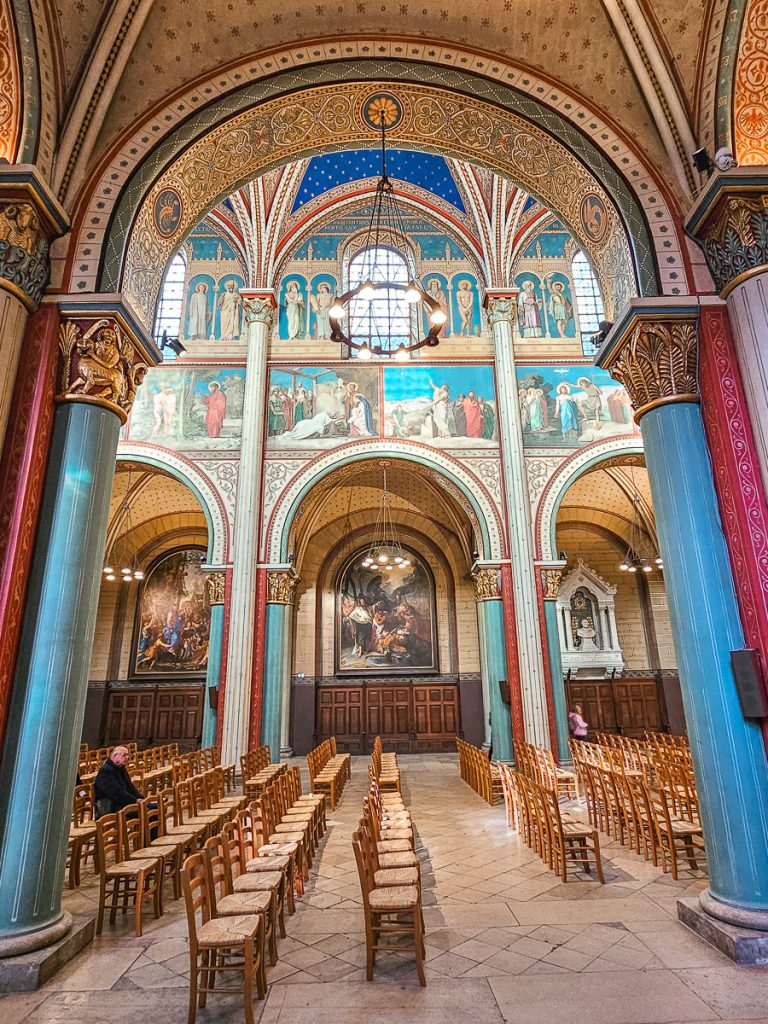

In the early 1800s, the church underwent a full restoration and redecoration, which is what gives it its distinctive interior today. The nave ceiling is painted deep blue and covered in stars, with colorful arches and geometric patterns along the columns. It’s a stunning space and definitely worth stepping inside while exploring Saint-Germain.
Eglise Saint-Sulpice

Saint-Sulpice is one of the largest churches in Paris, and is just a few blocks from Saint-Germain-des-Prés. Built mostly in the 17th century, it’s a great example of neoclassical design, where the focus is more on scale and symmetry than stained glass or ornate detail.

The sheer size of the church really hits you when you walk in, with long rows of massive, grand Corinthian columns running through the nave, and stonework, sculptures, and large paintings from the 1700-1800s along the walls.
One of the more unexpected details is the gnomon, a brass line built into the floor and wall in the 1700s to track the sun and calculate the date of Easter.

Don’t miss the monumental Cavaillé-Coll organ, installed in the 19th century and often considered one of the finest pipe organs in France, both for its size and sound.
Many people are familiar with the church’s name thanks to the book “The Da Vinci Code,” but it’s certainly worth a visit whether or not you’ve read the story.
The Literary Cafes
Les Deux Magots and Café de Flore sit directly across from each other beside Église Saint-Germain-des-Prés, forming one of the most recognizable café corners in Paris.

Both are closely tied to Saint-Germain’s literary and intellectual past and are associated with major 20th-century figures like Jean-Paul Sartre, Simone de Beauvoir, Ernest Hemingway, and Pablo Picasso. Café de Flore is more often linked to philosophers, while Les Deux Magots leans toward writers and literary prizes.


In practice, the experience at both is similar. Expect classic Paris café interiors, busy terraces, higher-than-average prices, and a mix of locals and visitors lingering for the atmosphere. You’re paying as much for the history and setting as for the coffee.
They’re not my top picks for food in Paris, though I personally enjoyed the food at Les Deux Magots more than Café de Flore. Still, both are at least worth a stop to take in the history, snap a photo, and soak up the Saint-Germain vibe as you explore the neighborhood.

Boulevard Saint Germain

Boulevard Saint-Germain is a wide, tree-lined avenue that is one of the main thoroughfares of the Saint-Germain and Latin Quarter neighborhoods. The buildings are elegant, the sidewalks are roomy, and it’s home to a great mix of cafés and boutiques, especially bookstores and chocolatiers.
Les Deux Magots and Café de Flore are both found on this boulevard, along with Église Saint-Germain-des-Prés. Just a few blocks off, you’ll hit places like the Jardin du Luxembourg or the Panthéon.
Even if you’re not heading anywhere in particular, this is a great Parisian walking street to window-shop and get a sense of everyday life in Saint-Germain.
Walking the Seine

The 6th arrondissement borders the Seine, and this area happens to be one of my favorite places to walk along the river. The views are excellent, with clear sightlines toward the Louvre, Île de la Cité, and Notre Dame.
As you walk, you can either stay up at street level and walk along the sidewalks to get great views of the bridges and buildings, or you can head down the staircases near the bridges and walk right along the river. I’d recommend doing some of both.
As you get closer to Notre Dame, you’ll also see the bouquinistes set up along the river. These green book boxes have been a Paris tradition since the 1500s and sell second-hand books, prints, posters, and other souvenirs.
There are two bridges here that are particularly worth paying attention to.
The Pont des Arts is a pedestrian-only bridge, and was the first iron bridge in Paris, commissioned by Napoleon in 1801.


Despite a name that means “New Bridge,” Pont Neuf is actually the oldest bridge in Paris, more than 400 years old and officially designated a historic monument. Look closely at the stone mascarons lining the bridge. These carved faces are all different and were originally meant to ward off evil spirits.

Finally, Place Saint-Michel sits right along the Seine at the boundary between the 5th and 6th arrondissements, and the 19th-century fountain at its center depicts Saint Michael defeating the devil.
Hidden Gems in the 6th
Definitely off the beaten tourist path, this section highlights other charming places to discover in Saint-Germain.
Mazarin Library

If you enjoy historic libraries, the Mazarin Library is one of the most interesting ones to visit in Paris. It dates back to Cardinal Mazarin (the prime minister to Louis XIV), who opened his personal book collection to scholars in 1643, making it the oldest public library in France.
By 1668, the collection moved into the Collège des Quatre-Nations, where it remains today, now attached to the Institut de France. The main reading room has been restored to reflect its original 17th-century design, with tall bookshelves, marble busts, and chandeliers that make it feel more like a museum than the working library it is.

You need to register if you want to sit and use the reading room, but visitors are welcome to quietly walk through and take a look.
To visit, you’ll enter the smaller blue-gray doors just to the right of the #23 sign, at this approximate location.
Cour du Commerce Saint André

Cour du Commerce Saint-André is a charming, tucked-away passage just off Boulevard Saint-Germain that feels like a little surprise when you stumble into it. It’s quite short and mostly lined with restaurants and food-focused shops.
One of the biggest draws here is Le Procope, often considered the oldest restaurant in Paris, which has hosted an impressive list of writers, politicians, and historical figures over the centuries.

You’ll also find Brémond Fils, a great stop for high-quality food items like olive oils, vinegars, honeys, salts, jams, and spreads that make great gifts.
This isn’t a spot you’ll spend a lot of time in, but it’s a lovely little pocket of Saint-Germain.
Rue de Buci

Rue de Buci is a historic Saint-Germain street that dates back around 800 years, to when this area was its own village.
It’s not very long and it’s on the narrow side, but it’s packed with restaurants, busy bars, and a few small shops. The streets really feel alive here, especially later in the day, with a mix of locals and visitors dining out and filling the many sidewalk terraces.
It’s an easy walk from Cour du Commerce Saint-André and a great street to wander if you’re looking for atmosphere or a fun place to grab a bite to eat.
Musée Delacroix
The Musée Delacroix is a small, low-key museum dedicated to Eugène Delacroix, one of France’s most important painters. He’s best known for Liberty Leading the People, one of the Louvre’s most famous masterpieces.

The museum is set in Delacroix’s former home and workshop, where he lived and worked from 1857 until his death. Since most of his belongings were auctioned off after he died, the space isn’t preserved as a traditional house museum.
Instead, it serves as a tribute to the artist, summed up by a quote displayed inside: “We tried to revive the spirit of the place by exhibiting works that would make the master’s memory come alive.”

Inside, you’ll find a mix of lesser-known originals, reproductions of major works, and pieces by other artists inspired by Delacroix. You can explore both his living space and his workshop, which sit in two separate buildings connected by a small, quiet garden where you can pause and relax for a minute.

The workshop also has a few personal items on display, like his palette, brushes, and painting desk, which help make Delacroix’s presence feel more tangible.
Admission is free with the Paris Museum Pass, or with your Louvre ticket on the same or following day.
Where to Stay in Saint-Germain
Hotel d’Angleterre: Charming, traditional building that used to house the British Embassy
Hotel Saint Paul Rive-Gauche: Cozy hotel right by the Jardin de Luxembourg
Hotel Clement: Great value hotel that’s centrally located
Where to Eat in Saint-Germain
The 6th arrondissement is known for having a lot of restaurants, and I can confirm there are so many good ones! Here are a few places to check out:
Breizh Cafe
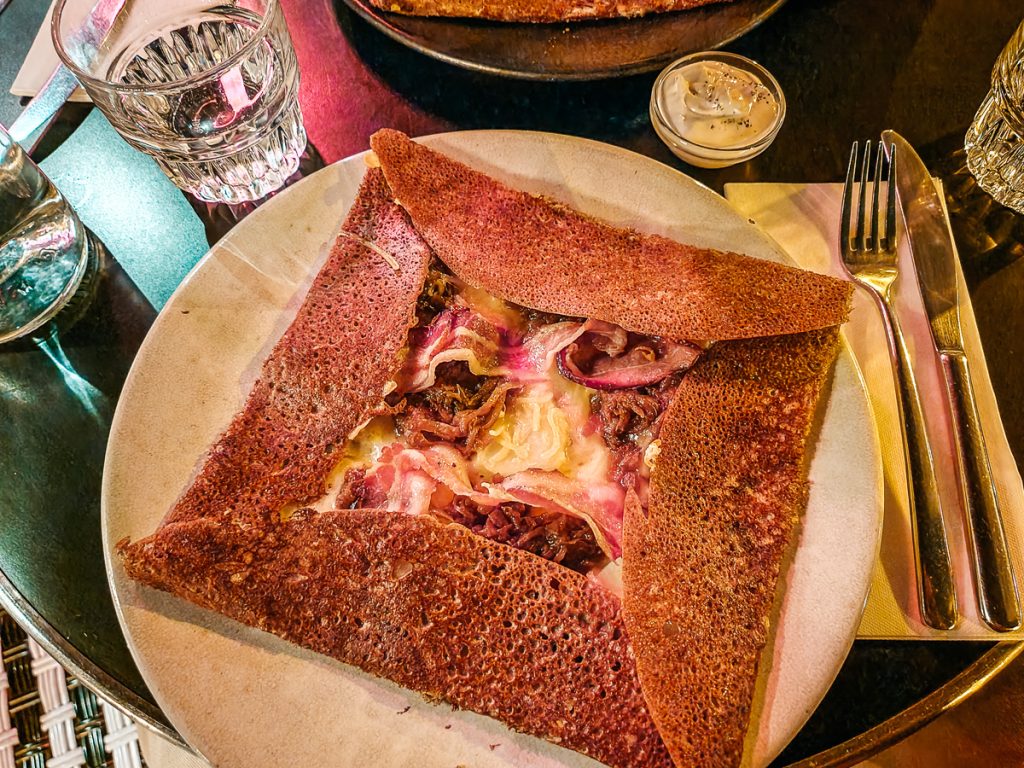
This charming restaurant serves Breton-style galettes, aka crepes made with buckwheat flour and filled with savory ingredients.
La Jacobine

A quaint little restaurant tucked into the Cour de Commerce Saint-André. I recommend the coq au vin (rooster cooked in wine), which was fantastic.
Bistro des Augustins

This tiny restaurant faces the Seine and serves a variety of potato gratins, which are particularly comforting and cozy on a cool evening.
Le Jardin Saint Germain

This is a small restaurant, and I’d recommend reservations even on weeknights. I had a great confit de canard (slow-cooked duck) here, but all the food was delicious.
Plaq

Plaq is a high-quality, small-batch bean-to-bar chocolatier. They sell various types of bar chocolates, sweet spreads, and incredibly luscious hot chocolate.
Chapon et La Chocolaterie de l’Eglise

Come here for the incredible chocolate mousse that is served in a little paper cone. It’s somehow both very light and fluffy, while also having a very rich and deep chocolate flavor.
Map of the Attractions in the 6th Arrondissement
Red stars are top sites, purple stars are hidden gems. Black icons are recommended restaurants and hotels. You can click the little star next to the map name to save this map to your Google account.
Want to Explore More Paris Neighborhoods?
Check out my other detailed Paris neighborhood guides:
- 1st Arrondissement: Your Ultimate Guide to Paris’ Central Neighborhood
- 2nd Arrondissement: Your Complete Guide
- Le Marais: A Complete Guide to Paris’s 3rd and 4th Arrondissements
- 5th Arrondissement: Your Ultimate Guide to the Latin Quarter
- 7th Arrondissement: Your Guide to the Eiffel Tower Neighborhood
- 8th Arrondissement: Coming Soon
- Your Ultimate Guide to Montmartre: A Self-Guided Walking Tour
Need Personalized Help Planning Your Trip to Paris?
If you’re feeling overwhelmed with options or short on time, my France planning calls can help.
These one-on-one video sessions are great for getting feedback, asking questions, and sorting through options, whether you’re building an itinerary from scratch or fine-tuning plans you already have.
