
Your Ultimate Guide to Montmartre [A One Day Self-Guided Walking Tour]

Montmartre has always felt a little apart from the rest of Paris – perched on a hill on the northern edge of the city, full of winding, cobbled-stoned streets and picturesque corners.
It used to be a rural village well outside the city limits, known for its crops, windmills, and vineyards, until Paris expanded far enough north. In 1860, Montmartre officially became part of Paris proper.
In the late 1800s, it turned into a magnet for artists who couldn’t afford central Paris. Studios and cafés were filled with artists, performers, and writers, including names you’ll certainly recognize: Picasso, Renoir, Toulouse-Lautrec, and Modigliani.
The cheap rent, open views, and sense of freedom gave Montmartre its bohemian reputation, one that still defines it today.

Exploring Montmartre
There are four main landmarks in Montmartre:
- Sacré Coeur Basilica
- Square Louise Michel
- Place du Tertre
- Moulin Rouge
However, unlike other neighborhoods, Montmartre is more about atmosphere than individual attractions. It’s often described as a “village within the city”, and like most villages, it’s best explored by wandering its hilly streets and soaking up the charm.
So instead of dividing this Paris neighborhood guide into top sites, mid-range attractions, and hidden gems like usual, I’ve laid it out as a walking route that naturally takes you through the area.
There’s also a map at the very bottom of the post with all the spots marked.
1. Square Louise Michel

Start your time in Montmartre at the Square Louise Michel, the lovely greenspace in front of and leading up to the Sacré Coeur Basilica. There are walking paths, staircases, and this charming carousel.

This is a very scenic way to reach Sacré Coeur, as you’ll get great views back over Paris as you climb.
This is also a common spot for the “Bracelet Scam” – if anyone approaches you and asks if you want a bracelet (or asks if you will sign a petition), just respond with a firm no and keep walking.
2. Halle Saint-Pierre

Just east of Square Louise-Michel is the Halle Saint-Pierre, a former covered market that now houses an art gallery, café, and bookstore. The gallery hosts rotating exhibitions throughout the year, which are often contemporary and fairly unconventional.
The café and bookstore have an aesthetic, artistic feel, and the shop carries an interesting selection of art and design books.
- Hours: Monday-Friday 11am-6pm; Saturday 11am-7pm, Sunday 12pm-6pm
- Entrance to the exhibits: €12
3. Tilted House


Have you seen this “tilted” house near Sacré Coeur on social media? The house is, of course, not actually tilted, but is just a matter of shifting the perspective of the camera.
There is a steeply slanted hill right in front of the building, so if you rotate the picture so the hill is “flat”, the house appears tilted. You can find this at the bottom of the top staircase in front of Sacré Coeur – this is the exact location for this view.
4. Sacré Coeur Basilica

Sacré Coeur, an impressive basilica with shockingly white domes, is the shining jewel of Montmartre. Thanks to the particular travertine stone used in construction, the basilica stays a stunning white year after year.
And thanks to being set on a hill (Montmartre means “Mountain of the Martyrs”), it towers over the surrounding neighborhoods, creating one of the more dramatic views you’ll find in Paris.

I’d definitely recommend walking through the basilica and taking in the soaring domes, stained glass windows, and colorful murals. No photos are allowed inside, so you’ll just have to go and experience it for yourself!
If you can’t do staircases, there is also a funicular just to the left of the park that will take you almost to the top. It uses the same tickets as the metro system (so a single fare would cost €2.55). You can find the exact location for the funicular here.
Pro Tip: The Sacré Coeur area (including the square in front) gets incredibly busy during the day, so I would highly recommend starting your day in Montmartre fairly early. You don’t have to be here at sunrise, but if you can be at Sacré Coeur by ~9am, you’re going to have a much better time than if you get here a few hours later.
- Cost: Free
- Hours: 6am-10:30pm
5. Domes of Sacré Coeur
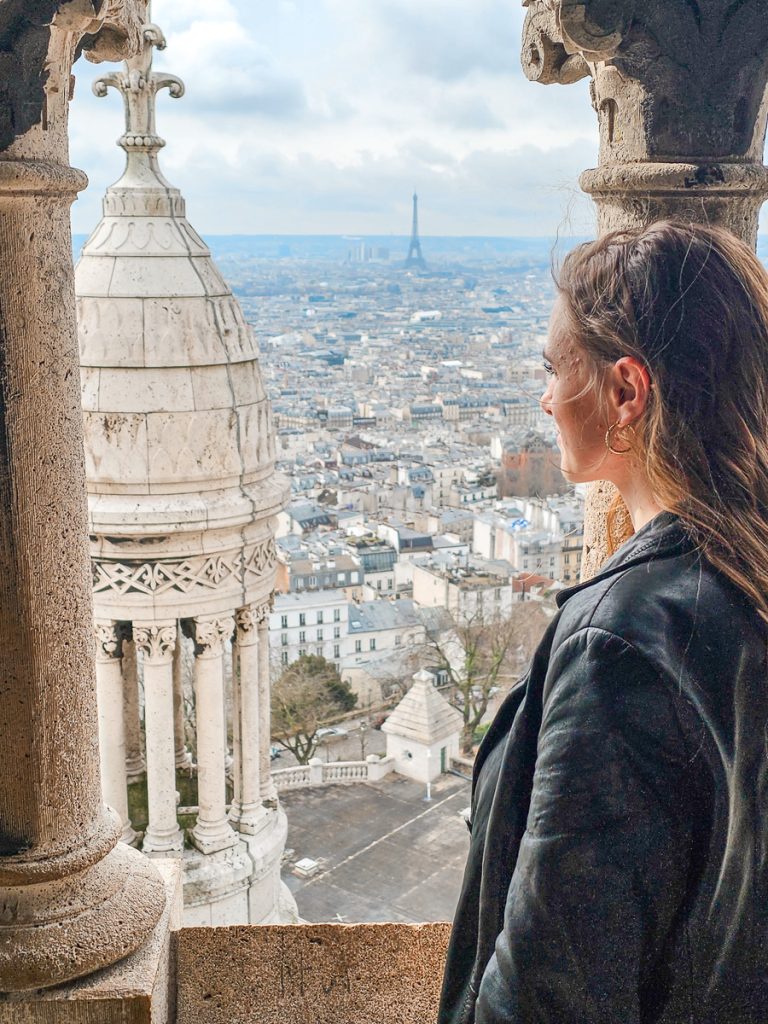
Very few people realize this, but you can climb up Sacré Coeur’s towers and into the main basilica dome.
Right before you enter the basilica, look for the sign for the panoramic viewpoint that leads you down and to the left of the church. Here, you’ll pay the entrance fee and then start climbing the 292 steps of the spiral staircase up to the rooftop.
When you reach the rooftop, you’ll walk a short pathway between the different domes and spires along the roof – a super cool part of the experience.
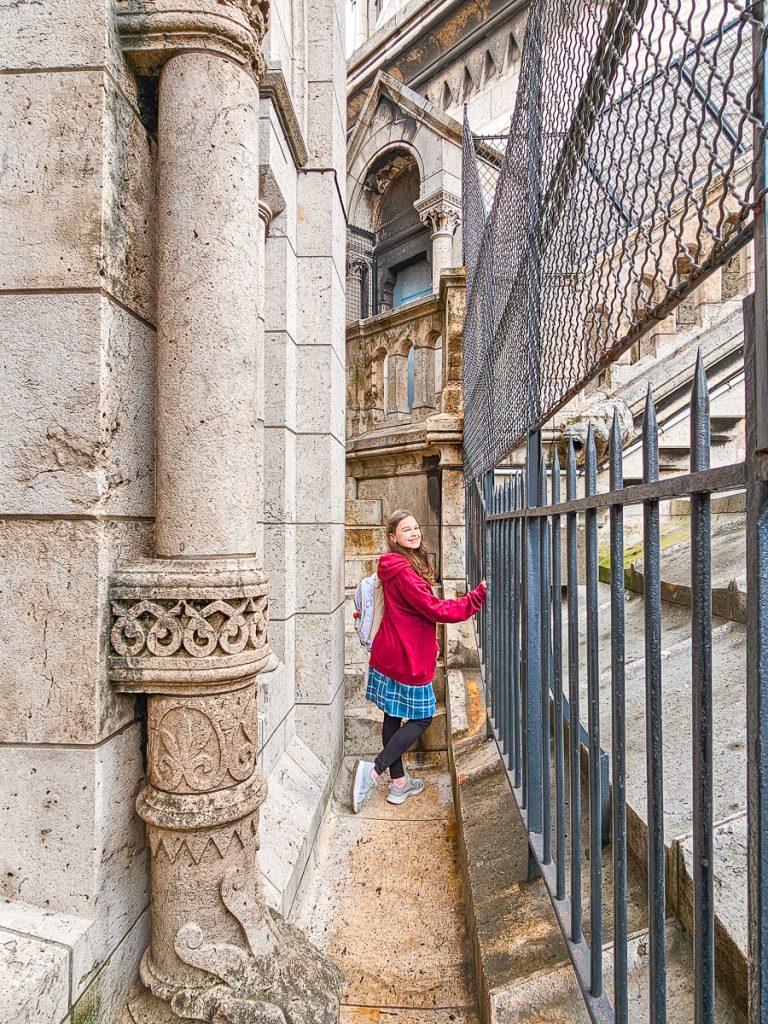
Then up another short staircase and you’re in the dome! There’s a little walkway inside the columns and you can walk around, enjoying the incredible 360° views over Paris.
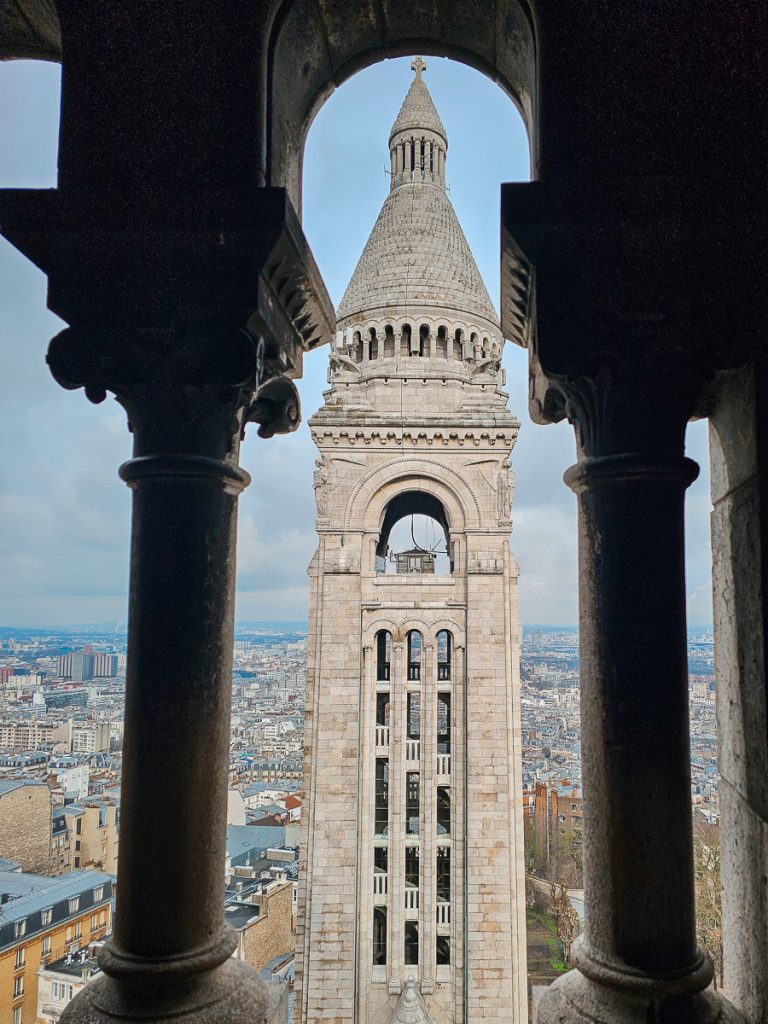
And while you can’t see the Eiffel Tower from the base of Sacré Coeur, up in the domes, you can enjoy one of the best Eiffel Tower viewpoints in the city.
6. Back of Sacré Coeur

While most people photograph Sacré Coeur from the front, I love walking around the back for a quieter view and a different perspective of the basilica. This photo was taken on the northwest side of the church, where you’ll often have the spot to yourself.
7. Parc de la Turlure

On the other (northeastern) side of the back of Sacré Coeur is Parc de la Turlure, an incredibly picturesque and quiet terraced garden. There are plenty of nice benches and shaded places to sit, with views of the basilica, walkways framed by leafy trelisses, and a petanque court and play areas for children.
The park is named after the Moulin de la Turlure, a windmill that was here in the late 1700s and demolished in the 1800s.
8. Staircases of Montmartre
Staircases are one of Montmartre’s signature features – there are 38 of them winding up and down the hill between quiet streets. I really think stumbling on these little stairways is one of the most delightful parts of exploring Montmartre.
You’ll certainly come across at least a couple of staircases just by wandering, but if you want to seek out more of these photogenic, unique parts of Montmartre, here are a few of my favorites (locations pinned on my map at the bottom of this post:


9. Musée de Montmartre

The Montmartre Museum is housed in one of the oldest buildings in the neighborhood (dating back to the 17th century). During the late 1800s, it was home and workshop to many artists, like Renoir, Suzanne Valadon, and Maurice Utrillo.
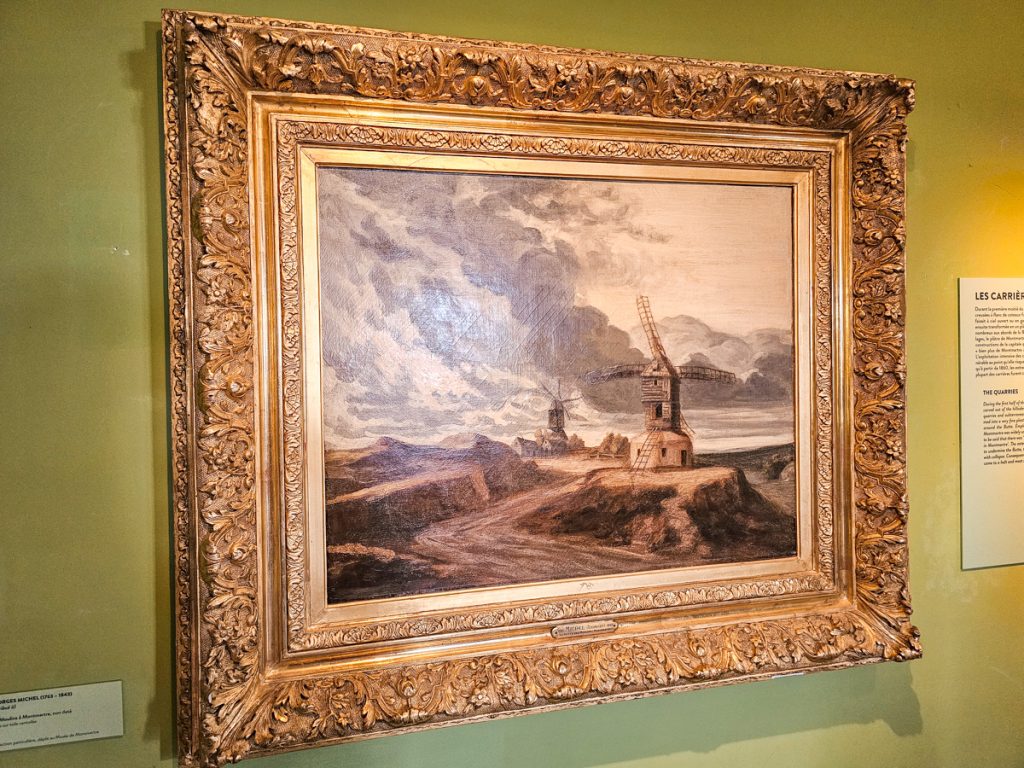
The first floor shows the evolution of Montmartre from a rural community to a bustling artist district through paintings and photographs. The upper two floors display works of art from some of the artists who lived and worked in Montmartre over the years.

Surrounding the museum are the Renoir Gardens, which overlook the Montmartre vineyard and rooftops of northern Paris. Pierre-Auguste Renoir, one of the most famous Impressionist artists, lived and painted here from 1875 to 1877. He created some of his best-known works in this haven, including Le Bal du Moulin de la Galette.
10. La Maison Rose

La Maison Rose is one of Montmartre’s most famous spots, sitting at the top of Rue de l’Abreuvoir. This now iconic pink café began in the early 1900s as the home and studio of painter Ramon Pichot, a friend of Picasso and Dalí. A few years later, his wife Germaine turned it into a café, painting the facade its now-iconic shade of pink.
For more than a century, artists, writers, and singers, including Dalida, have come here to dine. Today, it’s still a restaurant serving classic French dishes, and one of the most photographed corners in Paris.
11. Vigne du Clos Montmartre

While Montmartre used to have multiple vineyards, the only remaining one in Paris city limits is the Vigne du Clos Montmartre. Less than 2,000 bottles are produced from this vineyard every year, most of which are sold at auction and the proceeds donated to charity.
This vineyard is not open to the public, but you can walk by and admire it from the street. The best view is from the corner of Rue Saint-Vincent and Rue des Saules.
12. Au Lapin Agile

Just across the street from the vineyard is Au Lapin Agile, Paris’s oldest cabaret and a Montmartre landmark since 1860. It was once a favorite gathering spot for artists and writers, including Picasso, who even painted a piece named Au Lapin Agile that helped make the cabaret famous.
This small, intimate venue still hosts nightly performances of music and poetry, much like it did over a century ago.
13. Rue de l’Abreuvoir
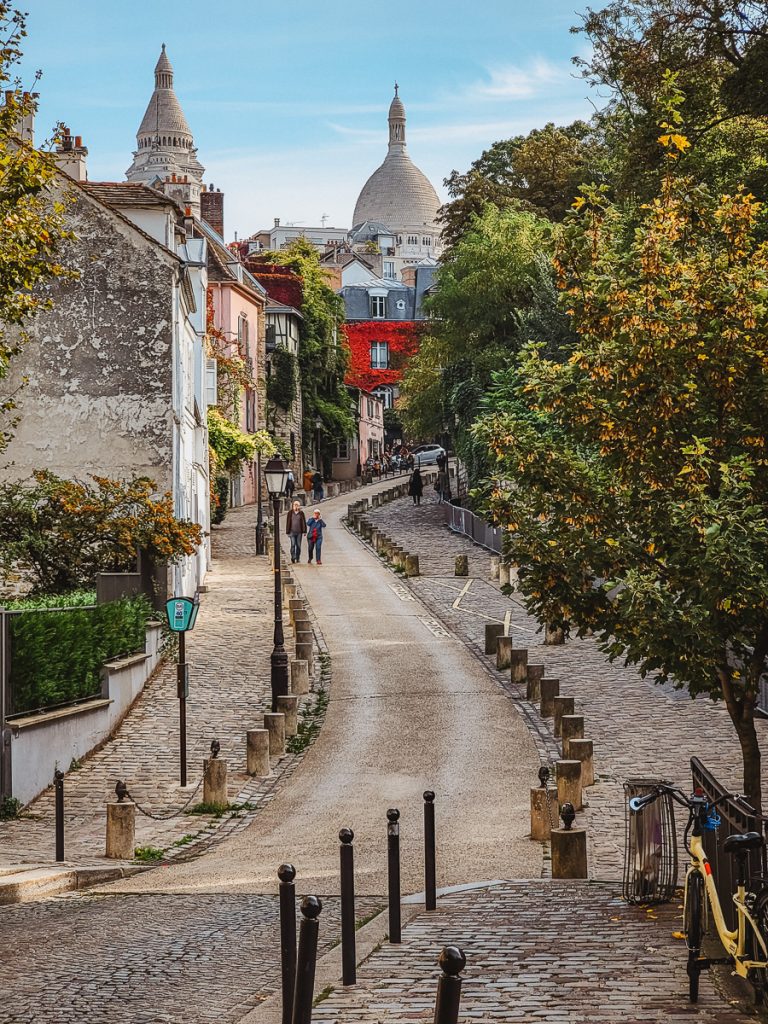
Rue de L’Abreuvoir is one of the prettiest little streets in Paris, and it is indeed little. What you see in the picture is literally the entire street, starting from La Maison Rose café at the top and ending at Place Dalida at the bottom.
Looking back up the street, you get such a charming view — the curve of the road framed by old Parisian buildings, with the domes of Sacré Coeur rising just above the rooftops.
14. Place Dalida

Place Dalida sits at the bottom of Rue de l’Abreuvoir and honors the iconic French singer Dalida, who lived in Montmartre for 20 years. Her career took off in 1957, and she remained one of France’s most popular singers (and occasionally an actress) until her death in 1987.
A bronze bust of her stands in the center of the square, a quiet tribute to one of the most famous French singers of all time.
From this square, you can also access the small staircase down Rue Girardon (mentioned in the Staircase section).
15. Square Suzanne Buisson

Square Suzanne Buisson is a small, quiet garden in the heart of Montmartre, notable for its statue of Saint Denis. Denis was the first bishop of Paris and was beheaded in Montmartre in 250AD for being a Christian.
Legend says he picked up his head and walked to what today is a northern suburb of Paris, where he finally died. Today, the Basilica of Saint-Denis stands in that spot, and is the burial place for the kings and queens of France.
Saint-Denis is always depicted in artwork holding his head in his hands, as he is doing in this statue.
16. Le Passe-Muraille
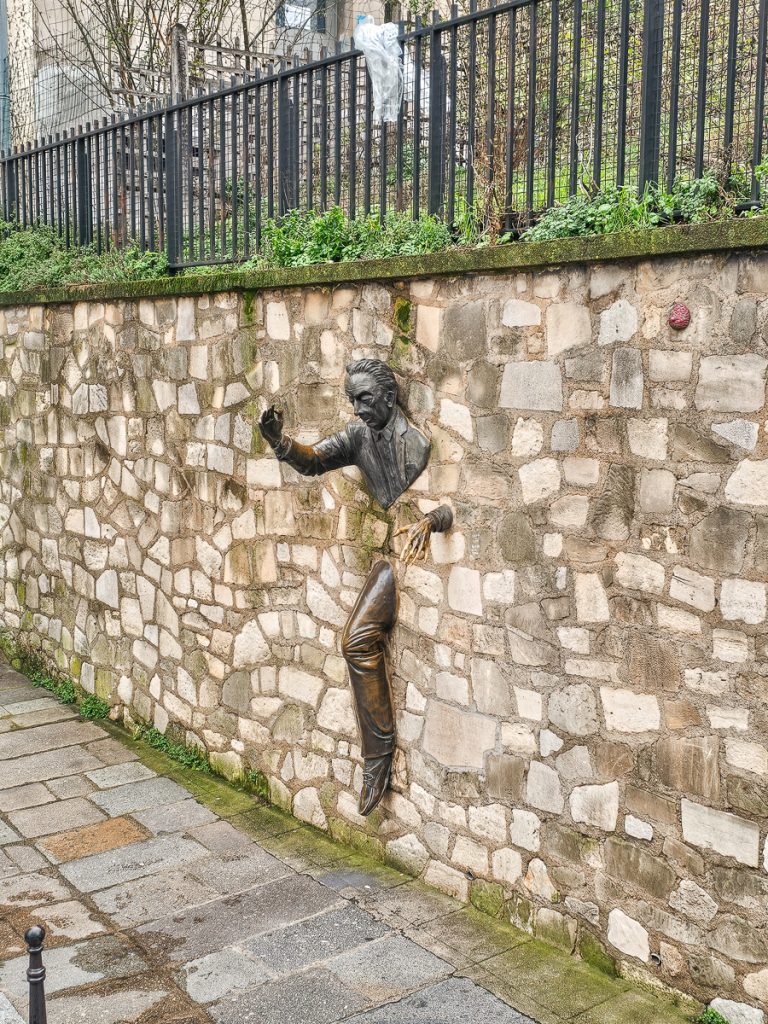
Le Passe-Muraille is one of Montmartre’s quirkiest sights: a bronze sculpture of a man walking through a stone wall. It’s inspired by a short story of the same name by French author Marcel Aymé, who lived nearby.
In the story, a man discovers he can walk through walls and uses his new power to commit crime and have an affair. He gets away with this until one day, his powers fail mid-step, trapping him forever inside the wall – the scene captured by this statue.
17. Le Consulat

Le Consulat is another iconic Montmartre café with a charming facade and sidewalk terrace, famous for its well-known clientele in the late 1800s and early 1900s. Its patrons included renowned artists, writers, and philosophers such as Van Gogh, Monet, and Picasso.
Van Gogh in particular was a frequent visitor to the café, and today you can do as he did, lingering over a coffee or a traditional Parisian bistro meal, or simply admiring the view as you pass by.
18. Place du Tertre

Place du Tertre is a café-lined square in the heart of Montmartre, where artists are out drawing, painting, and selling their pieces underneath leafy trees. This is a popular place to pick up a unique and beautiful artwork souvenir as a memory of Paris.
19. Rue Lepic

I love strolling down Rue Lepic – it’s the perfect walking street and perfect for taking in the Montmartre vibe, with very few cars, a cobblestoned road, and beautiful buildings with stately doors. You’ll also pass Moulin Radet (more on this below) on Rue Lepic.
Rue Lepic starts just past Place du Tertre and Le Consultat, making a dramatic 180° curve as it slopes down the hill, and finally ending at the famous Moulin Rouge cabaret.

The section of Rue Lepic between Rue des Abbesses and Boulevard Clichy is a great market-like street. You can find a nice fromagerie (cheese shop), a chocolaterie (A La Mère de Famille), bakery and pastry shops, and numerous cafes, including Café des Deux Moulins, where scenes in the movie Amélie were set.
20. Moulin du Radet

Historically, Montmartre used to have over 30 windmills, as the elevation on the hill was favorable for catching the wind. Moulin Radet, built in 1717, is one of two remaining windmills in Paris, and is today associated with the Moulin de la Galette restaurant. (In French, “moulin” means windmill).
Fun fact: One of Pierre-Auguste Renoir’s most famous paintings was inspired by these windmills – the piece being named “Le Bal de Moulin de la Galette.“
21. Mur des Je t’Aime

The ‘I Love You’ Wall is a cute fixture in Montmartre, tucked away in a little garden at Place des Abbesses.
This piece of art was created by artist Frédéric Baron and calligrapher Claire Kito, and the phrase “I love you” is written 300 times in 250 languages. The red splashes represent pieces of a broken heart, symbolizing that love is universal but not without struggle.
Snapping a picture in front of the wall is a popular romantic thing to do in Paris.
22. Abbesses Metro Station
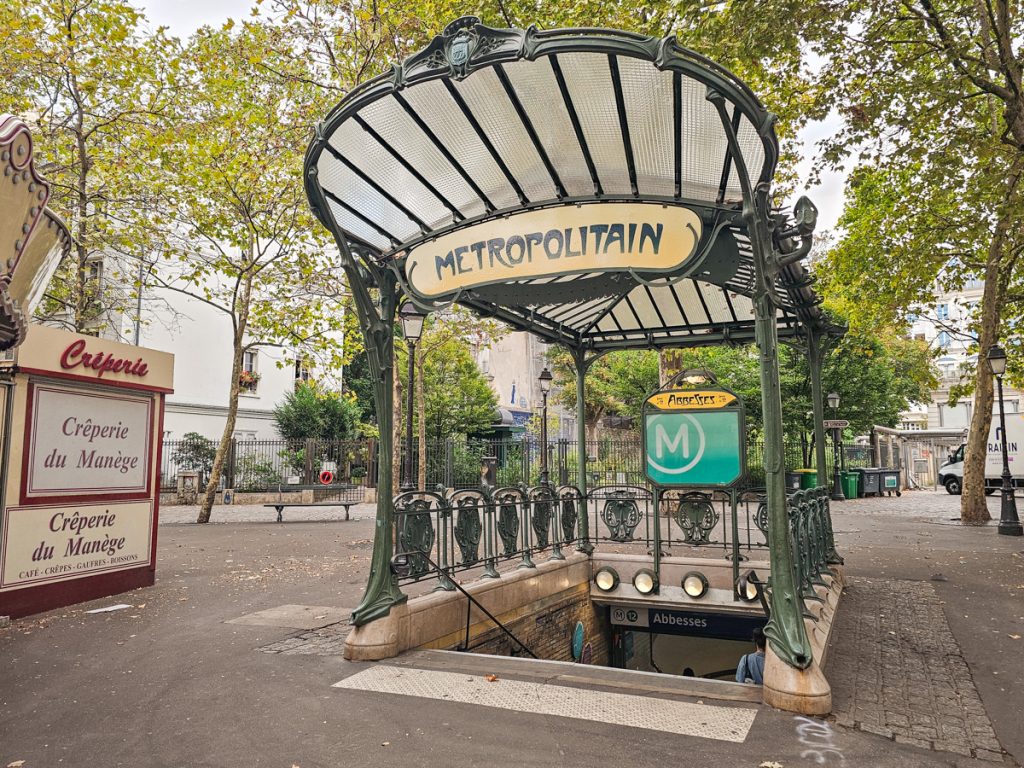
As you walk by Place des Abbesses, take a minute to notice the entrance to the Abbesses metro station. This is one of Paris’s most beautiful metro entrances, with a rare Art Nouveau glass canopy designed by Hector Guimard. It’s also the city’s deepest station, sitting over 30 meters underground (so unless you’re up for 176 spiraling steps, take the elevator up!)
23. Cimitière de Montmartre

While Père Lachaise is the biggest and most well-known cemetery in Paris, the Montmartre Cemetery is equally atmospheric and charming. The cemetery is protected as a historic monument, and is filled with ornate tombs and tree-lined paths that make it a peaceful place to walk through.
Quite a few well-known figures are buried here, including painter Edgar Degas, writer Alexandre Dumas, the singer Dalida, and scientist Léon Foucault, whose famous pendulum still hangs in the Panthéon.
24. Moulin Rouge

The Moulin Rouge cabaret is one of Montmartre’s most recognizable landmarks. “Moulin Rouge” means “Red Windmill,” though this one’s purely decorative and not one of the old working mills from the area’s past.
The show is a dazzling production with elaborate costumes and high-energy dance numbers that have made it such a popular entertainment venue. (Be aware that this is a cabaret where the women are sometimes topless.)
Grab a show ticket here or a dinner and show ticket here
Where to Eat in Montmartre
These are a few spots I’ve personally eaten at and really enjoyed in Montmartre.
Creperie Brocéliande
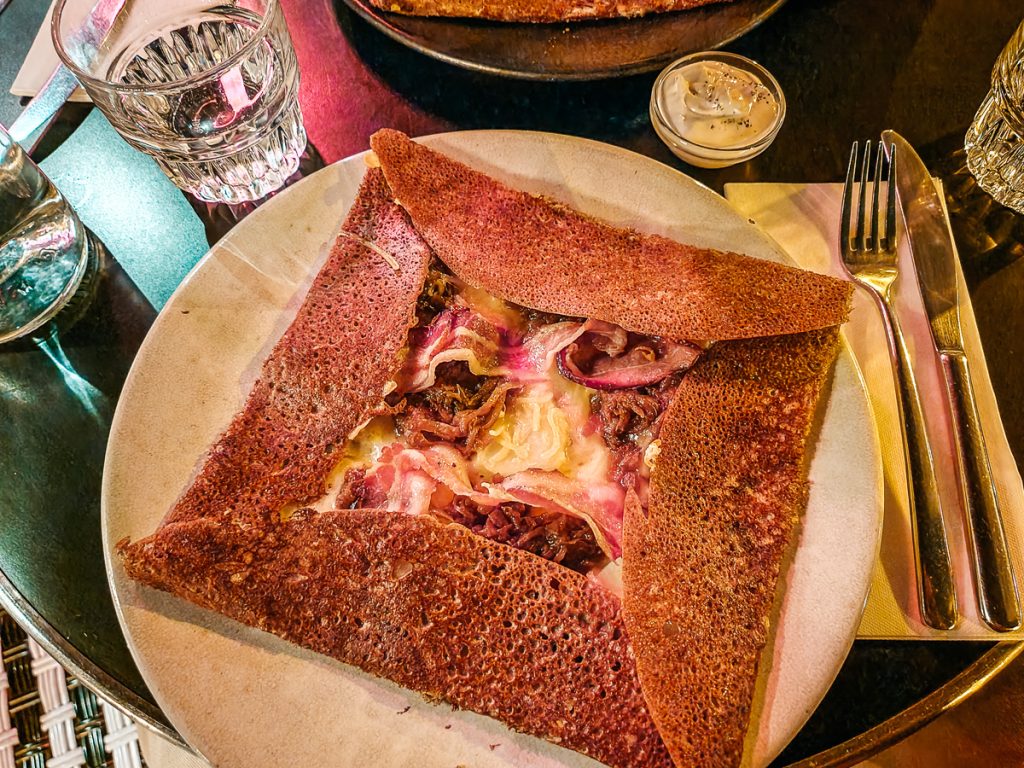
This small restaurant serves delicious galettes, which are traditional buckwheat crepes from the Brittany region.
You can order both sweet and savory galettes, with tons of flavor combinations. I recommend ordering a savory galette for yourself and a sweet galette to share!
Gilles Marchal

Gilles Marchal is a neighborhood pastry shop that specializes in madeleines. They make a huge variety of madeleines daily – we opted to try the plain and the pistachio.
Now, I’ll be honest and say that madeleines are generally not my favorite French pastry, but the Gilles Marchal ones are an exception! The pistachio had a perfectly tender crumb and a lightly sweetened pistachio cream in the center. Absolutely delicious. Closed Mon-Tues.
Boris Lumé Bakery

On the back edge of the Montmartre neighborhood, the popular children’s TV show “Miraculous” is based on this adorable, charming bakery. This is a French animated show that has been dubbed into English (and my kids love it).
We came for the TV show association but stayed for the delicious food. I can highly recommend the kouign-amann croissant, and their baguettes were incredible!
Where to Stay in Montmartre
Montmartre is a great area to stay in Paris, and although it is farther away from the city center, it is well-connected to the rest of Paris by multiple metro lines. I’d recommend the following three hotels in the 18th arrondissement:
Hotel Terrass: The views over Paris from the guest rooms and the rooftop terrace are truly spectacular – some rooms even have an Eiffel Tower view! The decor throughout the property is a trendy, modern style.
Hotel Monsieur Aristide: The Aristide is a newer boutique hotel, and they really show attention to detail with the furnishings around the property. The garden terrace is particularly gorgeous.
Hotel Litteraire: This is a great budget option in Montmartre and has nice, comfortable rooms. It’s still in a great location in the neighborhood and the design centers around the renowned French writer, Marcel Ayme.
Map of Montmartre Attractions
Map Key:
- Stars: Sites listed in this guide, with the red stars being the top 4 sites
- Orange walkers: staircases
- Black icons: Recommended hotels and restaurants
- I also included a general walking route through Montmartre, not taking into account staircases or restaurants, for more context
Want to Explore More Paris Neighborhoods?
Check out my other detailed Paris neighborhood guides:
- 1st Arrondissement: Your Ultimate Guide to Paris’ Central Neighborhood
- 2nd Arrondissement: Your Complete Guide
- Le Marais: A Complete Guide to Paris’s 3rd and 4th Arrondissements
- 5th Arrondissement: Your Ultimate Guide to the Latin Quarter
- Saint Germain: Your Complete Guide to Paris’s 6th Arrondissement
- 7th Arrondissement: Your Guide to the Eiffel Tower Neighborhood
- 8th Arrondissement: Your Complete Guide to the Elysées Neighborhood
The Wrap Up
Montmartre is absolutely worth visiting on your trip to Paris – the neighborhood has a great vibe, with so many charming little areas.
Many people just visit Sacré Coeur and don’t venture farther in, but as you can see, there are so many other spots to discover and enjoy!
Pin For Later!


