

15 Iconic Works of Art That Make the Louvre Absolutely Unforgettable

Walking into the Louvre feels a little like stepping into the center of the art world. Every hallway pulls you in a different direction, and every room has something famous, fascinating, or unexpectedly beautiful waiting for you.
And the Louvre truly is massive, with 35,000 works of art on display in hundreds of rooms. With so much to take in, it helps to have a starting point. This list narrows the museum down to 15 of its most iconic pieces that capture the range, history, and scale of the Louvre.
Some you’ll recognize instantly. Others might catch you by surprise. Either way, they offer a clearer sense of what makes the Louvre more than just Paris‘s biggest collection of art.
1. Winged Victory of Samothrace

- Artist: Unknown Greek sculptor
- Date: c. 190 BC
Perched with powerful grace at the top of the Daru Staircase in the Denon Wing, the Winged Victory of Samothrace greets you as if in mid‑flight. Even without her arms or head, the goddess Nike gives the impression of motion, like she’s just landed on the prow of a ship, wings still catching the wind.

She was carved in ancient Greece to celebrate a naval victory and originally stood in a sanctuary on the island of Samothrace. The marble base represents a ship’s prow, and the way her robes cling and ripple gives her a kind of urgency.
The intricate sculpture and monumental position make Winged Victory a top favorite for many visitors.
2. Mona Lisa

- Artist: Leonardo da Vinci
- Date: c. 1503-1506 AD (possibly continuing until 1517)
You’ll know you’re getting close when the crowd thickens. Tucked behind protective glass and a small barricade, the Mona Lisa is THE most visited work in the entire museum, and arguably the most famous painting in the world.
But despite the buzz and phones in the air, many visitors are surprised by how small and unassuming she looks in person. Leonardo painted her using sfumato, a technique that softens transitions between colors and tones, creating that famously enigmatic expression.
Her identity is believed to be Lisa Gherardini, a Florentine merchant’s wife, but the mystery has become part of the allure. Is she smiling? Smirking? Just patiently waiting?
What makes the painting so magnetic isn’t just the technique or the sitter, but the layers of history attached to it: centuries of intrigue, theft, and global fascination. Even if you only get a few seconds up close, it’s one of those moments you remember.
3. Venus de Milo

- Artist: Alexandros of Antioch
- Date: c. 130-100 BC
The Venus de Milo stands tall and unbothered, even without her arms. That mystery – What was she originally holding or doing? – has helped keep her legendary.
Created during the Hellenistic period, the statue shows a blend of classical ideals and more naturalistic movement. Her torso gently twists, one leg slightly bent, and the drapery seems to slide off her hips as if caught mid-motion. It’s thought she once held an apple or drapery in one hand, maybe a mirror in the other – no one really knows.
She is widely believed to represent Aphrodite, the goddess of love and beauty, though some details still spark debate. Either way, it’s hard not to pause in front of her: the marble, the posture, the sheer presence feels timeless.
4. Galerie d’Apollon
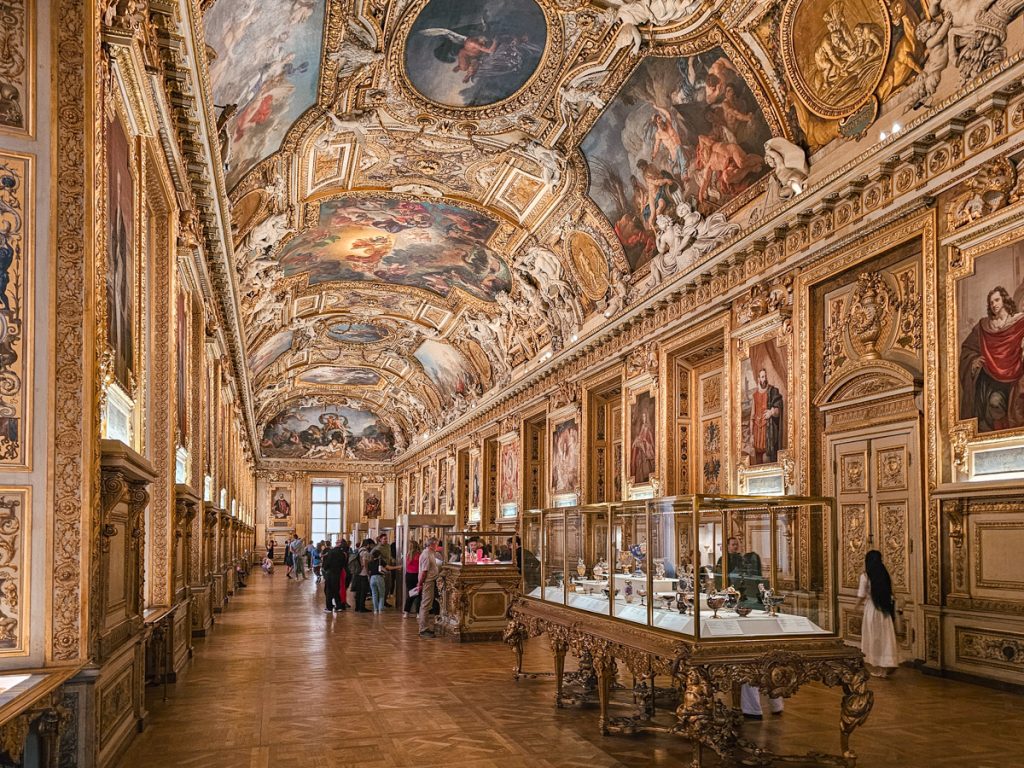
- Artist: Various; ceiling by Charles Le Brun
- Date: 1661-1679 AD
The Galerie d’Apollon is one of the most lavish spaces in the Louvre, the kind of room that makes you stop and stare before you even realize what’s in it. Gilded moldings, ceiling frescoes, and dramatic light create a sense of theatrical grandeur, with every inch designed to impress.
Charles Le Brun’s ceiling celebrates the sun god Apollo and reflects the values of Louis XIV’s court: power, light, and divine authority. In fact, this gallery was the direct inspiration for the Hall of Mirrors at Versailles, echoing the same style of absolute monarchy in visual form.

The Galerie is home to part of the French Crown Jewels, including a few pieces stolen in the October 2025 heist (and the gallery has been closed until further notice since the heist).
5. Code of Hammurabi

- Artist: Commissioned by Hammurabi
- Date: c. 1754 BC
At first glance, the black basalt stele looks like a simple pillar, until you realize you’re looking at one of the oldest written legal codes in history. Commissioned by King Hammurabi of Babylon, this monument records nearly 300 laws in cuneiform script, including rules about trade, property, wages, and punishment.

At the top, Hammurabi is shown receiving authority from the sun god Shamash, reinforcing the idea that law and justice were divinely sanctioned. The shape of the stele and its vertical arrangement make it feel more like a monument than a book, a permanent public reminder of order and control.
What’s especially striking is its clarity: many of the laws are practical, direct, and surprisingly familiar in tone. Standing in front of it, you’re reminded that the foundations of legal systems go back thousands of years, and that writing, itself, was once a revolutionary tool of power.
6. Great Sphinx of Tanis

- Artist: Unknown
- Date: c. 2600 BC
The Great Sphinx of Tanis is one of the oldest and largest sculptures in the Louvre, and it doesn’t need to try to compete for your attention. Carved from granite, the creature combines a lion’s body with a pharaoh’s head, radiating strength and authority even after thousands of years.
Believed to date back to the Old Kingdom, the sphinx was discovered in the ruins of Tanis and may have been repurposed by different rulers over time. The inscriptions are worn, but the weight of history is unmistakable.
It sits in a cool, vaulted space that feels more like a stone courtyard than a gallery. The lighting is dim and the floor echoes slightly, giving the whole area a hushed atmosphere. It’s a piece that invites lingering attention – not because it’s flashy, but because it has survived an incredible amount of time.
7. The Caryatides

- Artist: Jean Goujon
- Date: 1540-1550 AD
This set of four sculpted women might look decorative at first glance, but they’re actually doing architectural work. Known as caryatids, these figures take the place of columns, supporting the upper gallery with a quiet kind of strength.
Jean Goujon designed them during the French Renaissance, drawing inspiration from classical Greek models, particularly the Erechtheion on the Acropolis in Athens. But his version has a more elongated elegance, with flowing drapery and serene expressions that reflect the era’s taste for grace over realism.
The space they occupy once served as a royal ballroom, and the statues were meant to blend function with form – structure with sculpture. Standing beneath them today, you get a sense of both: the artistry of carved stone and the physical weight they bear. This is one of my personal favorite spots in the Louvre.
8. Michelangelo Gallery
- Psyche Revived by Cupid’s Kiss
- Artist: Antonio Canova
- Date: 1787-1793 AD
- Les Esclaves (The Slaves)
- Artist: Michelangelo
- Date: c. 1513-1516 AD
This iconic gallery brings together two masterpieces that feel worlds apart, even though both are sculpted in marble.

Canova’s Psyche Revived by Cupid’s Kiss is delicate and full of movement, a moment of awakening frozen in time. Cupid leans down, Psyche reaches up, and the light catches on their wings and limbs in a way that almost makes them seem alive.
Just a few steps away, Michelangelo’s Les Esclaves are rougher and more restrained – not in feeling, but in finish. The figures twist and strain as if still trying to free themselves from the stone. Unlike Canova’s smooth surfaces, Michelangelo’s chisel marks are visible, which only adds to their emotional impact.

Photo credit: Depositphotos.com/underworld1
Together, these works show two very different approaches to the human form: one polished and romantic, the other raw and unfinished. The tension between them makes this gallery especially compelling to walk through.
9. Coronation of Napoleon

- Artist: Jacques-Louis David
- Date: 1805-1807 AD
This painting is hard to miss, both for its scale and what it represents. At nearly 10 meters wide, The Coronation of Napoleon takes up a huge space on the wall and pulls you into a carefully staged moment of power.
Jacques-Louis David, Napoleon’s official painter, captures the scene inside Notre-Dame Cathedral in 1804. But instead of showing the Pope crowning the emperor, David presents Napoleon doing the crowning: a bold, calculated move that reinforced his authority as self-made. Josephine kneels in front of him, and nearly every face in the crowd is a real historical figure.
More than a portrait, this is visual propaganda. Every gesture and gaze is intentional, designed to legitimize Napoleon’s rule. Standing in front of it, you feel the drama – not just of the event, but of how deliberately it was meant to be remembered.
10. Liberty Leading the People

- Artist: Eugène Delacroix
- Date: 1830 AD
Delacroix painted Liberty Leading the People in response to the July Revolution of 1830, and it still carries the same fire today. At the center, a bare-breasted woman, Liberty, marches forward holding the French flag, surrounded by revolutionaries of all classes.
It’s both a historical document and a symbolic call to arms. The figures are grounded in reality, but there’s a heightened drama in the way they move and clash, with smoke swirling around them and bodies littered below. Delacroix himself appears in the painting, wearing a top hat and holding a musket, a quiet signature in a loud composition.
Romanticism is on full display here: emotion, motion, idealism. But it’s also raw and grimy, with no attempt to clean up the cost of rebellion.
11. The Raft of the Medusa

- Artist: Théodore Géricault
- Date: 1818-1819 AD
The Raft of the Medusa isn’t easy to look at, and that’s the whole point. Géricault based the massive canvas on a real maritime disaster: the wreck of a French naval frigate in 1816, where survivors were left adrift for days, leading to death, madness, and even cannibalism.
What shocked audiences wasn’t just the subject, but how unflinchingly he painted it. Géricault interviewed survivors, studied cadavers, and staged models to get the composition just right. The result is a rolling sea of bodies: some already gone, some barely holding on, and one man waving desperately at a ship in the distance.
When it was first exhibited, it caused a scandal, being both deeply realistic and emotionally charged. Today, it still stops people in their tracks, making you see not just see the wreck, but the desperation rising off the canvas.
12. Oath of the Horatii

- Artist: Jacques-Louis David
- Date: 1784 AD
This painting was created just a few years before the French Revolution, and you can feel the tension building in every pose. David chose a Roman legend to tell a story about duty over emotion: three brothers swearing loyalty to their father, while the women behind them collapse in grief.
It’s a textbook example of Neoclassicism: clean lines, dramatic lighting, and a moral message. The architecture is rigid and balanced, the figures are idealized, and the whole scene feels staged – because it is. David wanted it to be clear and powerful.
But beneath the clarity is a forming crack. The painting reflects the ideals of sacrifice and honor, but also hints at the emotional cost. Today, it feels like a warning about loyalty, power, and what happens when public duty pushes personal lives to the edge.
13. Assyrian Winged Bulls (Lamassu)

- Artist: Unknown Assyrian sculptors
- Date: c. 710 BC
Towering over visitors in the Cour Khorsabad, these winged bulls, known as Lamassu, once guarded the gates of an Assyrian palace. They combine the body of a bull, wings of an eagle, and a human head, projecting strength, wisdom, and divine protection.
Each figure stands over four meters tall and was carved from a single block of stone, designed to intimidate enemies and welcome allies. Their placement in the Louvre mirrors their original function: flanking an entryway, as if you’re passing into another world.
What’s most impressive is how they seem to shift as you move. Viewed from the front, they stand still; viewed from the side, they appear to walk – a clever optical trick using five legs instead of four. It’s a moment where ancient engineering and artistry meet, and for a few steps, the museum feels like a Mesopotamian fortress.
14. Cour Marly & Cour Puget

- Artist: Various French sculptors
- Date: 17th-18th centuries
These two adjoining sculpture courts feel more like grand indoor gardens than museum halls. Bathed in natural light from glass ceilings, the space gives room for large-scale marble and stone works to breathe.
The Cour Marly features sculptures originally commissioned for Louis XIV’s Château de Marly, many of them depicting mythological or heroic figures. Across the way, the Cour Puget showcases dramatic Baroque works, full of tension and twisting forms.
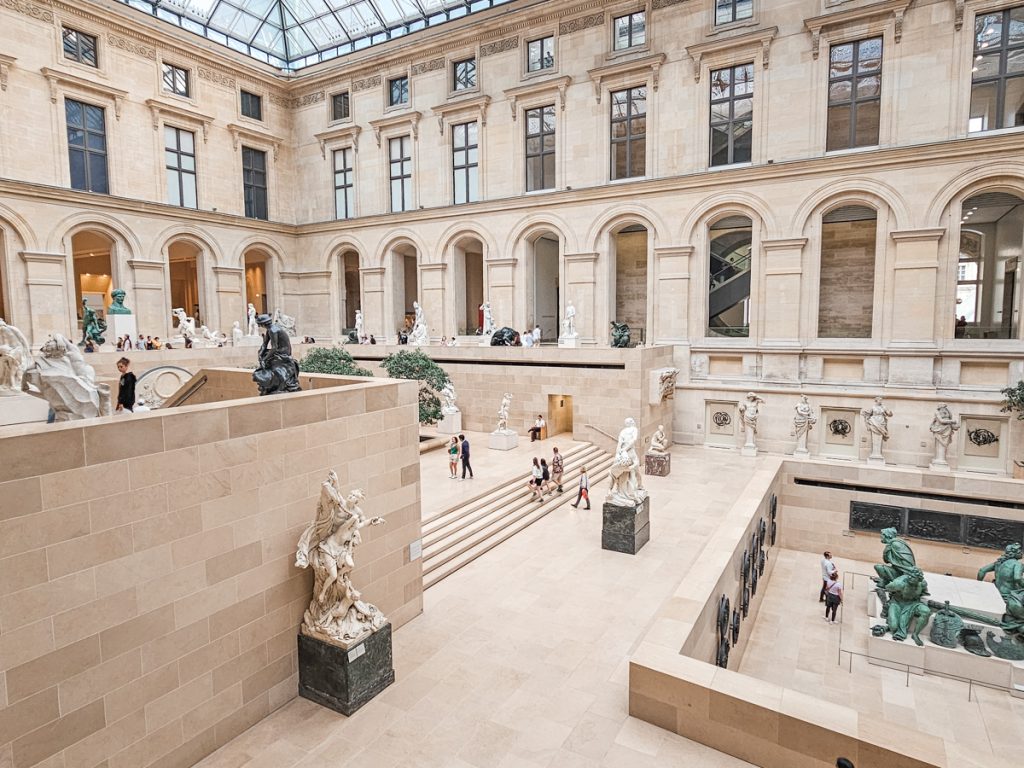
What makes both spaces unique is how open they feel: you can walk around the sculptures, view them from above, and see the interplay of shadow and sunlight. After the tighter galleries, the courtyards offer a moment of visual calm, where movement and scale take center stage.
15. Napoleon III Apartments

- Artist: Designed under Visconti and Lefuel
- Date: 1850s
The Napoleon III Apartments are a full immersion into 19th-century imperial luxury. Gilded moldings, towering chandeliers, and crimson upholstery turn every room into a performance of power.
Built during the Second Empire in the 1850s as the residence for the Minister of State to Napoleon the 3rd, these rooms hosted lavish dinners, masked balls, and receptions filled with Parisian high society.
These rooms weren’t just for living, they were for impressing. From the ornate dining hall to the mirrored salons, every detail was meant to reflect wealth and dazzle visiting dignitaries.

Unlike the museum’s more restrained galleries, this space feels unapologetically extravagant. It’s less about quiet observation and more about spectacle: gold on gold, style over subtlety, and a very deliberate display of grandeur.
The Wrap Up
The Louvre moves through time: from ancient stone to royal gold, quiet gestures to revolutionary roars. It’s almost impossible to see every piece of art in the Louvre, but these works anchor the experience, and are beautiful spots you won’t soon forget.
