

Paris’s 1st Arrondissement: A Complete Guide to the City’s Central District

The 1st arrondissement is the historic heart of Paris – small in size but packed with some of the city’s most iconic landmarks. Stretching along the right bank of the Seine and including the western tip of Île de la Cité, this district is one of the oldest in the city.
If you’re not familiar with the city’s layout, Paris is divided into 20 arrondissements, or districts, that spiral outward like a snail shell. And sitting right in the center of that spiral is the 1st, home to grand architecture, elegant boulevards, luxury boutiques, and centuries of history.

Royal palaces once stood here, major events of the French Revolution unfolded here, and today it’s where millions come to see world-famous sites like the Louvre and the Tuileries Gardens.
This guide to the 1st arrondissement covers what to see, how to prioritize your stops, and where to eat and stay while exploring the neighborhood around the Louvre.

Top Sites in the First Arrondissement
This first section includes the most iconic, most popular spots in the 1st arrondissement that belong on any itinerary.
1. The Louvre

The Louvre is the most visited museum in the world, drawing millions every year to see some of the most famous works of art ever created.
Inside this former royal palace, you’ll find everything from ancient sculptures to Renaissance masterpieces, and the scale of it all is staggering. Truly, the Louvre is massive, with 3 wings, 4 levels, and hundreds of rooms.
Most people come for the Mona Lisa, but the museum’s real magic lies beyond that one painting.

You can stand beneath the graceful Winged Victory of Samothrace, gaze at the timeless beauty of Venus de Milo, be impressed at the ancient Code of Hammurabi, or take in the drama of Liberty Leading the People and The Coronation of Napoleon.
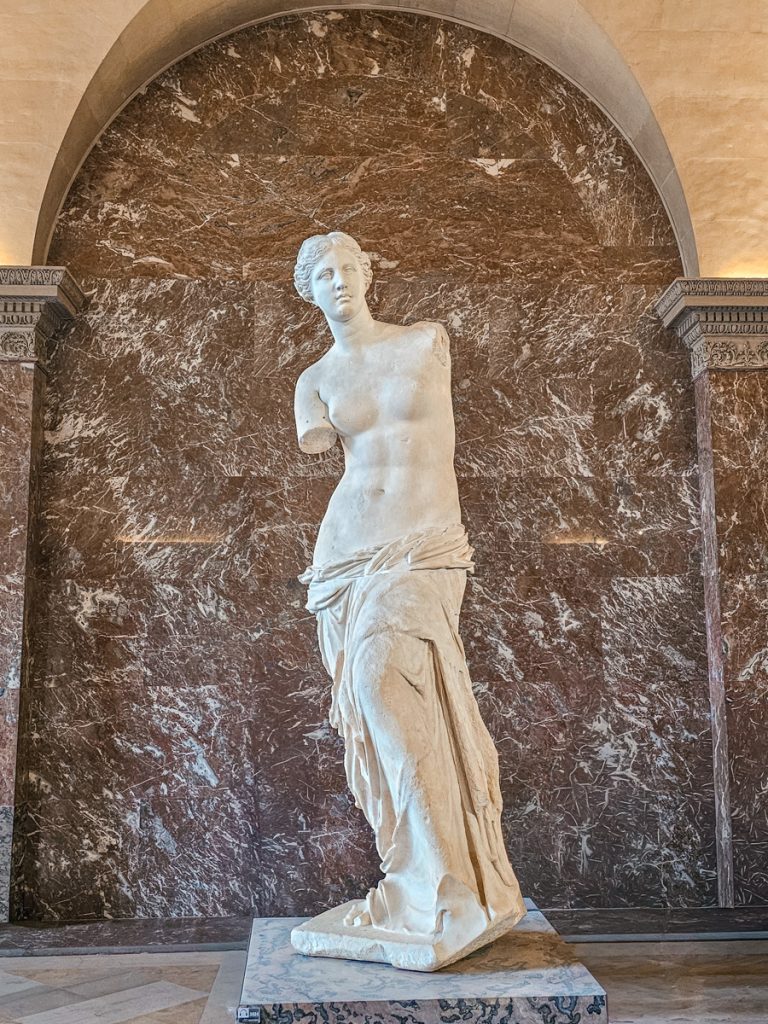

Massive canvases fill entire walls, and marble statues feel almost timeless in grand galleries.

Even if you’re not an art buff, it’s hard not to be impressed by the sheer size and beauty of the collection, and of course by the palace-turned-museum itself, with its sweeping staircases, gilded ceilings, and historic rooms, like the Napoleon III apartments or the French crown jewels in the Galerie d’Apollon.
Check out the guide for all my tips and tricks for visiting the Louvre.

2. Jardin des Tuileries
The Jardin des Tuileries stretches between the Louvre and Place de la Concorde, creating one of the most elegant green spaces in Paris. Once the royal family’s private garden, it opened to the public after the French Revolution and has been a favorite spot for Parisians ever since.


It’s an incredible spot for a stroll, with perfectly symmetrical pathways lined with trees, flowerbeds, and sculptures tucked among the hedges. Large basins dot the park, surrounded by iconic green chairs where people lounge and watch the world go by.

From nearly any point in the garden, the views are incredible. You can look back toward the Louvre’s grand façade or stand on the main thoroughfare where the obelisk of Place de la Concorde aligns perfectly with the Arc de Triomphe in the distance.

3. Arc du Carrousel
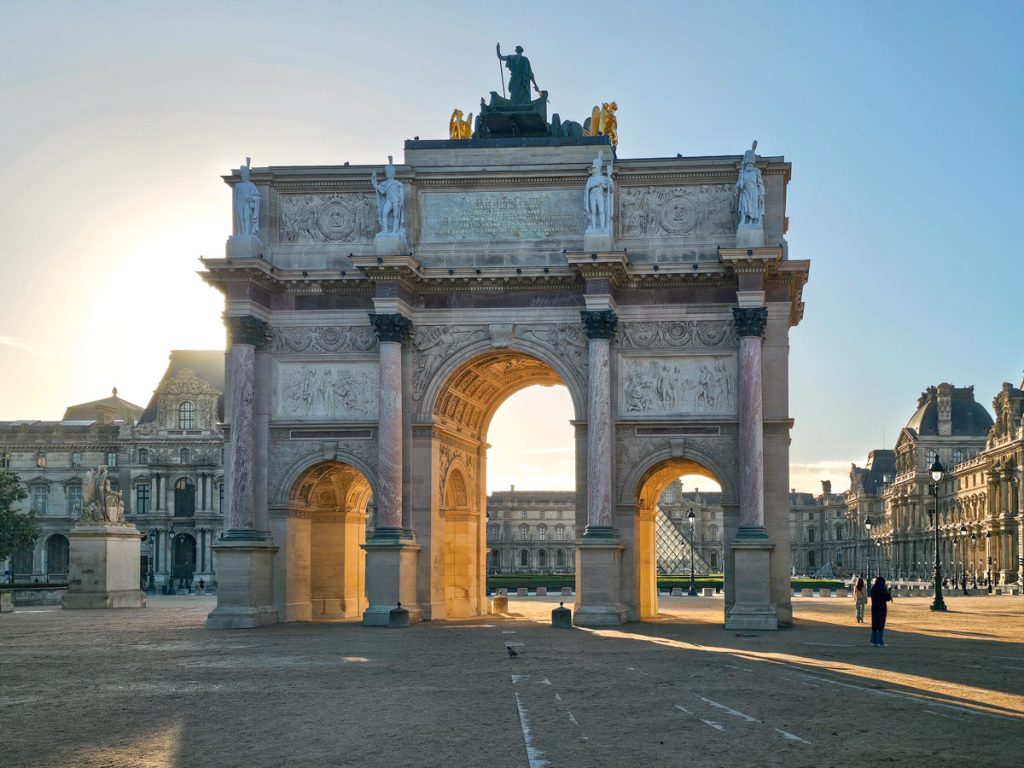
Officially called the Arc de Triomphe du Carrousel, this triumphal arch is the first and smallest of the three arches that align perfectly through Paris – followed by the Arc de Triomphe and the Grande Arche de la Défense.
Both the Arc du Carrousel and the Arc de Triomphe were commissioned by Napoleon in 1806 to celebrate his military victories, but this one was completed much earlier, in 1808, while the larger arch wasn’t finished until 1836.

The Arc du Carrousel stands between the Louvre and the Tuileries Gardens, serving almost like a gateway connecting the two.
4. Musée de l’Orangerie
The Orangerie Museum sits in a tucked away corner of the Tuileries Garden. It’s a small museum, but one that holds some of the most iconic paintings in France: Monet’s Water Lilies.
Two adjacent oval rooms upstairs are devoted entirely to these masterpieces. Each room has four large panels that nearly cover the curved walls, surrounding you in soft shades of blues, greens, and lilacs that capture the calm of Monet’s garden in Giverny.

In total, eight massive canvases are displayed here, just a few of the more than 250 Water Lilies Monet painted.
Monet personally worked with the city to design how the paintings would be displayed, and the oval rooms were meant to represent the symbol of infinity. Downstairs, the museum continues with a collection of Impressionist and modern works by artists like Cézanne, Matisse, Utrillo, and Rousseau.
5. Sainte-Chapelle

Sainte-Chapelle sits on the Île de la Cité island, just a short walk from Notre Dame. This “Holy Chapel” may be small, but it’s an absolute masterpiece, filled with floor-to-ceiling stained glass that floods the space with color.
The 15 towering stained glass bays, each about 50 feet high, hold 1,113 individual panels that depict stories from the Old and New Testaments, along with scenes from history.

Being surrounded by the soaring, colorful stained glass, bathed in light streaming through the purple, blue, and red-tinted windows, is awe-inspiring to say the least.
Commissioned in the 1200s by King Louis IX (later sainted as Saint Louis), the chapel was built to house sacred relics, including the Crown of Thorns and a fragment of the True Cross.
In the Middle Ages, possessing relics like these was a mark of immense prestige, and having them placed in Paris elevated the city’s religious significance. The Crown of Thorns itself is now kept in the treasury of Notre Dame Cathedral.
This is easily one of the most spectacular churches in France.
6. The Seine

Walking along the Seine is one of the best things to do in Paris, and the 1st arrondissement has a beautiful, long stretch of the river as one of its borders.
You can stroll the tree-lined paths at street level, looking down over the riverbanks, or take one of the staircases by the bridges to walk right along the water. You’ll get lovely views of the Eiffel Tower in the distance and the elegant façade of the Musée d’Orsay across the river.

The banks of the Seine come alive in the evening, people going for walks or runs or sitting out with friends or loved ones for a picnic dinner, to play games, or chat.
7. Pont Neuf

Pont Neuf is one of Paris’s most famous bridges – a historic stone bridge that stretches across the western tip of Île de la Cité, the island where Notre Dame stands. Pont Neuf means “New Bridge,” but it’s actually the oldest bridge in Paris, completed in 1578.
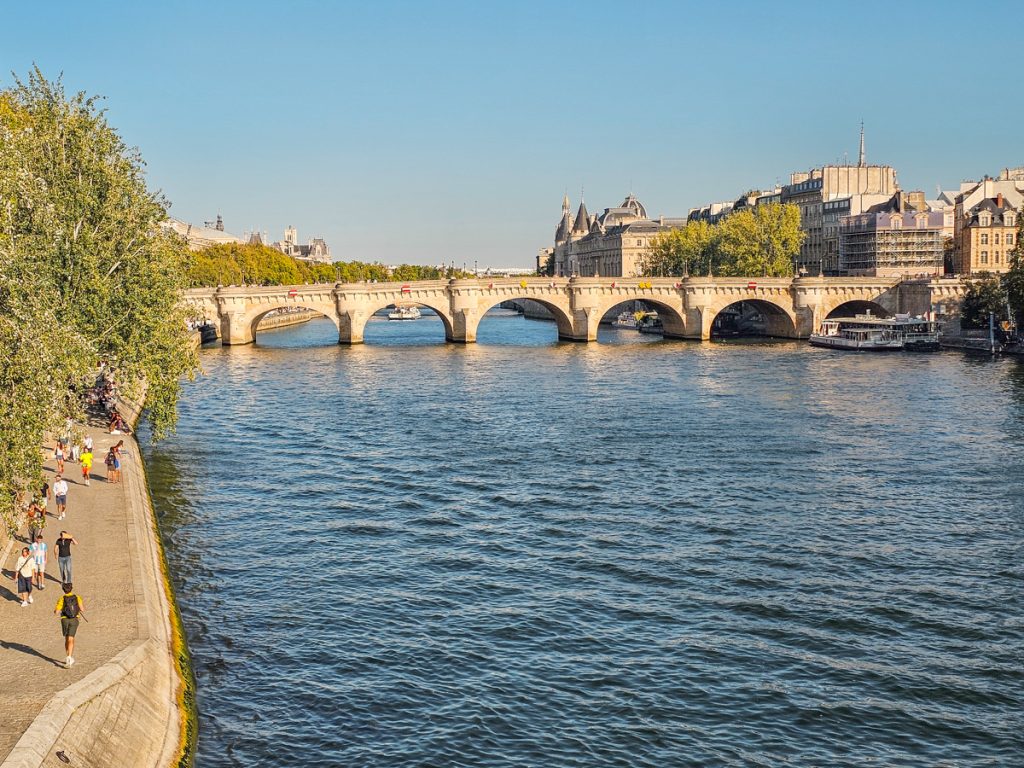

Pont Neuf also offers some amazing river views, and has been officially recognized as a monument historique since 1889.
Worth a Stop
The next section of this list includes attractions that are not quite as iconic or popular as the Top Sites, but are still important spots worth a stop if you have the time.
8. Palais Royal Gardens

The Palais Royal is a beautiful, tranquil spot tucked away just a couple of blocks from the Louvre. This royal palace was built in 1628 by Cardinal Richelieu (prime minister to King Louis XIII and a very powerful figure in French politics), and later became home to the king, as well as a young Louis XIV.

Over the centuries, it’s seen everything from royal life to revolution, including a famous speech in 1789 that helped spark the storming of the Bastille.

Today, the Palais Royal is much calmer. The Jardin du Palais Royal feels like a smaller, more peaceful version of the Tuileries, complete with long rows of trees, a water basin, statues, flower beds, and plenty of green chairs for relaxing.
The Cour d’Honneur, or main courtyard of the Palais Royal, is where you’ll find Les Deux Plateaux, commonly known as the Buren Columns, a contemporary art installation created in 1986.

260 black-and-white striped columns are arranged in a grid and vary in height, the striking modern lines contrasting beautifully against the historic palace architecture.

Like many now-iconic modern spots in Paris, it was pretty controversial when it was first installed. Today, it’s a well-loved landmark, and is a fun and unique place to wander around, run or climb on the columns, and take pictures.
You’ll also see Pol Bury’s reflective metal fountains nearby.
9. Place Vendome

Place Vendôme is one of the most elegant squares in Paris, known for its luxury boutiques, high-end jewelers, and the iconic Ritz Paris hotel.
The square was originally built in the late 1600s to celebrate the military triumphs of Louis XIV and once featured a statue of the king on horseback.
That monument was destroyed during the French Revolution, and Napoleon later replaced it with the Vendôme Column, crowned with a statue of Napoleon himself, to commemorate the Battle of Austerlitz.

Today, Place Vendôme remains synonymous with prestige. The matching façades surrounding the square are classified as historic monuments, and the nearby streets sparkle with window displays from luxury brands and jewelers whose creations often cost tens of thousands of euros.
10. Pont des Arts

Speaking of the Seine, the Pont des Arts is one of Paris’s most famous pedestrian-only bridges, connecting the Louvre’s Cour Carrée on the right bank with the Institut de France on the left bank.
Commissioned by Napoleon in 1801, it was the first iron bridge built in Paris. It’s a favorite for locals, visitors, and photographers alike, offering wide-open views over the Seine and a perfect angle of the tip of Île de la Cité.

The bridge was once covered in love locks, but those were removed after their weight began damaging the structure, and it’s now protected by clear plexiglass panels. (In general, locks are damaging to structures around Paris, so please refrain from adding one).

11. Saint-Eustache Church

Saint-Eustache Church sits just behind Les Halles and is one of Paris’s beautiful hidden gem churches. Built between 1532 and 1633, it blends several architectural styles: Gothic on the outside, with Renaissance and classical details inside.
The church is named for Saint Eustace, a Roman general who converted to Christianity after seeing a vision of a crucifix between a deer’s antlers, a story that led to his becoming the patron saint of hunters. Relics connected to him were given to the church from the Abbey of Saint-Denis, just to the north of Paris.
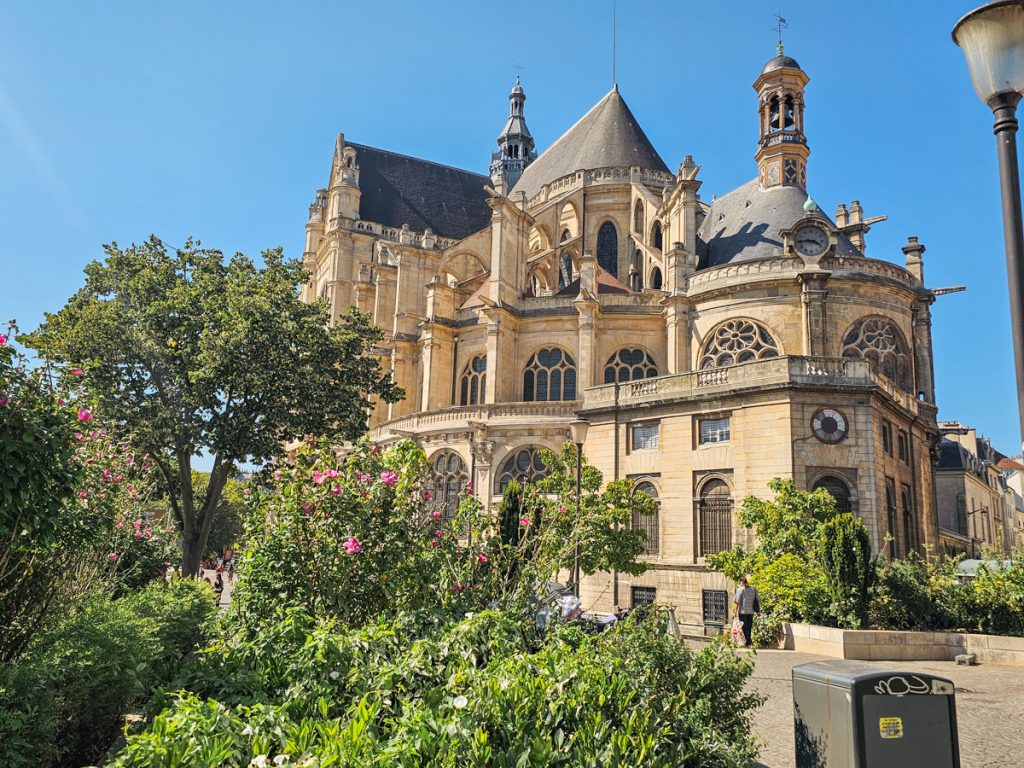
Outside, the dramatic flying buttresses are visible from the backside of Les Halles, while inside, soaring vaulted ceilings, intricate gold accents around the doors and chapels, one of the largest organs in France, and beautiful stained glass make it one of the most striking churches in the city.


And if you’re a music lover, Saint-Eustache also hosts concerts and choral performances in the evenings throughout the year.
12. Rue de Rivoli

Rue de Rivoli is a long boulevard that runs parallel to the Seine just north of the Louvre, beginning at Place de la Concorde and stretching past the Tuileries Garden, the Louvre, and Hôtel de Ville before ending at Place des Vosges in the Marais.
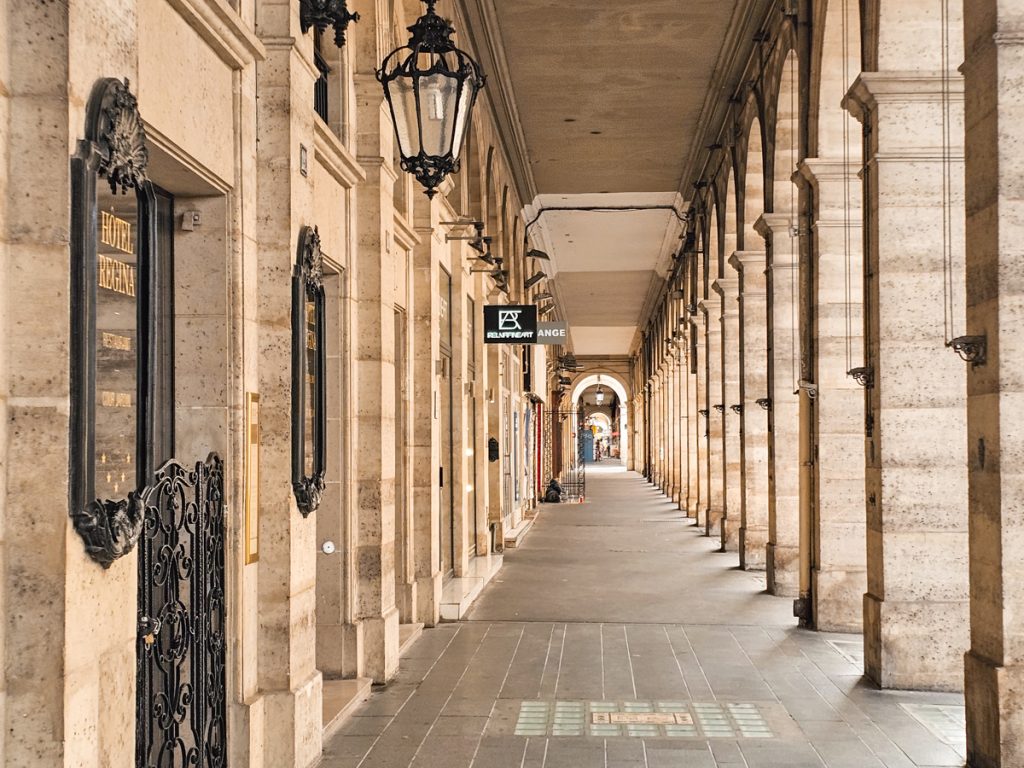
Near the Louvre, you’ll walk under elegant arcades with tiled walkways and a mix of souvenir shops, upscale boutiques, hotels, and cafés (including my favorite, Angelina, famous for its rich hot chocolate.)

Past the Louvre, Rue de Rivoli shifts into a bustling shopping street lined with both trendy boutiques and familiar brands, making it a great street for a casual stroll and some window shopping.
13. Chatelet-Les Halles
Chatelet-Les Halles is the biggest underground metro station in the entire world! This is the most central transit hub in Paris, with 3 of 5 of the RER lines (commuter lines), and 5 of the 16 metro lines passing through this station.

Les Halles was actually once the site of a large food market, and the metro station is now part of a large complex that holds a shopping mall, cinema, and even a swimming pool.

Honestly, Les Halles is not my favorite part of Paris – it’s very busy and chaotic, and the mall is just like any old shopping center. Still, it’s a noteworthy part of the 1st arrondissement, and one you’ll certainly pass through during some part of your stay in Paris.
Hidden Gems
Definitely off the beaten tourist path, this section highlights other charming places to discover.
14. Conciergerie

The Conciergerie was once a medieval royal palace known as the Palais de la Cité. It served as a royal residence for kings like Philip IV, Charles V, and Jean II in the 1200s and 1300s.

Thus, the first part of the visit to the Conciergerie takes you through the Great Hall, the kitchens, and other rooms used during that time, giving a glimpse of life in the palace centuries ago.
By the late 14th century, parts of the palace had been converted into prisons. The rest of the exhibits here walk you through the role and history of these prisons and the prisoners who stayed here, especially during the French Revolution.

Notably, Marie Antoinette was imprisoned here for 76 days before her execution (most prisoners stayed just a few days before facing trial and/or the guillotine).
It’s a fascinating museum, with far fewer crowds than many other historic sites in Paris.
15. Bourse de Commerce – Pinault Collection

The Bourse de Commerce – Pinault Collection is a contemporary art museum housed in a historic building just steps from Les Halles. The centerpiece of the museum is its stunning glass cupola, perched atop frescoed walls, that floods the space with natural light.

Originally the city’s Commodities Stock Exchange in the 1700s and 1800s, it’s now dedicated to rotating exhibitions of modern and contemporary art, including works from the private collection of François Pinault.
Exhibits change every few months, so it’s worth checking online to see what’s currently on display before your visit.
16. Louvre-Rivoli Metro Station

In contrast to the sprawling Chatelet-Les Halles station, the Louvre-Rivoli metro station on Line 1 is an absolute delight. The platform is decorated with alcoves holding replicas of some of the Louvre’s masterpieces, which certainly makes for one of Paris’s most memorable metro exits.
17. Palais Royal-Musée du Louvre Metro Station at Place Colette

Another noteworthy metro station in the 1st arrondissement is the entrance to the Palais Royal-Musée du Louvre stop at Place Colette. This whimsical, one of a kind entrance was created in 2000 by artist Jean-Michel Othoniel using 800 beads of Murano glass!
And, as fitting any work of art, it has a name: Le Kiosque des Noctambules (The Night Revellers’ Kiosk).
18. E Dehillerin

E Dehillerin is a historic cooking supply store that was reportedly a favorite spot for the famed chef, Julia Child. They sell high-quality cookware, knives, and often unusual kitchen utensils – with a specialty in beautiful copper pots and pans.
The store is no-frills and a little bit of organized chaos, which honestly makes browsing and discovering the different wares even more fun.
19. La Samaritaine
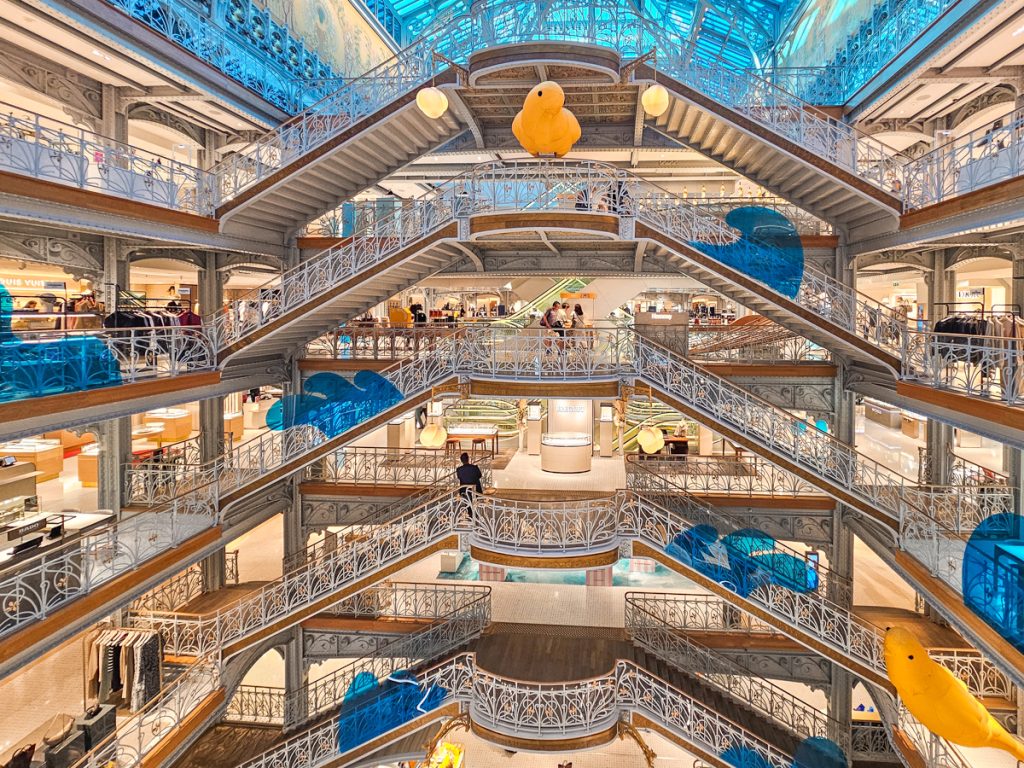
La Samaritaine is one of Paris’s most elegant department stores, recently renovated and reopened after years of restoration. It’s smaller than some of the city’s other grand stores, but what it lacks in size it makes up for in design.
The building is a stunning mix of Art Nouveau and Art Deco, with ornate ironwork, glass ceilings, and a beautiful central staircase that’s worth seeing on its own.
Even if you’re not shopping for luxury goods, it’s a lovely place to wander through and admire the architecture.
20. 59 Rivoli

59 Rivoli is a contemporary art space right in the center of Paris, known for its creative, slightly chaotic energy. The six-story building is home to around 30 artists who work and display their pieces right in their studios, so you can often see them in the middle of creating.

It’s part gallery, part studio, and part boutique, creating a space that feels spontaneous and a little bit edgy. A personal highlight was the spiral staircase covered in colorful murals, with each floor painted in a different style.

Free to enter (it’s part of the city’s lineup of great free museums), 59 Rivoli is one of the most casual and offbeat art experiences you can have.
21. Galerie Véro-Dodat

Galerie Véro-Dodat is one of Paris’s beautiful covered passages, and one of the few located in the 1st arrondissement. Built in 1826, it was part of the wave of glass-roofed shopping arcades that became popular in the early 1800s.
These galleries offered Parisians a warm, elegant place to shop and socialize away from the city’s muddy streets, and at one point, more than 150 could be found across Paris.
It’s now beautifully restored, listed as a historic monument, and lined with marble columns, checkered floors, and murals on the ceiling.

Today, the passage is home to high-end boutiques, including a Christian Louboutin boutique, along with art galleries and luxury shops selling everything from fine furnishings to perfume.
Great Places to Eat in the 1st Arrondissement
Au Pied de Cochon

A beloved Parisian restaurant serving pork products and seafood (the name literally means The Pig’s Feet). I had a delicious slow-cooked pork roast here, as well as some incredible frog legs (which are extremely rare on menus in Paris).
Poulette
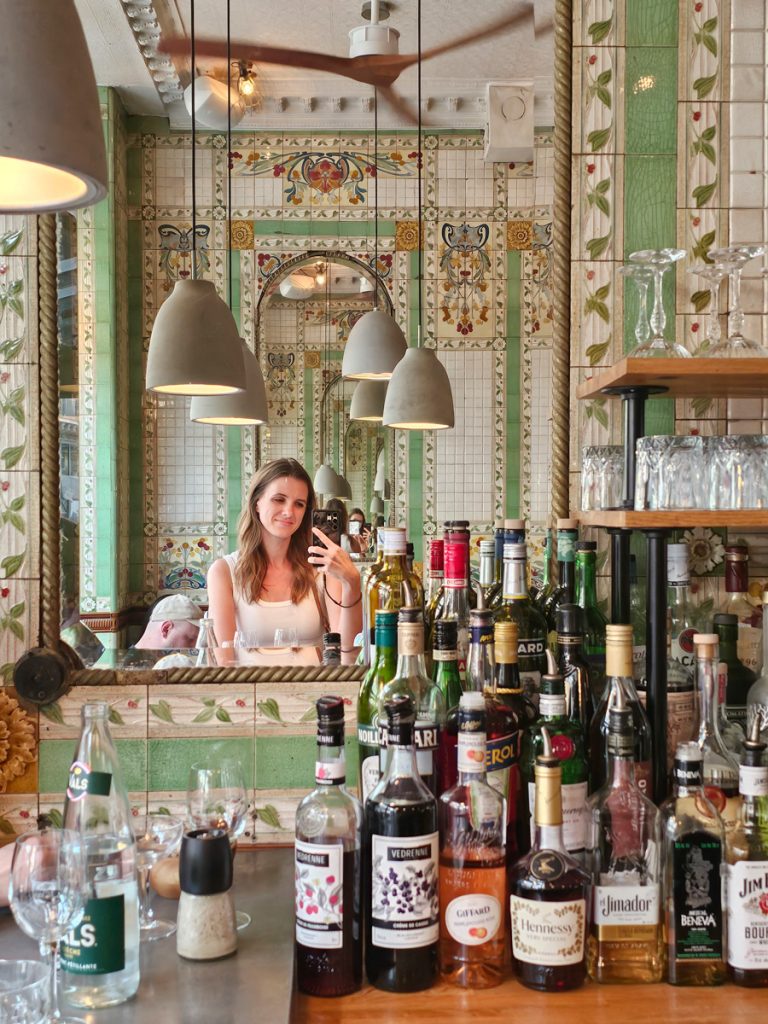
This small restaurant just north of Chatelet has lovely tiled walls and fantastic food that felt both classic and a bit inventive.
La Renommée
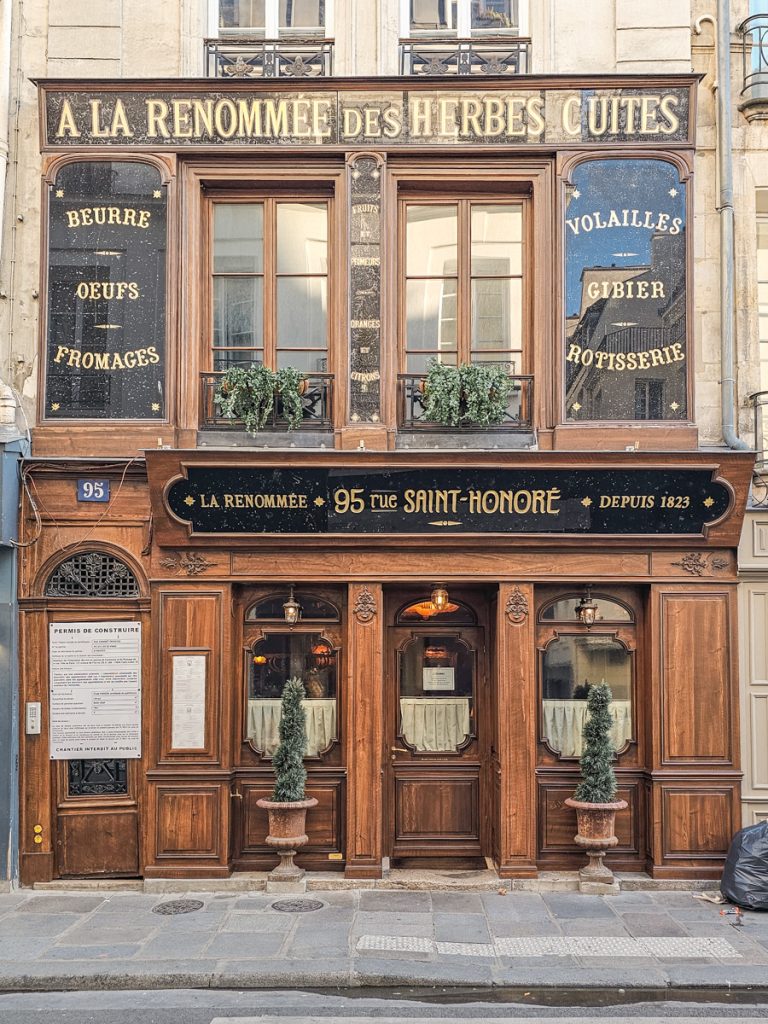
One of the most famous upscale restaurants on the right bank, dating back to 1823. Reservations open up 30 days in advance and sell out almost immediately.
Cafe Saint Honoré
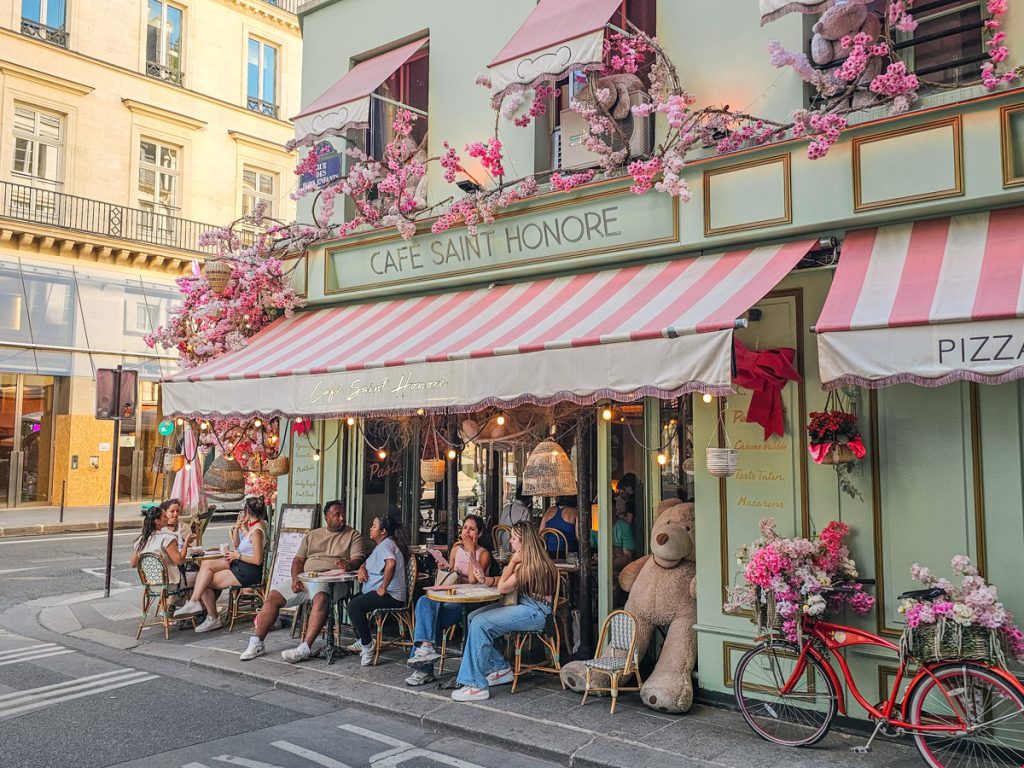
One of the prettiest cafes in the 1st arrondissement, especially remarkable for the oversized stuffed bears that decorate the premises.
Angelina

Renowned for their decadent hot chocolate, beautiful dining room, and delicious cafe food.
Jean-Paul Hévin Chocolatier

High-quality chocolatier selling, of course, hand-crafted chocolates, hot chocolate, and macarons.
Where to Stay in the 1st Arrondissement
Hotel Regina Louvre – historic, elegant, and just across from the Tuileries
Madame Rêve – modern, stylish, and has one of the best rooftop views in the city
Hotel Brighton – classic Parisian charm with views of the Louvre or Eiffel Tower
Map of 1st Arrondissement Attractions
Map Key:
- Red Stars: Major Sites
- Orange Stars: Mid-Range Sites
- Purple Stars: Hidden Gem Sites
- Black Beds: Recommended Hotels
- Black Silverware: Recommended Restaurants
Want to Explore More Paris Neighborhoods?
Check out my other detailed Paris neighborhood guides:
- The 2nd Arrondissement: Your Complete Guide
- Le Marais: A Complete Guide to Paris’s 3rd and 4th Arrondissements
- 5th Arrondissement: Your Ultimate Guide to the Latin Quarter
- Saint Germain: Your Complete Guide to Paris’s 6th Arrondissement
- 7th Arrondissement: Your Guide to the Eiffel Tower Neighborhood
- 8th Arrondissement: Your Complete Guide to the Elysées Neighborhood
- Your Ultimate Guide to Montmartre: A Self-Guided Walking Tour
The Wrap Up
The first arrondissement holds so much for visitors to Paris, whether you’re here for the museums, the history, the gardens, or the river views. It’s classic Paris through and through.
