
15 Art Masterpieces You Need to See in Paris

Paris has no shortage of great art, which is part of what makes visiting the city so exciting. Masterpieces are spread throughout dozens of museums, housed in everything from former palaces to modern galleries.
The 15 works on this list span eight different museums and represent some of the most important and influential art you can see in Paris. They’re pieces that shaped movements, changed how people thought about art, or became cultural touchstones far beyond the city itself.
This isn’t meant to be exhaustive (Paris has far too much great art for that), but it’s a solid way to get oriented and understand the city’s collections.
If you already love art, many of these will feel familiar for good reason. If you don’t, Paris has a way of changing minds, and this is a good starting point to understanding why.
1. Winged Victory of Samothrace

- Artist: Unknown Greek sculptor
- Date: c. 190 BC
- Museum: Louvre
The Winged Victory of Samothrace stands at the top of the Daru staircase, angled forward as if she has just landed. It’s an incredible setting for an incredible sculpture. Even without a head or arms, she carries a clear sense of movement: her wings are extended and her robe pulls back in tight folds, as if caught by wind.
She was carved in ancient Greece to commemorate a naval victory and likely stood in a sanctuary overlooking the sea. The base, shaped like a ship’s prow, reinforces the connection to water and motion.
Winged Victory (called Nike in French) often stops people in their tracks. The statue has presence, not just because it’s dramatic, but because it feels like a moment that’s still unfolding. For many people, this is a top highlight of the Louvre.
2. Venus de Milo

- Artist: Alexandros of Antioch
- Date: c. 130-100 BC
- Museum: Louvre
The Venus de Milo is believed to represent Aphrodite, the Greek goddess of love and beauty, though some scholars have debated whether she might be another figure entirely. The statue was discovered on the island of Milos in 1820 and has been part of the Louvre’s collection ever since.
The statue is elegant and larger than life, but there’s also tension built into her posture. Her torso twists slightly, one leg forward, drapery slipping from her hips as if she’s just shifted weight. The angle of her arms and whatever she once held is long gone, but that absence only adds to her appeal.
3. Liberty Leading the People

- Artist: Eugène Delacroix
- Date: 1830
- Museum: Louvre
A woman steps over bodies with the French flag raised high, leading a crowd of fighters through smoke and debris. She is barefoot, armed, and surrounded by workers, students, and fallen soldiers. This is Romanticism, but not the soft kind: full of motion, emotion, and grime.
Delacroix didn’t just paint what happened in the July Revolution of 1830, he shaped how it would be remembered. He even painted himself in, just left of center, dressed in a top hat and watching the scene unfold.
The result is a painting that walks a line between realism and allegory: part historical scene, part national myth. Liberty could be a real woman or an idea made human. Either way, she is in charge and the rest of the painting follows her lead.
4. The Coronation of Napoleon

- Artist: Jacques-Louis David
- Date: 1805-1807
- Museum: Louvre
There’s a lot happening in this painting. Napoleon crowns himself in the center, holding the golden laurel high above his head. The Pope sits off to the side. Nearly every figure in the crowd is based on a real person, carefully posed to witness the moment.
David was Napoleon’s official painter, and this wasn’t just a record of the event – it was image management. The actual coronation took place at Notre-Dame Cathedral in 1804, but what ended up on canvas was filtered through politics, ego, and rehearsal.
At almost 10 meters wide, the painting is massive and commands attention in the gallery, but what keeps you there is how tightly controlled everything feels. Like most of Napoleon’s legacy, it tells a story, but only the one he wanted you to hear.
5. Mona Lisa

- Artist: Leonardo da Vinci
- Date: c. 1503-1506 (possibly continuing to 1517)
- Museum: Louvre
You’ll hear the crowd before you see the painting, phones in the air and inching forward for a better view. At the center of it all, just 30 inches wide, is the Mona Lisa – half-smiling through layers of bulletproof glass.
Leonardo used a technique called sfumato, where edges blur and tones shift without clear lines. It gives her that famously unreadable expression. You think she’s smiling, until she isn’t. Then she is again.
She is thought to be Lisa Gherardini, the wife of a Florentine merchant, but like most things about this painting, nothing is confirmed. Her fame didn’t truly skyrocket until the 20th century, after she was stolen in 1911 and recovered two years later.
Up close, what’s striking isn’t her beauty or the background, but the stillness. Even with hundreds of people around you, she holds her space. That alone is something worth seeing.
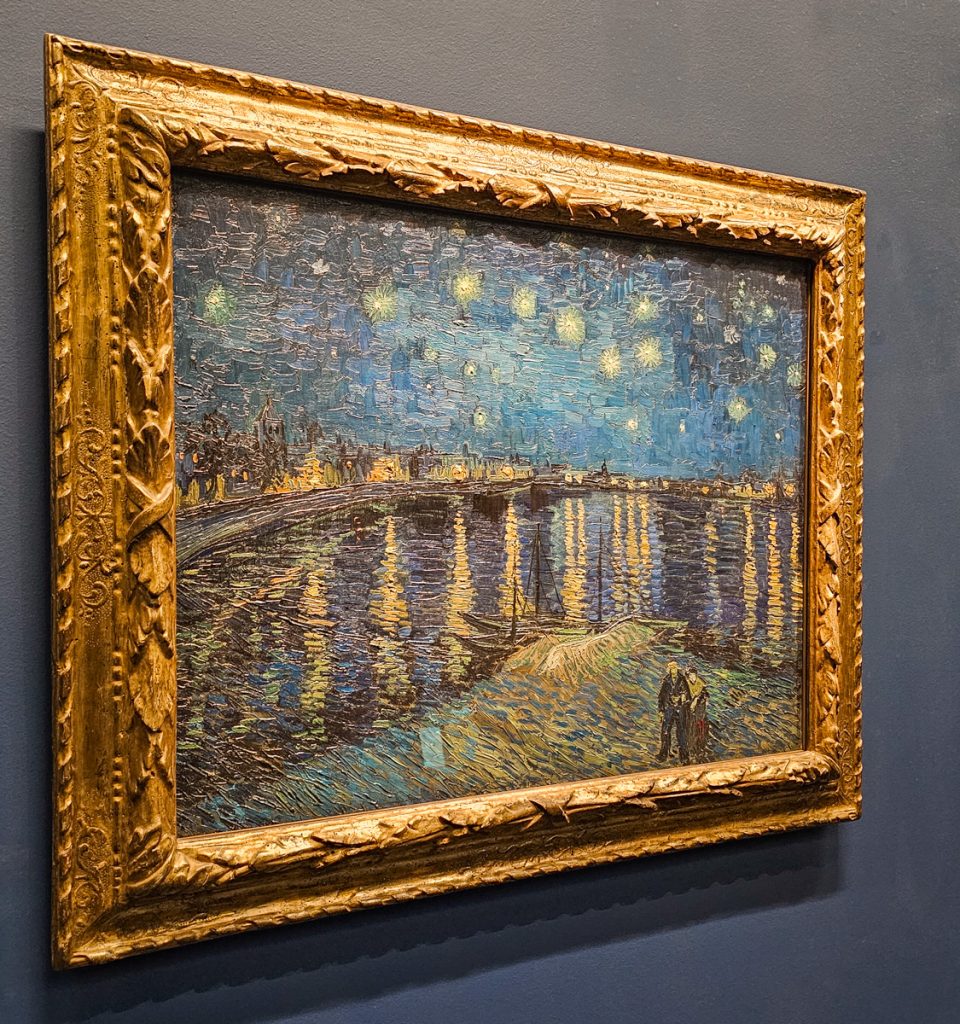
6. Starry Night Over the Rhône
- Artist: Vincent van Gogh
- Date: 1888
- Museum: Musée d’Orsay
This isn’t the Starry Night everyone knows. Starry Night Over the Rhône was painted a year before Van Gogh’s more famous swirling sky, but this one is no less captivating.
The stars are smaller and steadier. The sky is calm. Below it, gas lamps shimmer, scattering gold across the water.
He painted it just a few minutes’ walk from the Yellow House in Arles, likely standing near the embankment at night. The couple in the foreground is almost an afterthought. What matters here is the light: reflected, refracted, quiet.
There’s a softness in this piece that makes it easy to miss how precise it really is. Van Gogh mapped out the constellations carefully. The brushwork is textured, but not chaotic. It’s a painting that holds its energy just below the surface.
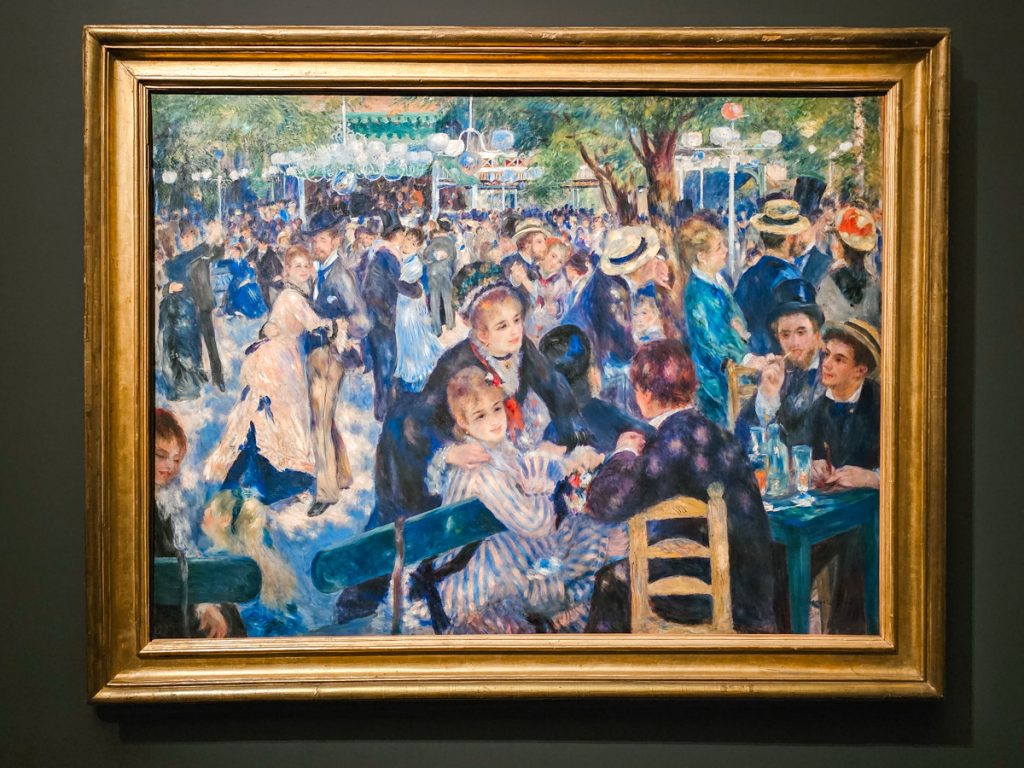
7. Bal du Moulin de la Galette
- Artist: Pierre-Auguste Renoir
- Date: 1876
- Museum: Musée d’Orsay
There’s music in this painting, even if you can’t hear it. Renoir captures a Sunday afternoon at a Montmartre dance hall: sunlight filtering through the trees, tables crowded with Parisians, the blur of movement across the floor.
Unlike more polished studio portraits, this one was painted quickly, outdoors, and mostly from life. You can see it in the loose brushwork and shifting light. Faces aren’t sharply defined, but that’s part of what gives the scene energy.
The real dance hall still existed when Renoir painted this, just a few blocks from his studio in Montmartre. Today, this is one of the most famous Impressionist paintings in the world, and it resides in the Musée d’Orsay, Paris’s beloved museum of Impressionist and post-Impressionist art.
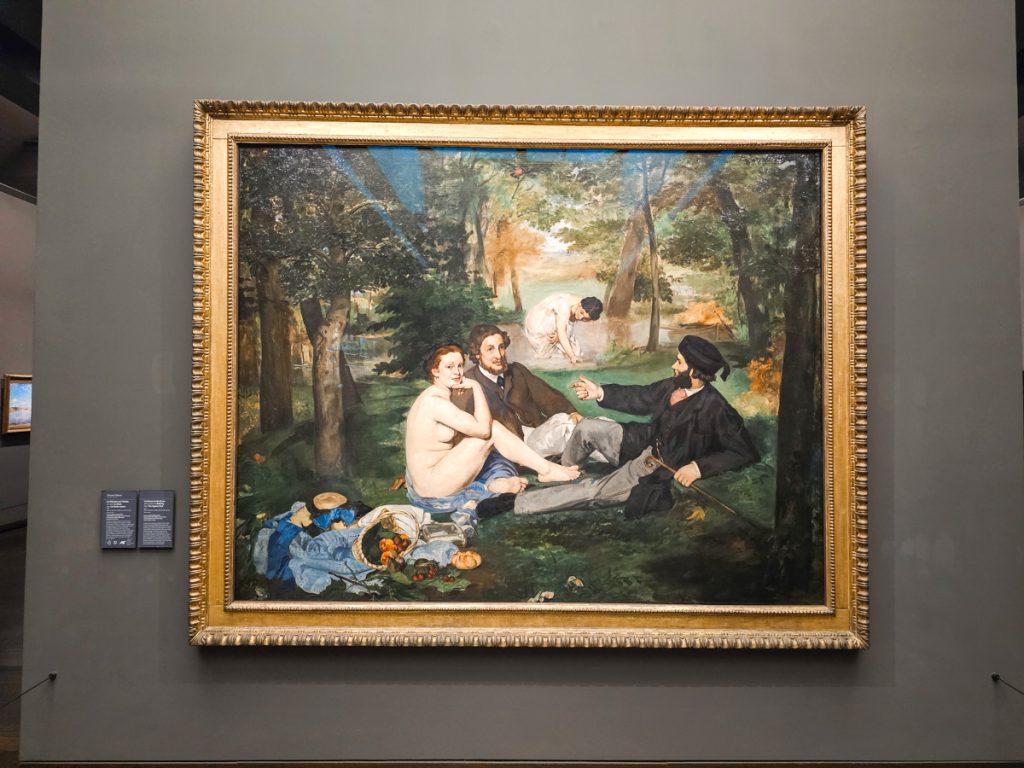
8. Dejeuner sur l’Herbe
- Artist: Édouard Manet
- Date: 1863
- Museum: Musée d’Orsay
At first glance, it looks like a picnic. Two men in dark suits sit comfortably in the grass. A woman, completely nude, looks directly at you. Another figure bathes in the background, half-lost in the brush.
When Manet first exhibited Déjeuner sur l’Herbe, it caused a stir. It wasn’t just the nudity (nudes were common in academic painting), but the context. The woman wasn’t a mythological figure or distant allegory. She looked modern, present, and unapologetic.
The brushwork also pushed against the norms of the time. Shadows are flat. The space is compressed. The scene doesn’t try to soften its contrasts. And that was the point: Manet wasn’t interested in fitting in.
You can still feel that break when you see it today. It’s less about the picnic and more about what it disrupted.
9. Water Lilies (Les Nymphéas)

- Artist: Claude Monet
- Date: 1914-1926
- Museum: Musée de l’Orangerie
To view Monet’s Water Lilies at the Orangerie, you have to practically step into them. The museum built two oval rooms specifically to house the 8 massive panels, surrounding visitors with nearly 100 meters of painted water, sky, and reflected light.
Monet worked on these near the end of his life in Giverny, when his eyesight was deteriorating. The brushstrokes are broad and loose. There’s no horizon or clear sense of depth, just layers of lilies, clouds, and shifting color that stretch across the walls.
He offered the panels to the French state in 1918, the day after the Armistice ended World War I. Today, they remain in their original setting as a meditation on nature, tucked away in a corner of the Tuileries Gardens.
10. Impression, Sunrise
- Artist: Claude Monet
- Date: 1872
- Museum: Musée Marmottan Monet
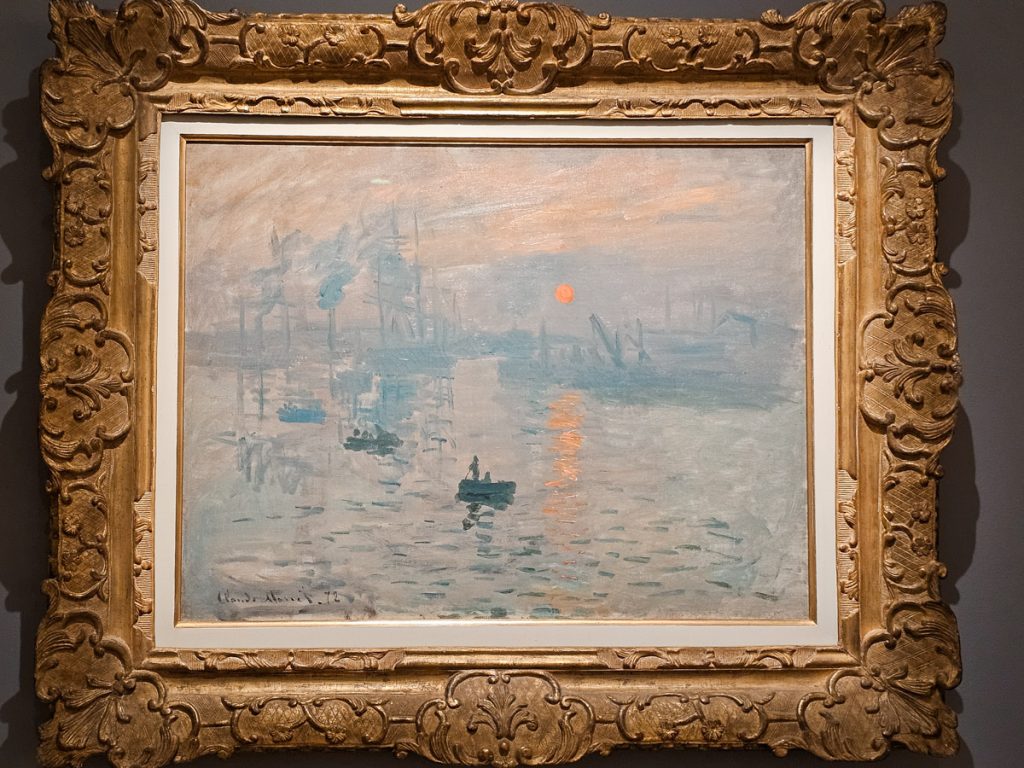
This is the painting that gave Impressionism its name, though not everyone meant it as a compliment. When Impression, Sunrise was first shown in 1874, a critic used the title to mock the unfinished look. The label stuck anyway.
The artwork shows the port of Le Havre at daybreak, painted quickly, almost without edges. The brushwork is loose. The color palette is limited: mostly greys and blues, with a single orange sun suspended over the water. Monet wasn’t trying to capture the boats or buildings exactly, just the feeling of the morning light.
Most people see Monet’s work at the Orsay or the Orangerie. But the Musée Marmottan Monet, tucked into a quiet corner of the 16th arrondissement, holds the largest collection of his paintings in the world, including this one. It’s rarely crowded, creating a truly serene atmosphere to take in the art.
11. The Thinker
- Artist: Auguste Rodin
- Date: 1880-1904
- Museum: Musée Rodin
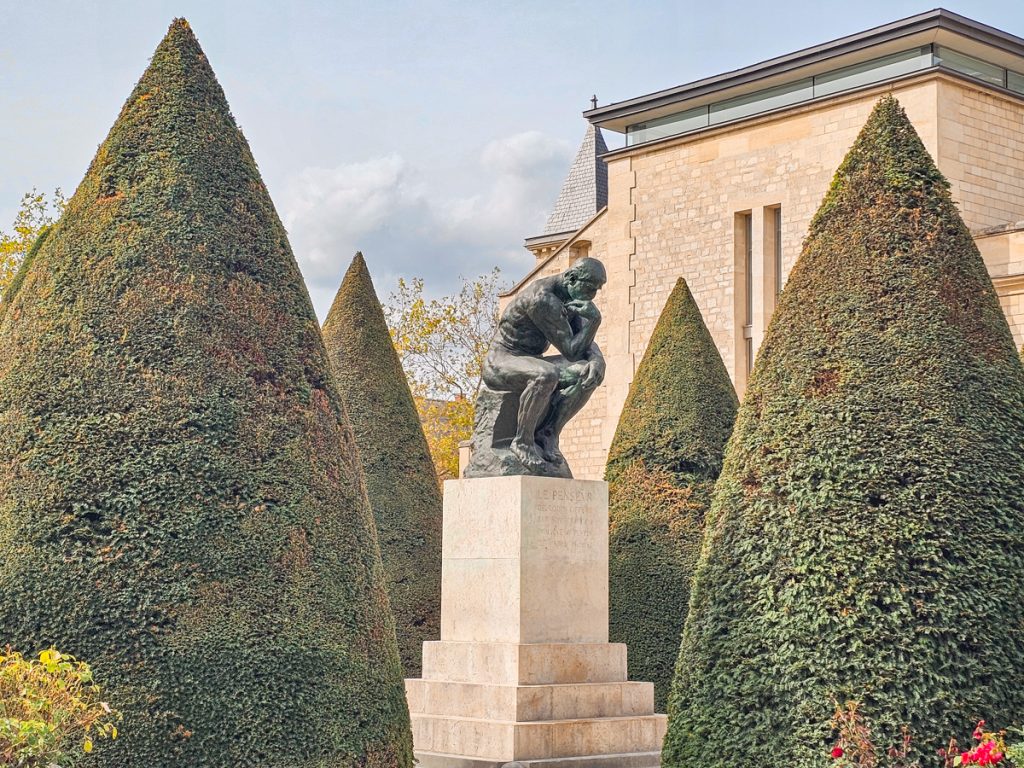
You’ve seen The Thinker in photos, but it’s so different in person: heavier, rougher, more alive. He sits forward, one hand pressed to his mouth, muscles tight. He’s thinking, but not idly. This is thought as effort.
Rodin originally designed the figure as part of The Gates of Hell, meant to represent Dante. Over time, the sculpture became its own work, larger in scale and broader in meaning.
The bronze version in the garden of the Musée Rodin is especially striking, framed by trees and open to the sky. The museum itself is one of my personal favorites in Paris, set inside a former hôtel particulier and surrounded by quiet lawns and old roses.
12. The Gates of Hell

- Artist: Auguste Rodin
- Date: 1880-1917
- Museum: Musée Rodin
Rodin worked on The Gates of Hell for nearly four decades. It was never finished, but that doesn’t make it feel incomplete.
The massive bronze doors depict a vision of Hell inspired by Dante’s Inferno, filled with figures representing punishment, despair, and human suffering. They rise over six meters high and are packed with more than 200 figures, some writhing, some falling, some barely holding on.
The Thinker was first sculpted as part of this larger work, and you can see him seated near the top of the doors.
The piece was originally meant to serve as a decorative entrance for a museum that was never built. Rodin used Inferno as a starting point, but he wasn’t interested in illustrating specific scenes. Instead, he focused on the emotional intensity of damnation itself, compressing movement, tension, and strain into a single surface.
Standing in front of the door in the garden of the museum, you’re struck by the scale of the piece and just how much energy Rodin was able to pull from bronze alone.
13. The Lady and the Unicorn Tapestries

- Artist: Unknown
- Date: Late 15th century
- Museum: Musée de Cluny (Musée National du Moyen Âge)
Six large tapestries hang in a darkened room at the Musée de Cluny in the Latin Quarter, lit just enough to make out the details: red millefleur backgrounds, a unicorn, other animals, and a noblewoman standing at the center of each scene. Together, they make up The Lady and the Unicorn, one of the most iconic surviving works of medieval art.
Five of the panels represent the five senses. The sixth is more ambiguous, with the words “À mon seul désir” woven above the central figure. Scholars still debate what it means: free will, renunciation, love without possession?
The tapestries were rediscovered in the 19th century, badly damaged but still intact. Today, they’re displayed with care and quiet. You don’t need to know their full meaning to feel their presence. The room itself does most of the work.
14. The Fairy Electricity
- Artist: Raoul Dufy
- Date: 1937
- Museum: Musée d’Art Moderne (a great free museum)
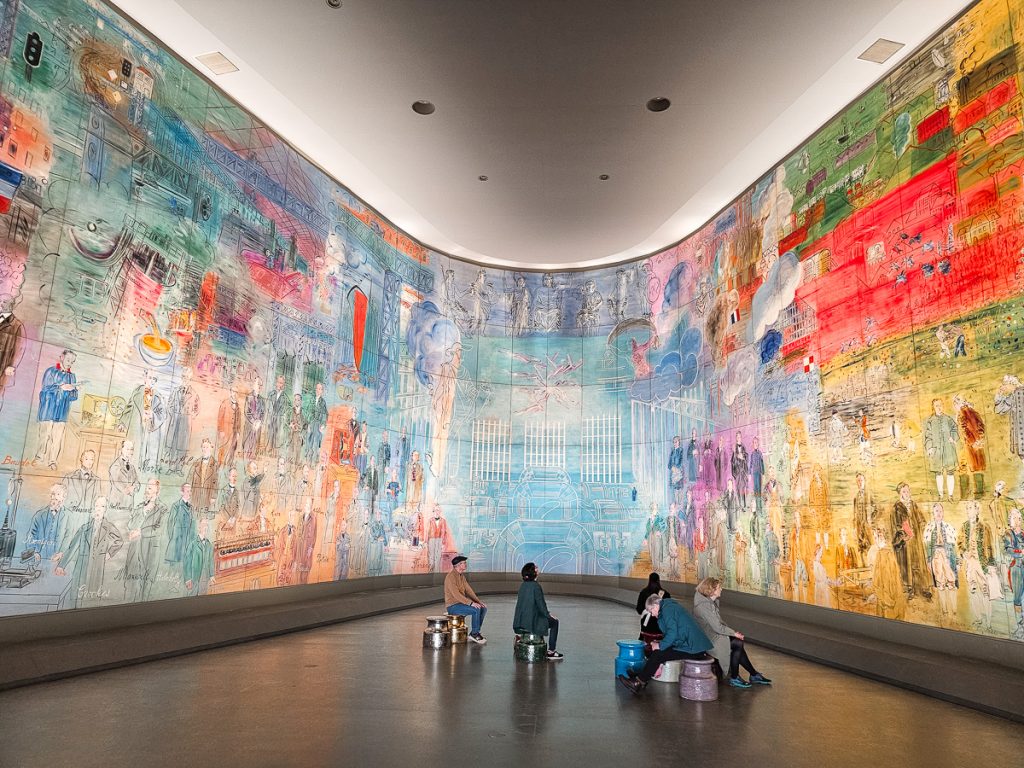
Raoul Dufy painted La Fée Électricité for the 1937 International Exposition and it hasn’t moved far since. The work stretches across an entire curved wall: 600 square meters of painted panels that trace the history of electricity, from static sparks to modern power grids.
Dufy blends gods and inventors, flashes of light and blue washes of color. The composition reads like a timeline, but the feeling is more like walking through a memory: bright and scattered as well as strangely calm.
You don’t have to understand everything that’s happening to enjoy it, but the museum does provide interactive tablets to help explain many of the scenes. Still, just the sheer scale of the piece makes you stop, and the longer you stand there, the more connections you start to see.
15. The Frame
- Artist: Frida Kahlo
- Date: 1938
- Museum: Centre Pompidou
Frida Kahlo painted The Frame on a thin sheet of aluminum, small enough to hold in your hands. Her face appears at the center, surrounded by birds, flowers, and a folk-art border that feels separate from the self-portrait.
That separation is intentional. The frame, painted on glass, was already decorated before Kahlo purchased it. She placed the glass over the aluminum sheet, creating a layered work in which the portrait and its frame remain distinct.
It’s the first work by a 20th-century Mexican artist that entered the Louvre’s collection (now housed at the Pompidou) and also the only work that she managed to sell when she came to Paris in 1931.
The painting is easy to miss on a first pass through the Pompidou’s modern galleries. But once you see it, it holds your attention quietly and completely.
Note: The Pompidou is closed until 2030 for extensive renovations.
Final Thoughts
Paris has no shortage of art, but certain pieces stay with you because of their scale, the craftsmanship, or the space they occupy. You don’t need to rush or see it all. Start here, and let the rest unfold at its own pace.
