
23 Extraordinary Things to Do in Arles, France

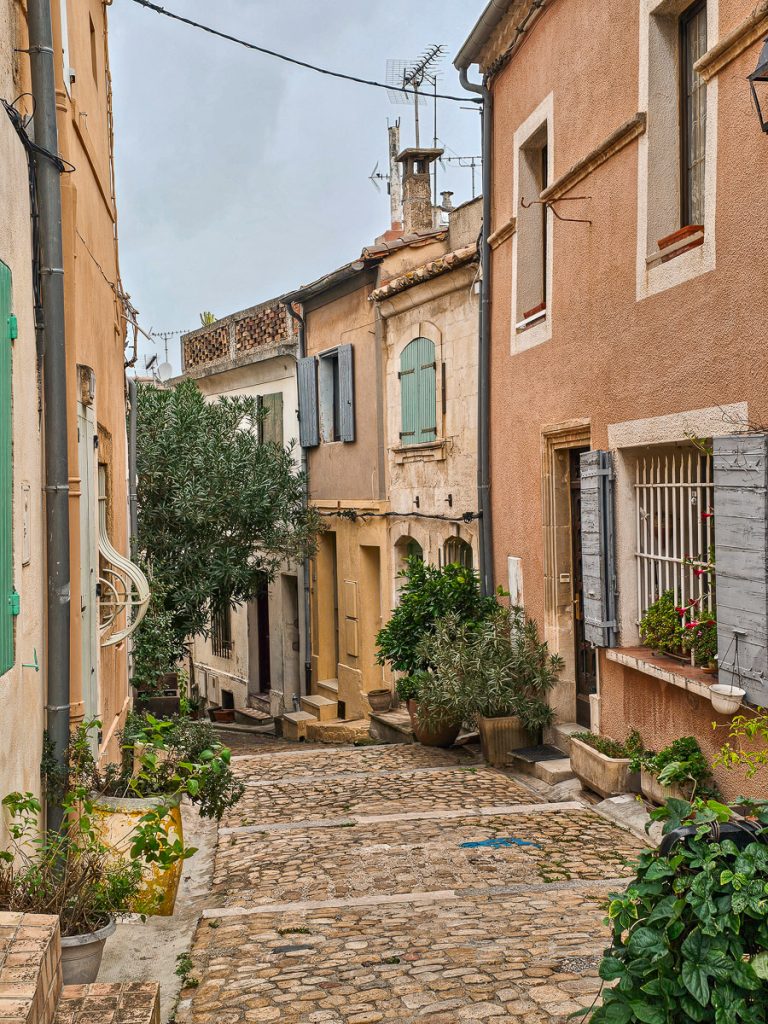
Arles is a city where it feels like you’re literally walking through history. The city center is quintessentially Provençal, with its Mediterranean style reflected in tan, cream, and marigold stone buildings adorned with colorful shutters in shades of green, blue, and magenta.
Narrow streets wind through ivy-covered facades and tiny squares lined with oak trees and cafes, creating a postcard-perfect setting.
What truly sets Arles apart, though, is its astounding collection of Roman artifacts, which has earned Arles its UNESCO World Heritage site designation.
Once a prominent Roman city, Arles was founded in 46 BC by Julius Caesar and earned the nickname “the little Rome of Gaul” for its grand Roman architecture – some of the best and most concentrated in France.
It feels like every few minutes you stumble across another leftover from the Roman Empire.
Arles is truly an astounding city to visit in Provence, and is worth a place on any southern France itinerary. Here are the best things to do in Arles during your visit.

Tourist Passes in Arles
Arles offers two attration passes for tourists, and if you’re going to visit even a few of the sites, I think its definitely worth getting a pass – they’re a great value.
There are two options: the Pass Avantage and the Pass Liberté.
The Pass Avantage gives you access to all 6 Roman monuments and 4 of the major museums in the city (Réattu, Arlaten, Arles Antiquité, and Camargue Museums). It costs €19 and is good for several months.
The Pass Liberté gives you access to 4 monuments (whichever 4 you prefer) and 2 museums (your choice of the 4 available from the Pass Avantage). The cost is €15.
The combo ticket for just the Roman Arena + Roman Theater is €11, so for just a few more euros you can visit so many more monuments and museums.
I would recommend doing the Pass Avantage so you can see all the Roman sites – you can definitely visit all of them with just one day, and can add on a couple of the museums as well. You can buy either of these passes on-site, no need to purchase ahead of time.
Also, I’ll note here that all the monuments have the same hours: March- October 9am-6pm (7pm May-Sept), November-February 10:30am-4:30pm.
23 Extraordinary Things to Do in Arles
1. The Arles Arena

The Arles Arena is the must-see site in the city, and it’s nothing short of awe-inspiring. Built at the end of the 1st century, the amphitheater measures 136 meters long, 107 meters wide, and 21 meters high, with two levels of 60 arches.
It is a little bit larger than the Roman amphitheater in nearby Nimes, making it the 20th largest arena in the Roman World.
The arena could hold 20,000 people, and was mainly used for combat fights. Gladiator shows were the most famous and popular shows, but there were also animal hunts and executions.

Both the arena and the nearby theater served important purposes to entertain (and thus placate) the population, as well as assimilate them into Roman culture.
After the fall of the Roman Empire, the arena was repurposed as a self-contained village. During the Middle Ages, large towers were added, and the structure became a small community.

People rented homes built into the stands, while the arena floor served as the village center, complete with a chapel. Over time, heavy use took its toll on the structure, and much of the original seating has been lost, though remnants of the Roman originals still remain.
You can explore the arena freely, walking through the portals and across its various levels, though access to the pit is restricted. From the upper levels, you’ll be treated to impressive views over the rooftops of Arles.
It’s such an imposing and dominant part of the town, and it’s interesting to relect on how central the arena was in the lives of people living in the first centuries AD.

It’s remarkable to see a structure of this scale and significance still standing nearly 2,000 years later. And in fact, the arena is still in use – often hosting bull games with bulls born and bred in the Camargue, just south of Arles.
*A Van Gogh marker and painting is at the top of the grand staircase just next to the arena, where he paints people in the crowd interacting at a bullfight.
2. Ancient Roman Theatre

The Arles Theater, completed around 12 BC, was a grand structure that could hold over 10,000 spectators and was primarily used for cultural events, like plays. It featured a massive stage with multiple levels, supported by 100 Corinthian columns, and was an impressive centerpiece of Roman life in the city.
Over the centuries, much of the theater was dismantled, particularly around the 5th century, with its materials repurposed for other buildings. The Tour Roland is the only remaining part of the original wall, providing a sense of the theater’s original height and scale.
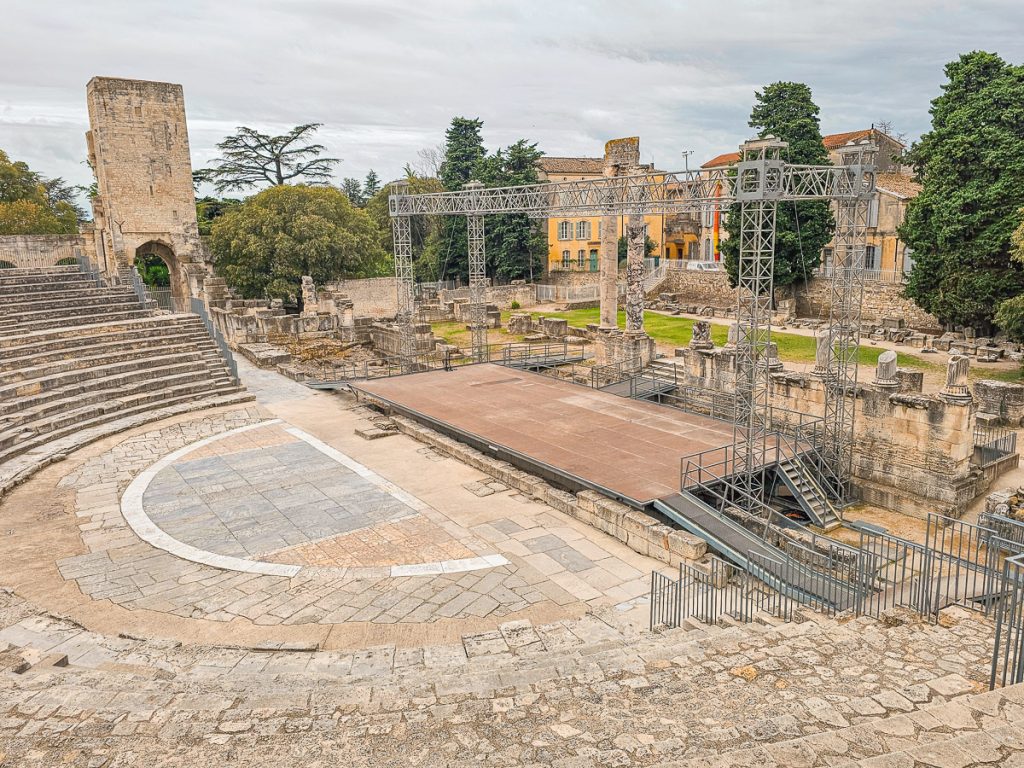
Excavation and restoration efforts in the 19th century uncovered the theater’s layout, and it was classified as a historic monument in 1840.
Today, only two columns remain standing from the original 60, but the site still hosts festivals and concerts, offering a unique experience against this historic backdrop.
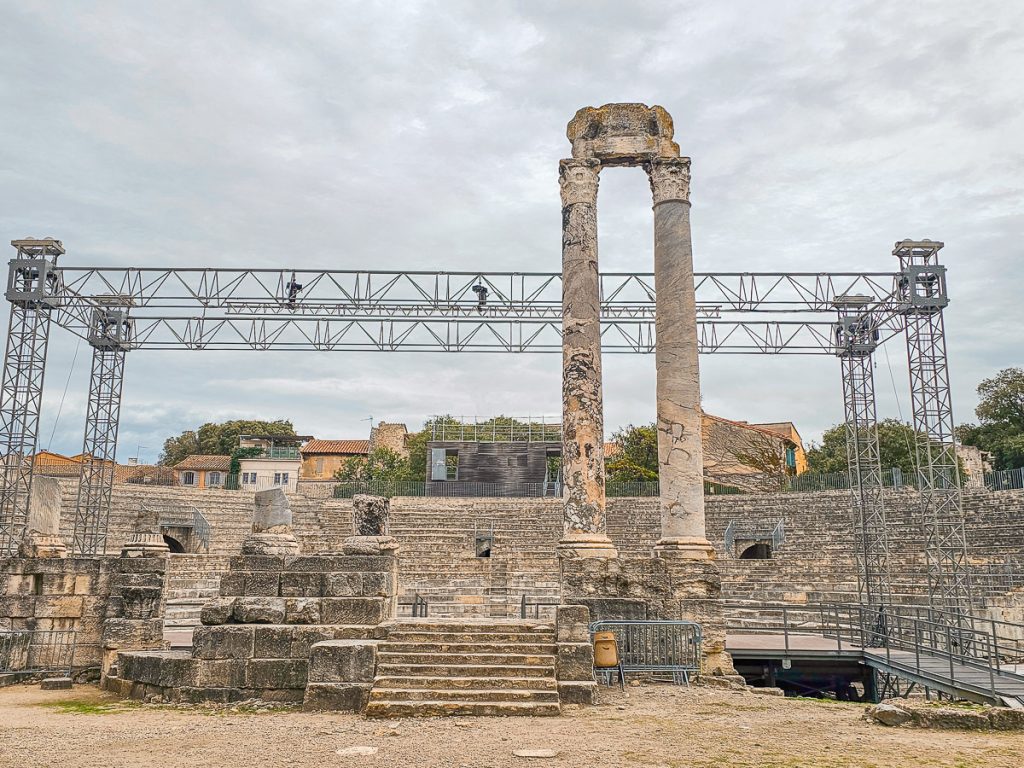
Visitors can explore the entire ruined ancient theater site. You can walk up on all the levels of the seating, view the stage and columns from behind, walk through the scattered stone remains, and even walk on the stage.
There’s an excellent short film at the back of the site that really brings the theater’s history to life – don’t skip it!
3. Alyscamps
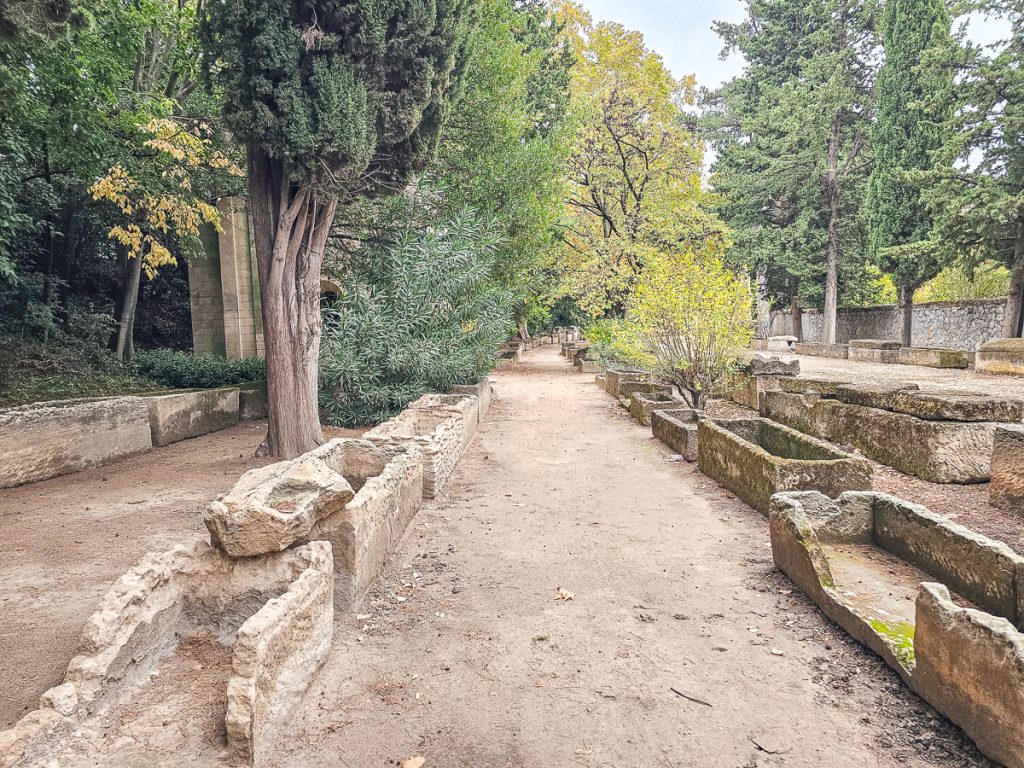
The Alyscamps, or “City of the Dead,” is a Roman necropolis that was once a large cemetery located just outside the town of Arles.
During the Middle Ages, it became one of the most famous cemeteries in Western Europe and was a significant stop along the Saint-Jacques de Compostela pilgrimage route, where pilgrims visited important churches and saints on their way to Compostela.
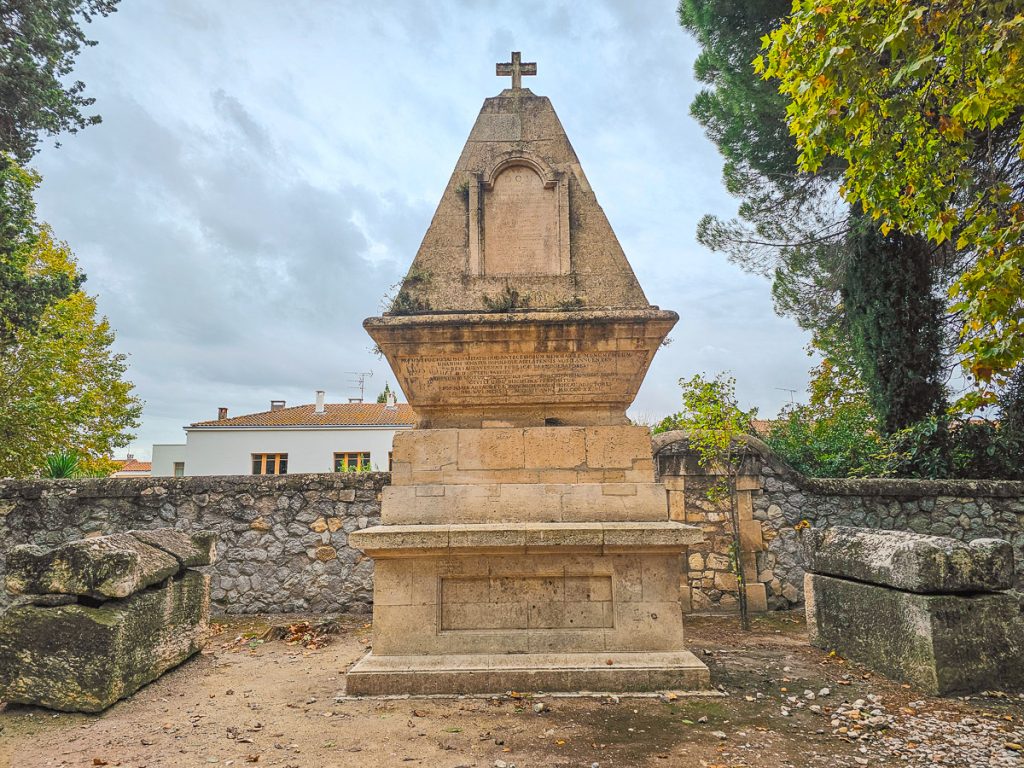
Today, only a single sarcophagus-lined avenue remains, along with a few chapels and the Saint Honrat Church, the remnants of the many chapels, crypts, and funerary monuments that once filled the area during Roman and medieval times.
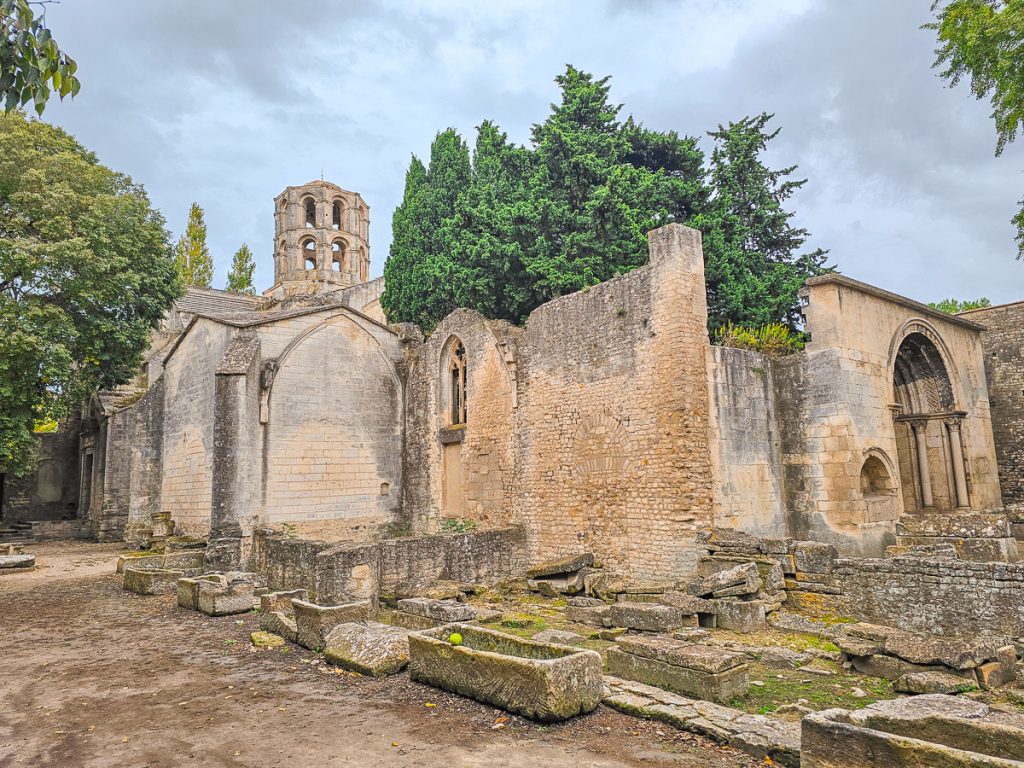
The sarcophagi, now empty and open, line the peaceful, tree-shaded pathway, creating a tranquil and reflective atmosphere. In Roman times, these tombs were elaborately decorated, and some examples of their intricate carvings can now be seen in the Arles Museum of Antiquity.
*At the end of the avenue, you’ll find a Van Gogh marker commemorating his painting of Alyscamps.
4. Crypoportiques

The Cryptoportiques is a unique Roman monument, consisting of underground vaulted galleries built around 10 BC to support the massive Roman Forum above.
The forum, which served as the town square, was a central hub for commercial, political, and religious activities. These underground arches were essential for stabilizing the elevated columns and porticos that formed the forum’s grand structure.

Today, the Roman Forum is 100% demolished – only the underground galleries remain. These galleries, located 6 meters underground, are arranged in a U-shape and are open for visitors to explore.
The experience is both intriguing and slightly eerie, with dimly lit corridors and offshoot rooms creating an atmospheric and mysterious feel.

Note that access to the Cryptoportiques is through the Town Hall (Hôtel de Ville).
5. The Thermal Baths of Constantine

The bathhouses were built in Arles in 4th century AD, and were enormous – covering over 3500 square meters. Bathhouses were incredibly popular in Roman times, with nearly 1000 in the empire. People came to to meet up and socialize, while also cleaning themselves and enjoying the perceived health benefits of thermal water.

Less than a third of the bathhouse remains today, and what is left is in ruins. While it’s hard to really distinguish any distinct pools in the ruins, the ruins themselves are very cool, with walls in various stages of disrepair, and layers of walls, domes, arches, and enclosures filling the site.
You can wander in and around almost all of the ruins, exploring the different nooks and crannies left by the walls.
6. Saint-Trophime Cloisters
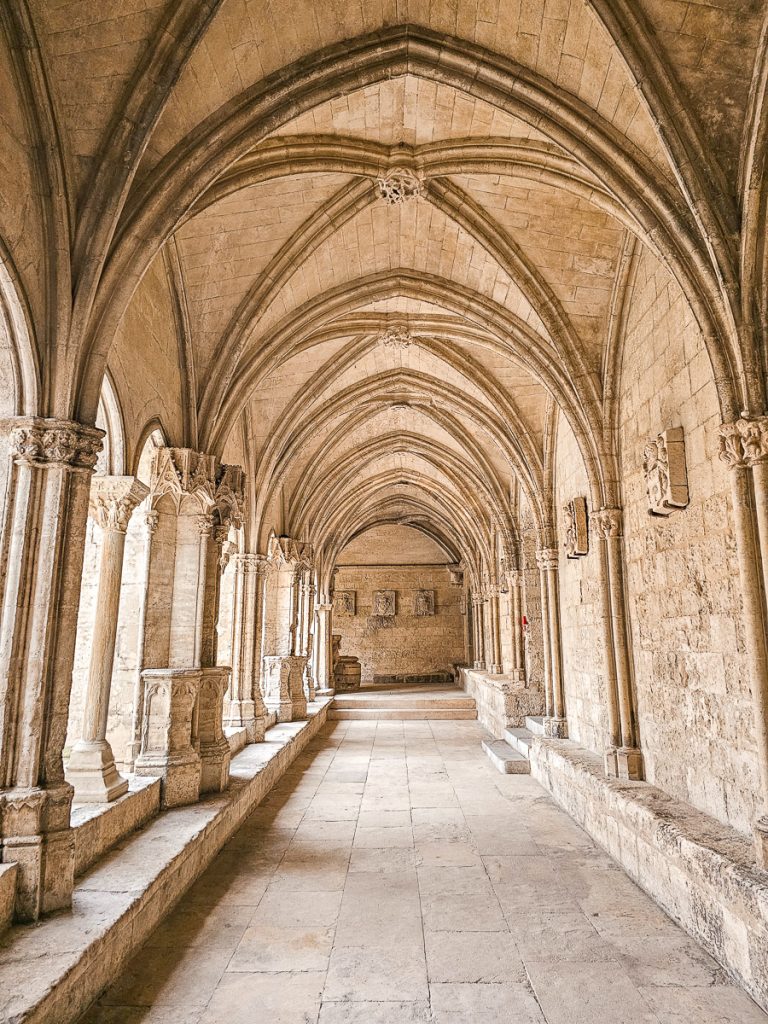
The final of the 6 monuments of Arles is actually not a Roman monument, but rather dates to Medieval times. Cloisters are usually part of a convent or monastery and are covered archways surrounding a garden courtyard. The Saint-Trophime cloisters are a part of the Archbishop’s Palace compound.

The cloisters are particularly impressive due to the intricate sculptures adorning their columns and pillars. Each column’s capital (the top section) tells a unique story, such as the Passion of Christ depicted on one side of the cloisters, while another showcases various Biblical scenes.

The corner pillars hold detailed sculptures of saints and apostles, adding to the cloisters’ beautiful and fascinating design. Don’t miss going up to the rooftop of the cloisters for a bird’s eye view down into the courtyard.

>>Ranking the Monuments in Arles
I think all the monuments in Arles are worth visiting, especially if you have a full day to explore.
However, if you’re short on time or not interested in seeing them all, here’s how I would personally rank them, from favorite to least favorite: Arena, Theatre, Cloisters, Alyscamps, Thermal Baths, and Cryptoportiques.
7. Van Gogh Path
Vincent Van Gogh, one of the most famous painters in the world, is inextricably linked to the city of Arles. Van Gogh was born in the Netherlands, but moved to Arles in 1888, as he sought inspiration in the idyllic Provencal villages and landscapes.
His best and most famous works of art came during his time in southern France, but it was also when his mental health was at its lowest. He cut off his ear in Arles, which resulted in him being admitted to the Hotel-Dieu Hospital in the city.
A year later, he was admitted to the Saint-Paul-de-Mausole hospital in nearby Saint-Remy-de-Provence for his continuing mental health struggles. He produced over 150 paintings in the year he spent in Saint Remy, using the beautiful countryside surrounding the hospital as inspiration.
From Saint-Remy, he moved back to northern France, where he died a few months later in 1890. In total, Van Gogh spent 27 months in Provence, where he created more than 500 drawings and paintings, including masterpieces like Starry Night.
One of the most fascinating things to do in Arles is following the Van Gogh Path. By downloading the guide and interactive map from wivisites.com, you can explore the locations across Arles that were significant to Van Gogh’s life and paintings.
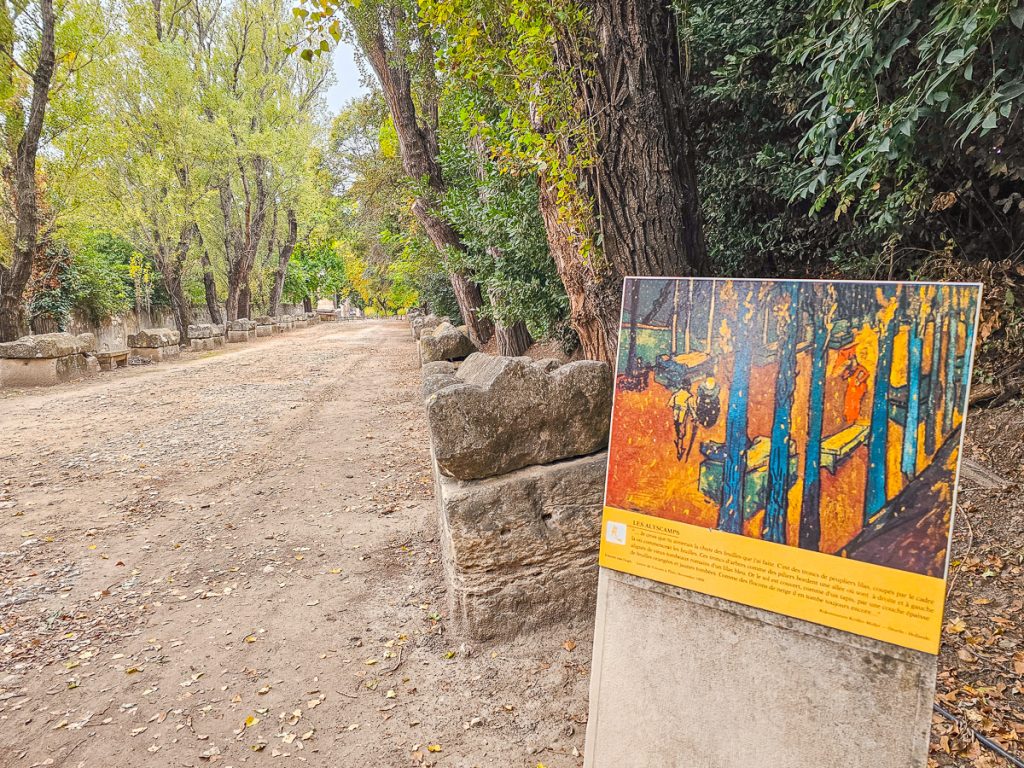
Most of these spots have a photo of the painting displayed right where he created it, allowing you to compare the artwork with the real-life scene. I loved this unique way of connecting with his work!
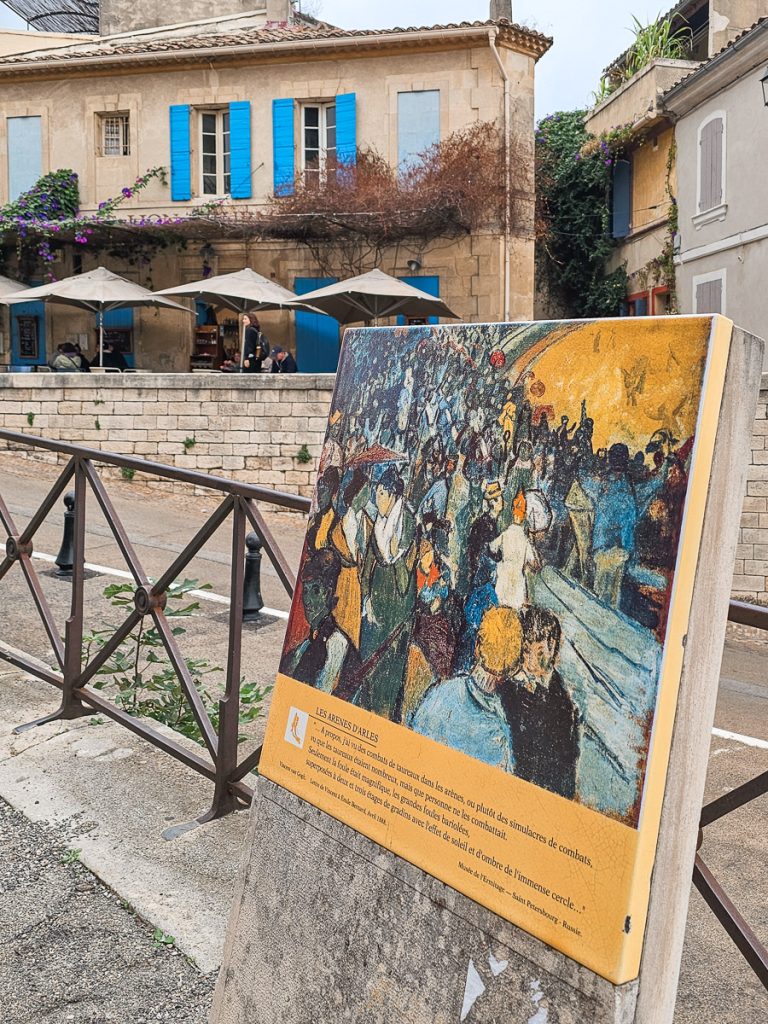
That said, not every location was fully intact. About half of the sites were missing their placards and pictures when I visited, but the app still provides the images, along with detailed explanations of the paintings.
It’s fascinating to walk in Van Gogh’s footsteps and learn more about his process, the meaning behind his art, and how he interpreted Arles through his work. Even with a few missing placards, this experience is a must to really appreciate the connection between Van Gogh and Arles.
8. Jardin d’Eté – The Summer Garden

This small garden features a few walking paths, park benches, and a calm atmosphere. It’s situated on a hill right under the Roman Theater, and the Tour Roland is the bakdrop for the garden and principal fountain – its quite lovely.

At the park’s entrance, you’ll find a Van Gogh marker displaying one of his paintings inspired by this very spot.
- Hours: October-March: 7am-6:30pm, April-September 7am-8:30pm
9. Place de la Republique

The main square in Arles, Place de la République, is home to several key landmarks, including the obelisk fountain, Saint Trophime Church and Cloisters, and the entrance to the Cryptoportiques.
The square is surrounded by a blend of grand buildings with impressive facades and traditional Provençal shops, creating a charming atmosphere.
10. Cathedral Saint Trophime

The Saint Trophime Cathedral, the largest Catholic church in Arles, features a stunning facade and a beautiful interior adorned with large-scale tapestries and paintings hanging along its walls.

11. Espace Van Gogh

The Espace Van Gogh, formerly the “Hôtel Dieu” hospital, is where Van Gogh was treated in 1889 after famously cutting off his ear. During his stay, he painted the vibrant courtyard, capturing its charm from his room on the upper level.
Today, the building houses a media library and gift shop, but the courtyard has been preserved almost exactly as it was during Van Gogh’s time. The building is painted in striking yellow and blue, and the garden is filled with vibrant flowers, trees, and a fountain.
A Van Gogh marker in the courtyard displays the painting he created of this very scene.
12. Musée Arlaten

This is an extremely well-designed and fascinating museum in Arles, I would put it as my favorite of the 4 museums i visited in the city.
The courtyard features Roman ruins, while the interior combines modern and traditional elements. The museum is dedicated to showcasing the culture of Arles and Provençal life through interactive and immersive displays that illustrate what life was like in historical Provence.

The exhibits include several life-sized scenes depicting daily life and important celebrations, each with fascinating, historically accurate details. For example, one scene shows women welcoming a new mother and baby, while another depicts a Christmas Eve gathering.
A room dedicated to fishing in Provence and the Mediterranean features models and artifacts from fishing villages and vessels. Another highlight is the collection of santons, traditional Provençal miniature figurines, displayed in a room dedicated to this regional craft.

Other exhibits showcase clothing, furniture, homes from the Camargue, and countless objects and artifacts that bring the region’s history to life.
The museum concept was incredibly well-executed, with regular opportunities to interact with the exhibits, and was such a fascinating look at what life was like in the “olden days.”
13. Saturday Provencal Market

This charming Provençal market takes place every Saturday on Boulevard des Lices, near the Tourism Office.

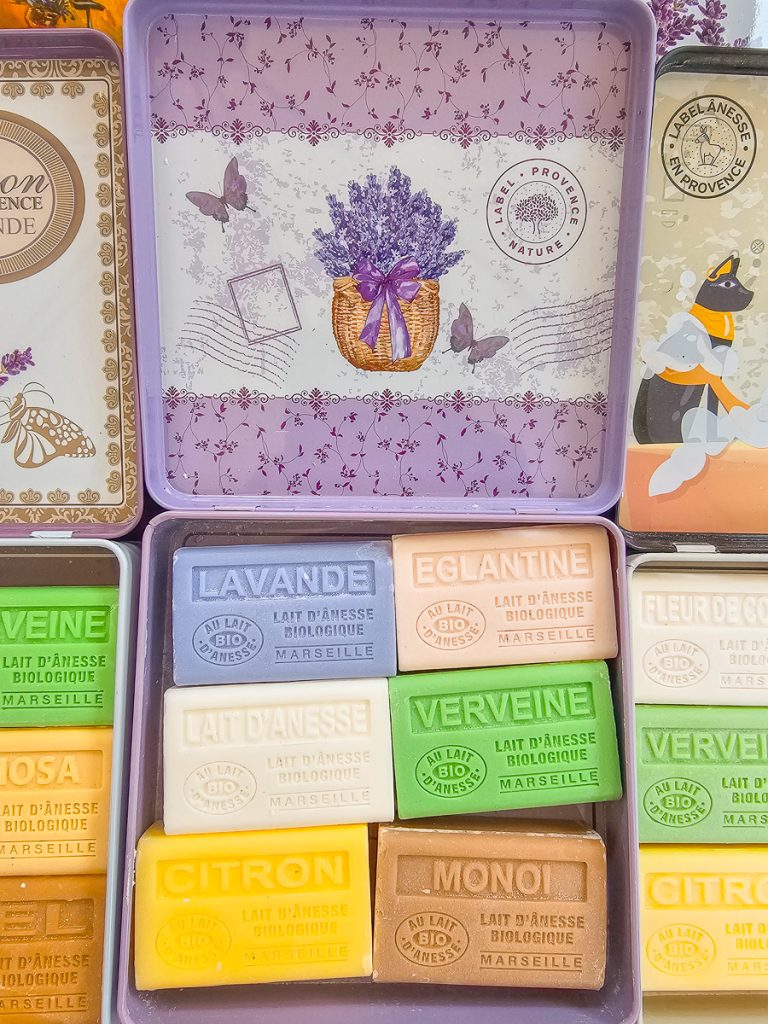
The stalls offer a delightful mix of goods, including fresh produce, soaps, honey, jam, lavender, and handmade crafts. You’ll also find jewelry, scarves, toys, baskets, bowls, tablecloths, and plenty of local foods like bread, cheese, meat, eggs, and even freshly roasted chickens.
14. Place du Forum

This charming square, typical of Arles and Provence, has ruins of a Roman colonnade on one side with the outdoor seating of cafes filling most of the square.
Van Gogh famously painted a café at night in this square. While there’s supposed to be a Van Gogh marker here, it was missing during my visit. However, you can still view the painting in the app, for context to the charming scene.
15. Fondation Van Gogh Museum
This museum’s name can feel misleading—it’s called the Van Gogh Museum, but there’s very little Van Gogh (or Impressionism) here at all. I was informed at the ticket desk that there was only one Van Gogh painting on display, but I was expecting maybe a little bit more Impressionism or Post-Impressionism.
However, the exhibits primarily focus on modern and contemporary art and change throughout the year. When I visited, there was a big emphasis on abstract art.
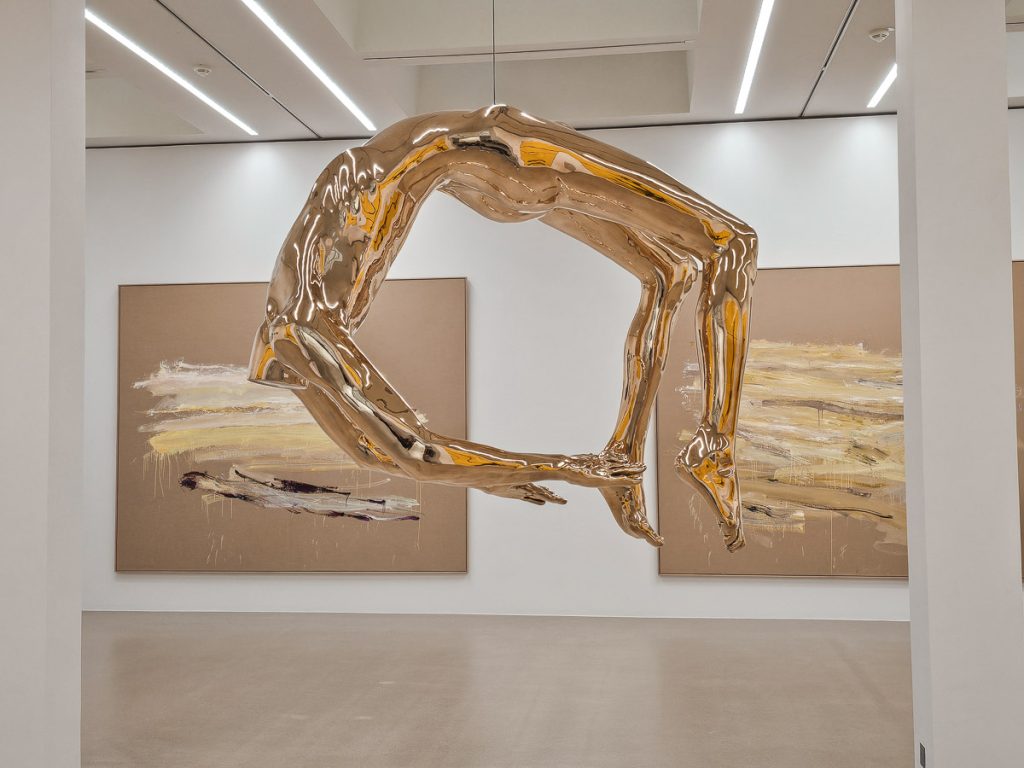
While I’ve grown to appreciate abstract and modern art more as I’ve gotten older, the pieces here pushed the boundaries of what I could personally connect with. However, for abstract art enthusiasts, this museum will likely be a great fit.
As for the Van Gogh piece, the specific painting rotates throughout the year, typically on loan from other museums. During my visit, I saw Le Lieur des Gerbes (The Sheaf-Binder), painted in nearby Saint-Rémy-de-Provence.

While it would be amazing to have a museum showcasing a collection of Van Gogh’s works in Arles or Saint-Rémy, where he created many of his masterpieces, most of his paintings are held by major art institutions around the world.
- Cost: €10, not included in the tourist passes (though it does get you a small discount)
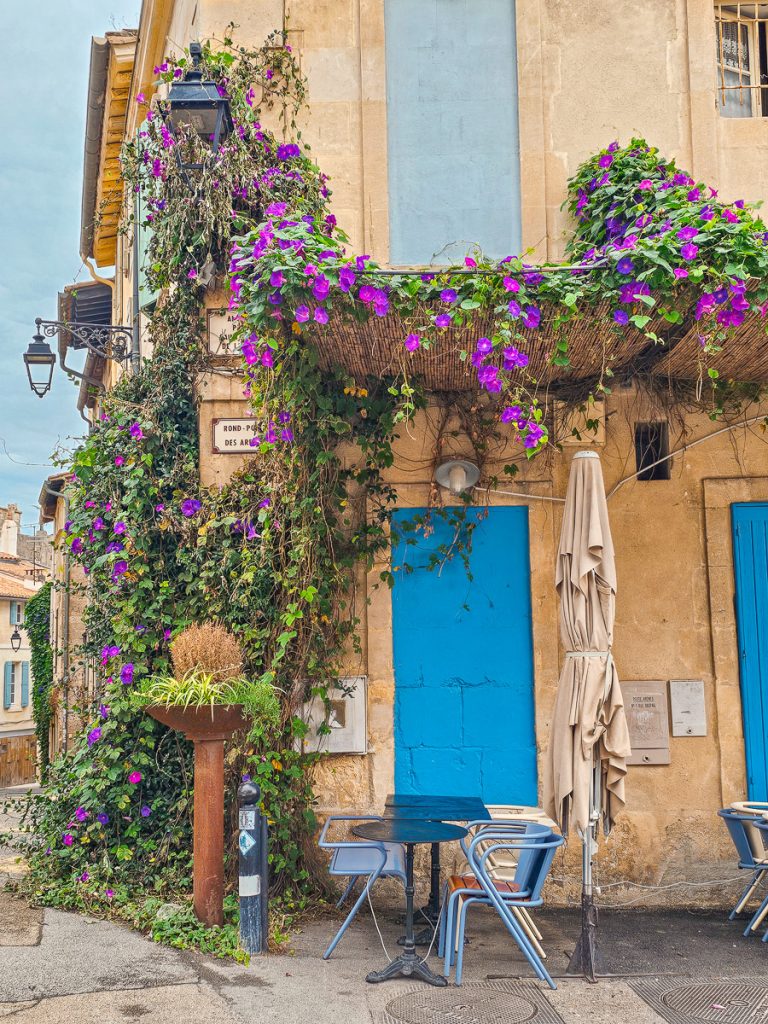
16. Wander the Picturesque Streets

The streets of Old Town Arles are so incredibly charming and picturesque – it’s worth its own section just to call out what a delightfully adorable city this is. Make sure to take time to just wander and take in the idyllic streets.

17. Musée Réattu

The Réattu Musuem is Arles’ Fine Arts Museum, housed in a historic mansion. The museum is dedicated to the works of Jacques Réattu, an Arlesian painter whose creations form a significant part of the collection.

The museum also features works by other artists, including pieces that were part of Réattu’s personal collection.
18. Notre Dame De La Major

The Notre Dame de la Major church is built at one of the highest spots in Arles, and is one of the oldest churches in the city. It’s a relatively simple church, but is only steps from the Arena and worth a stop.
19. Porte de la Cavalerie

The Porte de la Cavalerie was the main gate into the city, built in the 1500s, complete with a drawbridge and ramparts that once encircled Arles.
Today, you can still see a small section of the ramparts connected to the towers. Just outside the gates, Van Gogh lived in his “Maison Jaune” (Yellow House), which he famously painted along with the surrounding area.
20. Amédée Pichot Fountain

Located at the end of a narrow building, this fountain features Corinthian columns, intricate embellishments, and a fresco. Its design was inspired by the iconic Place Saint-Michel fountain in Paris.
21. Rhône River + Lions
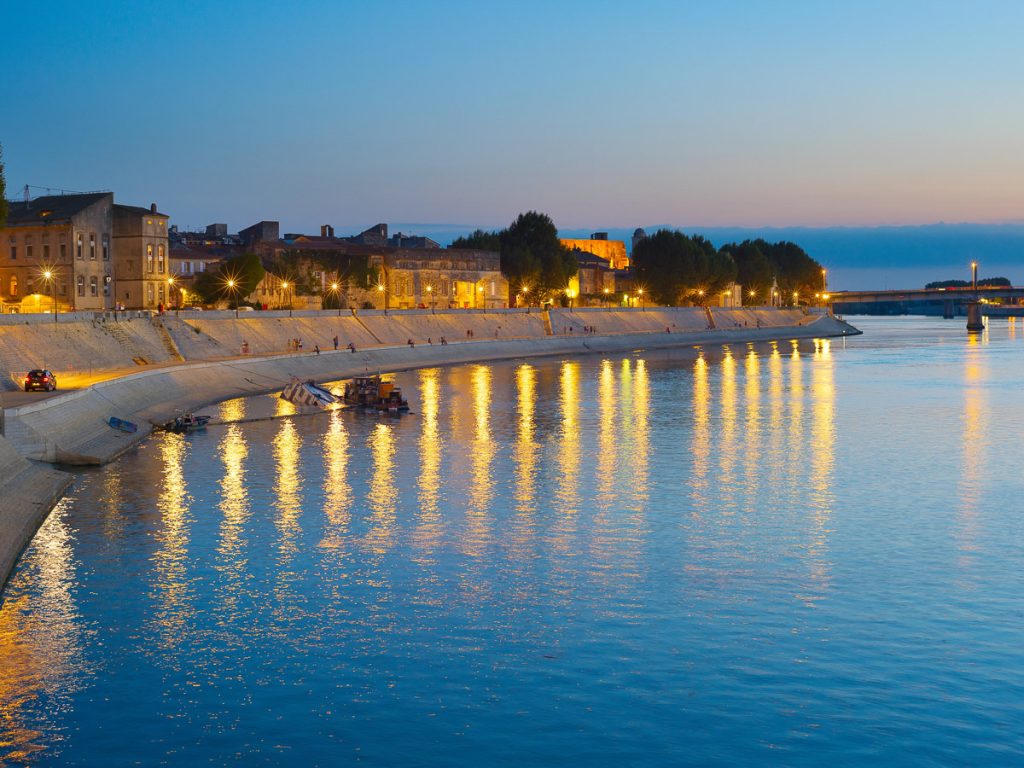
The Rhône River flows along the edge of Arles, just outside the Old Town city center. Walking paths run both along the riverbanks and higher up on the walls, offering scenic views of the river.
A short walk upriver takes you to the spot where Van Gogh painted Starry Night Over the Rhône, a beautiful work with similarities to his iconic Starry Night.

You can also stop by the Lions, two columns that once marked the edges of a bridge that has since collapsed.
22. Musée Departemental Arles Antique

Located about 20 minutes on foot from the city center (or a 5-10 minute drive), this museum is dedicated to Roman history in the Arles area.
It houses an extensive collection of sculptures, pottery, architectural remains, mosaics, and funerary tombs dating back nearly 2,000 years. It’s truly remarkable how well-preserved many of these ancient artifacts are!


One of the most fascinating exhibits is a large Roman barge recovered from the bottom of the Rhône. Sunk during a flood in the 50s AD, the barge remained remarkably intact, buried in sand and silt until its discovery in the 2000s.
If you’re interested in Roman or Arles history, this museum is an absolute must-visit.
23. Visit the Camargue

The Camargue Natural Park is a wetland area where the Rhone River meets the Mediterranean Sea, just south of Arles. This unique natural park is full of rice paddies, marshy areas, bull and horse farms breeding traditional Camargue animals, and flamingos!
The Camargue is such a unique and distinctive landscape in France that you won’t find anywhere else in the country, and is well worth a visit when you’re visiting Arles.

I’d recommend doing a jeep “safari” tour to the Camargue from Arles – this is what I did, and I loved having a guide take our very small group to the best spots in the Camargue, teaching us about the history and the culture, and pointing out all the most interesting plants, animals, birds, and features.
You can book the exact Camargue tour I did here
Map of Attractions in Arles
How Long Do You Need in Arles?
With one day in Arles, you can see and experience most of the highlights and things on this list. You’ll need a half-day to experience the Camargue, so to do everything on this list at a leisurely pace I’d plan for 2 days, but you could do basically everything on this list with about 1.5 days.
