
12 Unforgettable Masterpieces of the Musée Rodin in Paris

The Musée Rodin is one of my very favorite museums in Paris, and one I keep coming back to again and again. Part of that is the setting. It’s housed in the Hotel Biron, an 18th-century mansion in the 7th arrondissement where Auguste Rodin once lived, with beautiful galleries inside and sculpture-filled gardens outside.
The visit naturally moves between the house and the grounds, with major works placed among trees, hedges, flower beds, and rose bushes along quiet walking paths. Together, the indoor galleries and the gardens make the museum feel as much about the experience of wandering as it is about the art itself.


But the other reason I love this museum is that the art is truly spectacular. Auguste Rodin lived from 1840 to 1917, and he is often described as the “father of modern sculpture.”
Walking through the museum makes that feel very real. His work is intensely physical and emotional, capturing desire, suffering, tension, and movement in a way that still feels powerful today.
Many of his most famous sculptures exist in multiple casts around the world (including a few at the Musée d’Orsay just down the street), but seeing them here, where he lived and worked, just hits different.
These are 12 of the most famous and iconic masterpieces displayed in the Musée Rodin.
1. Gates of Hell

The Gates of Hell began as a commission from the French government in 1880, when Rodin was asked to design monumental doors illustrating scenes from Dante’s Divine Comedy. He chose to focus on Inferno, the poem’s darkest and most visceral section.
The doors were intended for a planned museum of decorative arts. That museum was never built, but the project quickly outgrew its original purpose.
Over the next several decades, the Gates of Hell became Rodin’s creative laboratory. He produced more than 180 figures for the composition, constantly reworking and rearranging them.
Instead of illustrating specific scenes, Rodin focused on states of suffering and torment. The figures show souls in anguish, each reacting differently to eternal punishment.

Rodin showed the gates in fragments in 1900, concerned that some figures overpowered the composition. He agreed to have the work cast in bronze only months before his death and never saw the finished result.
The doors now stand in the gardens of the Musée Rodin, an enormous masterpiece over 20 feet tall and densely packed with figures from top to bottom. It’s a sculpture you can stand in front of for a long time, slowly picking out details and realizing just how much is worked into every inch.
2. The Thinker

The Thinker is easily Rodin’s most famous work, and at the Musée Rodin it sits outdoors in the center of a small cluster of manicured hedges and topiaries. The setting is as quiet and reflective as the sculpture itself, and you can take it in from multiple angles.
The Thinker was originally created in 1880 as part of The Gates of Hell. At the time, Rodin called it The Poet, and it’s believed to represent Dante, author of the Divine Comedy, seated above the doors and looking down over the scenes of Hell below.


What’s interesting is how physical that thinking looks. The figure’s body is tense and compact, with muscles engaged and the spine bent forward. This wasn’t meant to be a relaxed or detached observer. Rodin imagined someone wrestling with ideas, burdened by them, but still in control of his own mind.
Rodin began exhibiting The Thinker on its own in 1888, even while it remained part of The Gates of Hell. When he enlarged it to a monumental size in 1904, the sculpture took on a more universal figure – someone caught in the space between thought and action.
3. The Burghers of Calais

The Burghers of Calais is one of Rodin’s most powerful sculptures. You can see a cast today in the museum gardens, though it was originally created for the city of Calais to commemorate a dramatic moment from the Hundred Years’ War.
In 1346, after an eleven-month siege, Calais was starving and near collapse. England’s Edward III agreed to spare the city only if six of its leading citizens surrendered themselves. They were ordered to walk out barefoot, dressed in sackcloth, with nooses around their necks and the keys to the city in their hands.
Six men stepped forward, led by Eustache de Saint-Pierre, believing they were sacrificing their lives to save everyone else. Rodin captures this moment, right before their march to the English camp.

Each figure processes the same fate differently. Fear, resignation, grief, and resolve all appear side by side. Rodin exaggerates their hands, heads, and feet, making the physical weight of the moment impossible to ignore.
Several of these elements were sculpted with the assistance of Camille Claudel (more on her below), whose contribution helped intensify the expressiveness of the figures.
When the monument was unveiled in the late 19th century, it shocked viewers. Instead of triumphant heroes elevated on a pedestal, Rodin presented ordinary men burdened by doubt and dread.
The story ends with their lives spared, after Queen Philippa of Hainault intervened, fearing that their deaths would bring bad luck to her unborn child. However, what matters here is not the mercy that followed, but the moment when six men believed they were going to die, and the power of that sacrifice.
4. The Kiss
The Kiss is likely the most famous sculpture inside the mansion at the Musée Rodin.

This marble sculpture didn’t begin as a general image of romantic love. Rodin originally conceived it as Francesca da Rimini, depicting Paolo and Francesca from Dante’s Divine Comedy. In the story, the two fall in love while reading together, are discovered by Francesca’s husband, and are killed for their affair.
Like The Thinker, the lovers were first designed as part of The Gates of Hell. Rodin ultimately removed them, feeling that their tenderness and intimacy felt out of place amid the surrounding scenes of suffering and torment.

Exhibited independently in its large form in the late 1880s, the sculpture quickly became one of Rodin’s most celebrated works, and the more universal title The Kiss stuck. At the Musée Rodin, the indoor version is carved in marble, while a second version in bronze stands outside in the gardens.
5. The Cathedral

The Cathedral is perhaps less well-known than Rodin’s headline works, but it’s a piece I always stop for at the Musée Rodin. It shows two right hands, belonging to two different people, raised toward each other – almost touching, but still separated by a small gap. The gesture is simple, but the shape they create together feels very intentional and unexpectedly intimate.
Rodin originally called this piece The Ark of the Covenant. After publishing a book on French Gothic cathedrals, he renamed it The Cathedral because the space between the hands reminded him of the soaring interiors of those churches. It’s an interesting comparison, and once you see it, the symbolism is quite moving.
What makes the piece so compelling is that inner space. Small and enclosed, it feels protected and calm, like a quiet sanctuary formed by the emotional connection between two people. For such a minimal sculpture, it carries far more emotion than you expect.
6. Monument to Balzac
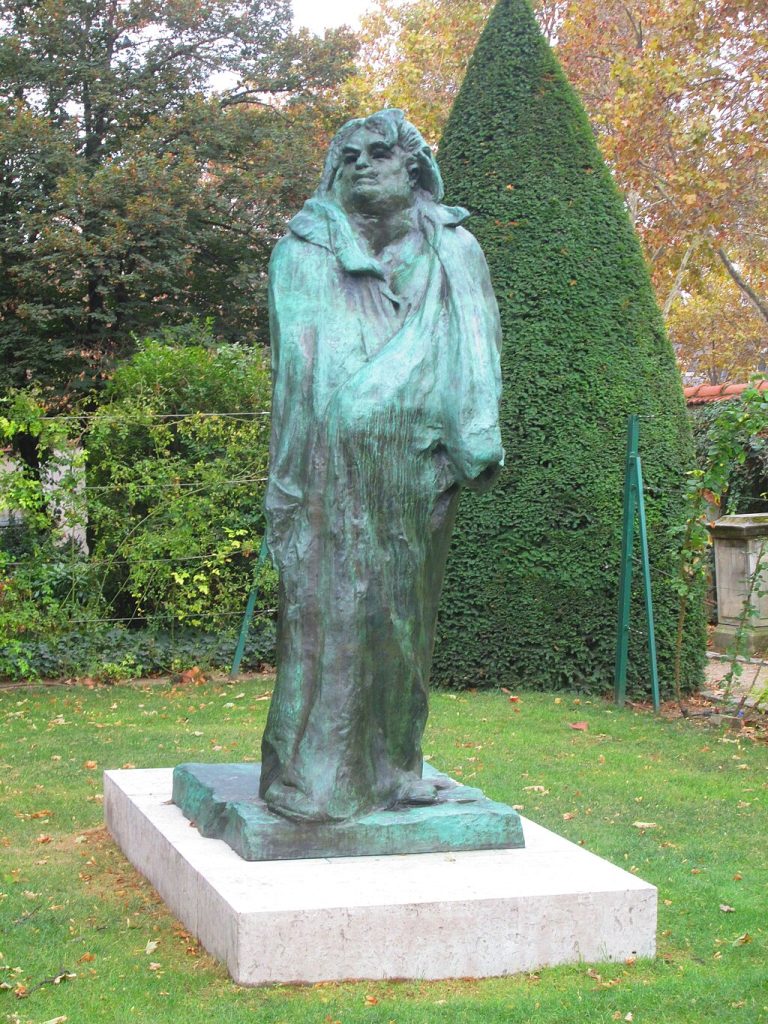
Monument to Balzac is considered one of Auguste Rodin’s most radical works. Rodin was commissioned in 1891 to honor the novelist Honoré de Balzac, but instead of producing a conventional portrait, he spent years trying to understand the writer himself.
He read Balzac obsessively, traveled to his home region, studied men with similar builds, and made dozens of studies. The longer he worked, the less interested he became in physical likeness.
What Rodin ultimately produced after nearly seven years was not a portrait in the traditional sense. Balzac stands wrapped in a heavy dressing gown, inspired by the robe he wore while writing.
The body is simplified and almost abstract, while the head carries all the focus and intensity. With no pen, book, or other props, the figure feels less like a portrait and more like Rodin’s idea of Balzac at work, communicating his strength and creativity.
When the monument was unveiled in 1898, it caused an uproar. Critics rejected it outright, and the commission was canceled. Rodin never saw the sculpture cast in bronze during his lifetime. Finally, 22 years after Rodin’s death, the model was cast in bronze and displayed on the street in the 14th arrondissement in Paris.
7. The Walking Man
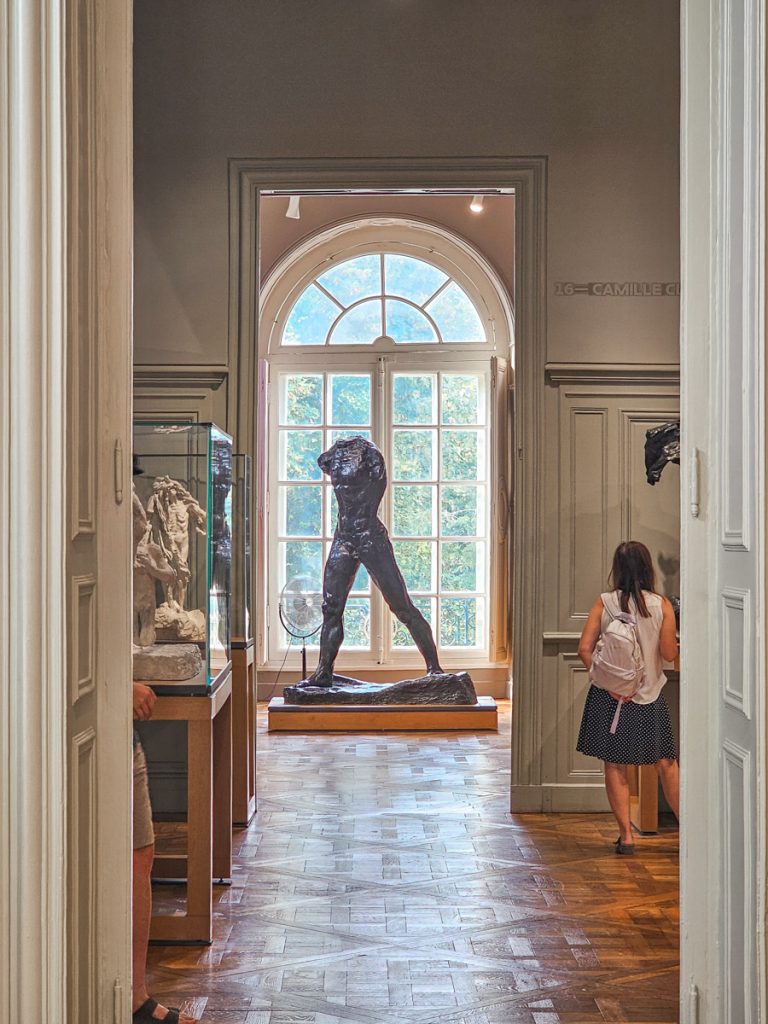
The Walking Man shows just how experimental Auguste Rodin was willing to be. It looks unfinished, but this is actually exactly how Rodin intended it.
The figure was assembled around 1899 using parts he had modeled years earlier for Saint John the Baptist. The legs and torso were originally separate studies, made at different times and in slightly different styles. Instead of smoothing those differences out, Rodin leaned into them, combining the fragments into a single figure defined by motion rather than completeness.
By removing the head and arms, Rodin stripped away anything that might distract from the act of walking itself. There’s no expression to read, no gesture to interpret — just forward movement.
At the time, this was a radical move. Academic sculpture prized the “complete” human figure, but Rodin was more interested in what could be expressed with less. Here, movement becomes the subject.
Rodin eventually abandoned the reference to Saint John and gave the sculpture its more universal title, The Walking Man.
8. The Age of Bronze
The Age of Bronze is one of Auguste Rodin’s early breakthrough works, and the sculpture that first put him at the center of a major controversy.

Credit: Daderot, Public domain, via Wikimedia Commons
Rodin modeled the figure in the mid-1870s using a young Belgian soldier, Auguste Ney, as his sitter. The statue is life-size and intentionally stripped of anything that would identify the figure as a specific person. There’s no uniform, no weapon, no setting. What’s left is a nude male body caught in a moment somewhere between awakening and exhaustion.
When the sculpture was first exhibited in Brussels in 1877, and later that year in Paris, it caused a scandal. Critics accused Rodin of cheating by casting directly from a living model (putting molding clay directly on the skin of the model), which was an explosive claim at the time.
Rodin was forced to defend himself, proving that the realism came from careful observation and study, not from a life cast. He was eventually cleared, and the controversy only drew more attention to his work.
Part of what unsettled viewers was the ambiguity. The pose doesn’t clearly signal victory or defeat, joy or suffering – it’s just an incredibly realistic, “open-ended” nude. The Age of Bronze led directly to Rodin’s commission for The Gates of Hell in 1880, setting the course for everything that followed.
9. The Three Shades
The Three Shades is the last Gates of Hell-related work on this list, and it’s also one of the most haunting.
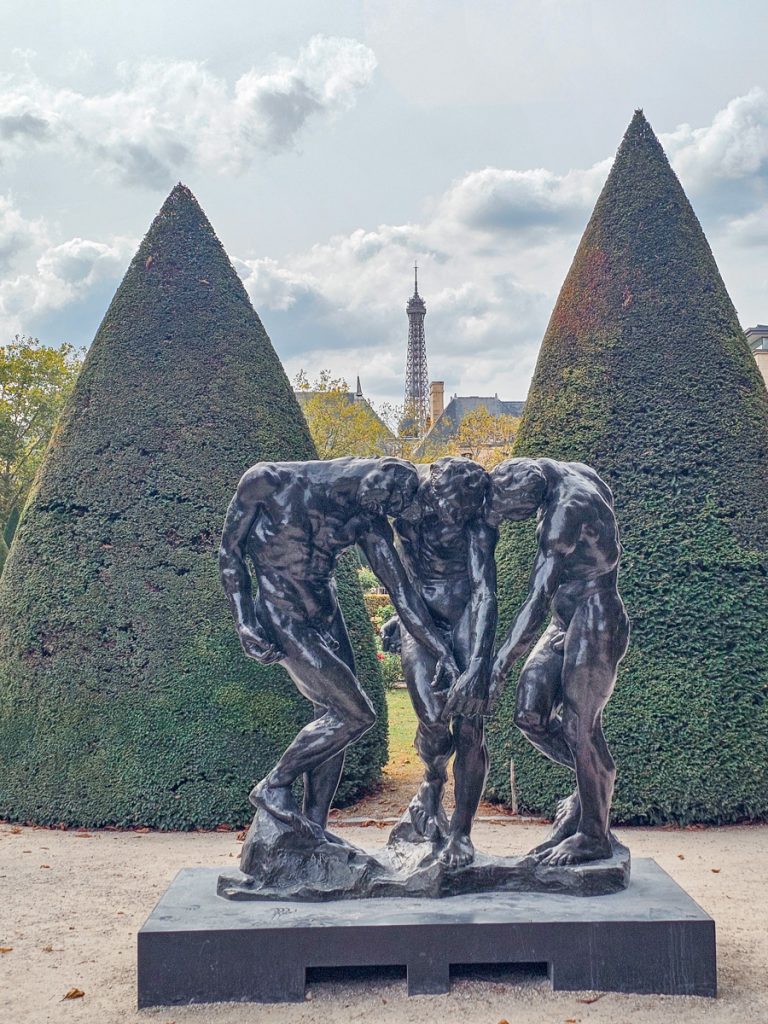
In the Divine Comedy, the “shades” are the souls of the damned, standing at the entrance to Hell beneath the warning to abandon all hope. Auguste Rodin made multiple studies of this figure before deciding to repeat one three times, rotating the same body into slightly different positions. The result feels circular and trapped, as if the figures are endlessly turning around the same point.
Rodin placed the group above The Gates of Hell, crowning the doors and looming over viewers below. Their heads hang so low that the necks and shoulders nearly form a single horizontal line, emphasizing submission and despair.
Rodin later enlarged The Three Shades into a monumental sculpture in its own right. At the Musée Rodin, it stands outdoors not far from The Gates of Hell. In either context, the effect is the same: a single emotional state, repeated and intensified, with no escape.
10. The Waltz, by Camille Claudel

The Waltz is one of my favorite works in the Musée Rodin, it’s by Camille Claudel. Claudel was Rodin’s student, then collaborator, then lover, but reducing her to that relationship misses the point.
She was an exceptionally talented sculptor in her own right, and her influence on Rodin was at least as strong as his influence on her. There is an entire room in the museum dedicated to her work.
Claudel began working on The Waltz around 1889, during the height of their relationship. In its earliest form, the sculpture showed two nude dancers locked in a close embrace, their bodies merging into a single, fluid shape. The woman’s head rests against the man’s shoulder as he turns toward her, caught in an intimate moment mid-turn.
When Claudel sought a public commission, the work ran into trouble. Critics praised its modeling and emotional intensity but deemed it inappropriate for public display.
In response, Claudel reworked the sculpture, adding a flowing skirt that wraps around the lower half of the female figure. But instead of toning it down, the drapery actually makes the movement feel stronger, sweeping outward and making it seem like the couple is still spinning.
The revised version was exhibited in 1893, where it again drew attention and controversy. Despite support from Rodin, Claudel was denied a public commission, in part because officials objected to a woman creating such a sensual work.
Seen today at the Musée Rodin, The Waltz feels both dynamic and intimate, capturing movement while still portraying the softness of a close relationship. It’s a powerful reminder that Claudel was never just a footnote to Rodin, she was an artist with her own voice, vision, and command of form.
11. The Age of Maturity, by Camille Claudel

The Age of Maturity is one of the most emotionally charged and devastating works in the Musée Rodin.
Created by Camille Claudel in the mid-1890s, the sculpture is a three-figure group that Claudel herself described as an expression of destiny. A young woman kneels and reaches forward, just releasing the hand of a man who is being pulled away by an older female figure.
Claudel designed the work to be autobiographical, as it was created while her relationship with Auguste Rodin was collapsing. Rodin had promised to leave his longtime companion, Rose Beuret, and commit fully to Claudel, a promise he never kept.
When Rodin first saw The Age of Maturity in 1899, he was reportedly furious and deeply shaken by it, recognizing himself in the figure being drawn away. Shortly after, he cut off his support for Claudel and distanced himself from her professionally.

Looking at the sculpture more broadly, it reads less as a breakup and more as a commentary on time itself: a man being pulled away from youth and toward maturity and eventual old age, whether he’s ready or not.
The figures are also sometimes interpreted mythologically, with the older woman representing Fate or Venus, and the kneeling young woman tied to the myth of Psyche and Cupid and a love that cannot last.
The French state initially commissioned the work, but the project was ultimately canceled. Claudel never delivered the official version, and the sculpture was cast privately later on.
Seen in person, The Age of Maturity is raw and deeply personal, making clear just how much Claudel was willing to turn her own life into art.
12. Père Tanguy, by Van Gogh
Portrait of Père Tanguy is the one major painting in this list, and it definitely earns its place.

Auguste Rodin was deeply connected to the Paris art world of his time. He was friends with the Impressionists and Post-Impressionists, collected their work, and even owned several paintings by Monet and Vincent Van Gogh. A handful of these hang inside the mansion, and one of the most notable is Portrait of Père Tanguy.
Julien Tanguy, affectionately known as Père Tanguy, ran a small paint supply shop in Paris. He was a lifeline for struggling artists, often accepting paintings instead of payment and quietly championing the new painters of the day. Van Gogh was a frequent customer and a close friend.
Van Gogh painted three portraits of Tanguy, and this final version, completed in 1887, marks a turning point in his work. The vivid colors and energetic brushwork show him growing more confident and expressive with paint.
Tanguy sits calmly, hands folded, almost monk-like, surrounded by a world of color and pattern.
Tanguy kept this portrait for the rest of his life. After his death, Rodin purchased it, adding it to his personal collection. Today, it hangs at the Musée Rodin, where it hangs today in an upper room.
Want to Discover More Of Paris’s Best Art?
- 15 Iconic Masterpieces of the Louvre Museum
- 15 Famous Works That Make the Musée d’Orsay Paris’s Most Beloved Museum
- 15 Most Famous Works of Art in Paris
Museums are just one part of a trip to Paris. If you’re working on your Paris travel plans, these guides can help:
- Where to Stay in Paris – A neighborhood-by-neighborhood breakdown to help you choose the right base
- Ultimate List of Things to Do in Paris – Nearly 100 sights and experiences, from must-sees to hidden gems
If you want everything in one place, my Paris travel guide page pulls together neighborhood guides, attraction and museum guides, foodie recommendations, and travel tips in one hub.
And if you’re feeling overwhelmed or short on time, I also offer Paris planning calls.
These one-on-one video sessions are great for getting feedback, asking questions, and sorting through options, whether you need a full plan or help fine-tuning what you already have.
