
20 Essential Tips for Driving in France for First Timers

One of the best parts of visiting France is the excellent public transportation system around the country. High-speed and regional trains take you pretty easily between destinations.
Metros, subways, and trams get you around cities, and buses take you between small towns. For many trips, you can rely solely on public transit options (in fact, in Paris or other big cities, you definitely don’t want to drive around the city itself).
But once you head into wine regions, small villages, coastal towns, mountain areas, or D-Day beach sites, a car becomes incredibly useful. Public transportation can take you far, but not everywhere.
Driving in France is very doable, and we’ve done it many times for extended periods of time. However, there are a few things that are good to know before you pick up that rental car.

These are all generally universal tips, although some are written specifically with the differences between the USA and France in mind.

Get Your Rental Booked
If you’re considering a road trip around France, I highly recommend you book a car ASAP. This is my #1 platform choice to search for and book rental cars. Bonus – there’s free cancellation if your plans change.
1. Get the Smallest Car You’re Comfortable Driving
When you’re booking a rental car in France, smaller is almost always better.
Streets are narrower than what many of us are used to in the U.S., especially in older city centers and small villages. Lanes can feel tight, and it’s common to pass parked cars with very little extra room on either side.
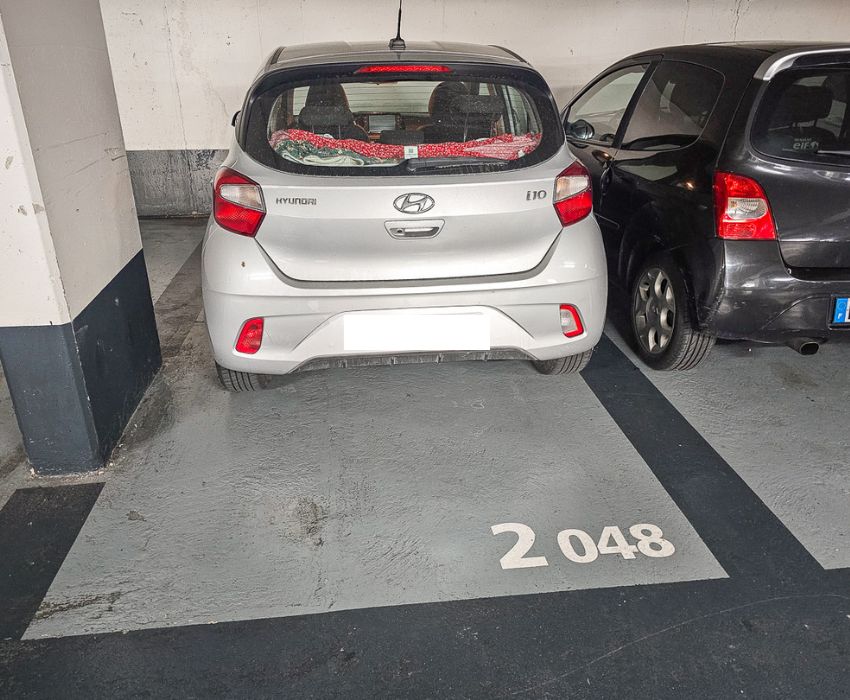
Parking follows that same pattern – you just won’t have the generous spacing common in suburban America. Garages are often underground with narrow ramps and sharp turns. Parking stalls are compact. And if you’re in an apartment rental that comes with a dedicated parking space, that parking space could be almost unbelievably tight.

If a car looks tiny compared to what you drive at home, it’s probably the right size for France. Many aspects of driving in France just feel more comfortable in a smaller vehicle.
2. Plan Ahead for Parking
Before heading to a new destination, take a minute to look up parking in that city or town. Once you pick a lot, plug it into navigation before you start driving so you know exactly where you’re going.
I usually choose a lot on the outskirts instead of trying to drive through the center, which is often more chaotic. I also don’t like to assume I can find street parking – sometimes I see it on the way to a lot and will turn into a spot, but often it’s hard to come by.
I also check the photos on Google Maps. Some “parking lots” are tiny five-car corners that are full, private, or not worth the effort. I prefer mid-size or larger lots, or a proper parking garage.
You can also search for free parking. “Gratuit” means free. Larger cities rarely have much of it, but smaller towns and villages sometimes do. The exception is Sundays and public holidays, when most street parking and many lots are free.
3. How Parking Garages and Lots Work
Most parking garages in France are underground. When you enter, a machine will issue a ticket. Take it with you; don’t leave it in the car.
When you return, look for the payment machines near the pedestrian entrance. You’ll insert your ticket, pay there, and the machine will validate it. Then, as you drive out, insert the paid ticket at the barrier to exit.

Open-air parking lots sometimes work the same way. Other times, there’s no ticket at entry. Instead, you’ll park and find a payment machine in the lot.
You’ll need to enter your license plate number and prepay with a credit card for a certain amount of time. Usually, you’ll get a small receipt to place on your dashboard, but sometimes everything is registered digitally by plate.
This is also the standard procedure for street parking.
When in doubt, look around before walking away from your car. There’s almost always a machine somewhere nearby.
4. Manual vs. Automatic
Manual transmission (stick shift) is much more common in France than automatic transmission. Thankfully, automatic cars are widely available from rental car dealers, but sometimes they do cost more.
If you need an automatic, make sure you specifically search for and reserve that kind – I usually set the search filters to automatic before I do anything else.

5. Electric Rental Cars Are Becoming More Common
When you rent a car in France now, there’s a good chance the lowest-priced option will be electric.
Rental companies are adding more and more electric vehicles to their fleets, and France’s charging network has expanded quickly. Charging stations are common in cities and increasingly easy to find across the country.
That said, I still haven’t opted for a fully electric vehicle on a longer road trip, although a hybrid is fine by me. I don’t have much experience with fully electric cars, and when I’m covering distance, I don’t want to plan my day around charging times.
Very recently, I was booking a rental and was genuinely surprised that most of the available cars were electric.
If you’re comfortable driving electric, this is great news. If you’d prefer gas or hybrid, book early and double-check what you’re reserving.
6. Rental Requirements
Car rental companies require you to have a valid driver’s license, a credit card, and a passport to rent a car – nothing too crazy there.
If you are coming from a non-EU country, it is a very good idea to have an International Driver’s License as well. Usually, you don’t need it to rent a car, though occasionally I’ve been asked if I have one at pickup (but not asked to produce it, just to verify I have it).
The idea is that it can aid if you are in an accident or stopped by the police. If you’re in the US, it’s cheap and super easy to get an IDL from AAA or online.
If your driver’s license is not in the Latin alphabet (the alphabet used in French, English, and much of South America and Western Europe), you will definitely need an International Driver’s License.
Quick language tip: In French, location de voiture means car rental center.

7. Where to Book Your Rental Car
I always use car rental aggregates to find and book my rental cars. I like that they show you a ton of different options, are easy to filter by amenities (eg automatic vs manual) and find lowest prices, and almost always offer free cancellation until 48 hours before.
Stephanie’s Tip
👉My #1 option is always this car rental aggregate – I would say at least 80% of the time I find the best availability and lowest prices here.
But I also usually check this aggregate too, as occasionally there are better options.
I highly recommend making car reservations as soon as possible to get best prices and availability (plus, with the usual free cancellation options, there’s essentially no risk if you need to change your plans)
8. There Is No Right Turn on Red
In the US, turning right on red is normal. In France, you stop and wait for green unless there is a specific arrow allowing you to turn. This will usually take the form of a flashing yellow arrow, where you can make the turn if all is clear.
But the default is, even if the road looks empty, you wait.
And speaking of turning right, France drives on the right-hand side of the road. For many visitors, this will feel familiar. If you’re used to driving on the left, you’ll need to stay especially alert during your first day or two.
9. Yield to Pedestrians, Always

In France, pedestrians have the right of way at crosswalks. If someone is waiting to cross, drivers are expected to stop. And people will step out confidently because they assume you will.
As an American, in theory, this doesn’t sound too different from our laws. In practice, though, it’s been surprising how often as a pedestrian I’ve wanted to wait for cars instead of expecting cars to wait for me.
In France, that’s not how it works. As a driver, if someone is about to enter a crosswalk, you stop.
10. Roundabouts Are Everywhere
France has the largest number of roundabouts in the world, by a long shot. You’ll come across them everywhere!
Drivers in the roundabout have the right of way. As you approach the roundabout, you’ll usually see a sign that says “cédez le passage,” which means yield. If there are no cars coming, you can enter without stopping.

In multi-lane roundabouts, stay in the outer lane if you’re taking the first or second exit. Use the inner lane for later exits, then signal and move outward before exiting. (Or just stay to the outer lane the entire time if you want).
You should use your signal before exiting, particularly on bigger, busier roundabouts.
11. Priority to the Right
In France, the default rule at intersections is priorité à droite, which means you yield to the vehicle coming from your right.
This applies at any intersection that isn’t controlled by a traffic light, stop sign, yield sign, or roundabout. And there are more of these than you might expect.
In fact, Paris famously has almost no stop signs. There are traffic lights and roundabouts, but also plenty of small intersections where there’s no signal at all.
On bigger avenues, the right of way is usually obvious, as smaller roads generally yield to larger ones. But when it’s not clearly marked, assume the person on your right has priority.
12. Toll Roads Are Normal

Many highways in France are toll roads. The system is straightforward. When you enter the highway, you’ll usually take a ticket. When you exit, you pay based on the distance traveled.
Booths are usually fully automated and credit cards are widely accepted, but many booths also take coins.
Lanes coming into toll booths marked with a “t” are reserved for drivers with an electronic toll pass, so stick to the lanes that show coins or a credit card.
Occasionally, you’ll encounter shorter toll sections where you pay a flat fee at entry instead of taking a ticket.
Toll roads are common enough that the costs can start to add up. To give you a real-world sense of it, a one-week trip in the Loire Valley ended up costing me about €80 in tolls. A week driving in the French Alps was closer to €25. A two-week trip in Normandy came out to roughly €100.
It varies by region and how much highway driving you’re doing, but it’s something to factor into your overall transportation budget.
13. Beware Speed Cameras
France relies heavily on automated speed cameras, and you’ll rarely be pulled over for speeding. Instead, a ticket can show up later through your rental car agency, which will pass the charge on to you.
The cameras aren’t always obvious, so pay close attention to posted speed limits, especially when entering towns where the limit can drop quickly.
14. Speed Limits

Speed limits in France are clearly posted in circle signs with a red border, but the limits can sometimes change frequently. These are the typical speed limits in France:
- 130 km/h on highways in dry conditions
- 110 km/h on highways when it’s raining
- 80–90 km/h on secondary roads
- 50 km/h in towns
- 30 km/h on inner-city streets
15. Signs for Entering and Leaving a Town
When you enter a town in France, you’ll see a road sign with the town’s name on it. That sign usually marks the start of the 50 km/h speed limit, unless otherwise posted.
When you leave town, you’ll see the same sign again with a red slash through it. That indicates you’re exiting the town limits and the higher speed limit now applies.

It’s a small detail, but it’s helpful to recognize what those signs mean as you’re driving.
16. Watch for Bikes, Scooters, and Motorcycles
Cyclists are everywhere in France, especially in cities. They use dedicated bike lanes, but they also ride in bus lanes and sometimes along regular traffic.
Before turning, always check your mirrors carefully. A bike can appear quickly on your right.
Scooters and motorcycles are also common, and they’re allowed to filter between lanes of cars in slow or stopped traffic. If you’re not used to that at home, it can feel surprising the first time you see it. Just stay aware and give them space.
17. Gas Stations

Gas stations in France generally work much like they do in the US. You tap your card at the pump, select your fuel type, and fill up. Most stations are self-service, and many are open 24/7 with automated payment machines. But, there are also ones that close in the evening completely, especially in rural areas.
Occasionally, you’ll find a pump without a payment terminal. In that case, just start pumping, then go inside to pay when you’re done.
A few important fuel terms:
- “Gazole” is diesel, and usually has a black or yellow handle
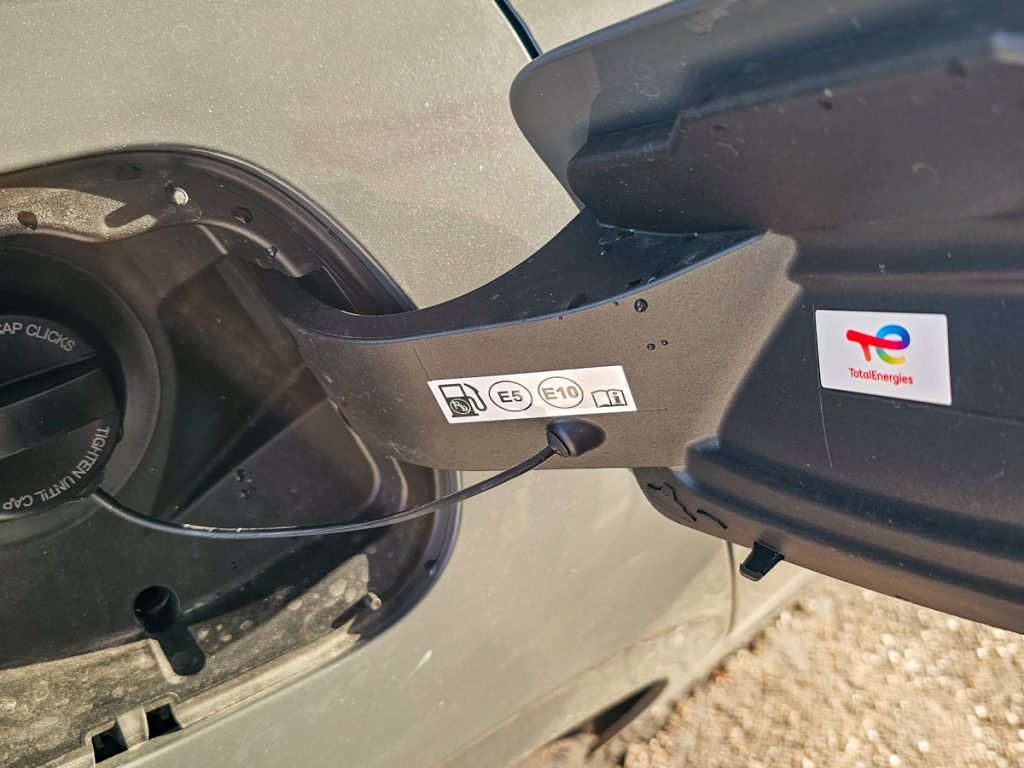
- “Sans plomb” is unleaded petrol, and usually has a green handle. It can be labeled as E5 or E10, or SP95 or SP98.
Most rental cars use petrol (sans plomb), but confirm when you pick up the car. There’s often a small sticker inside the fuel door that tells you exactly what to use.
18. Download Maps Ahead of Time
Downloading maps for offline use is incredibly handy, and I do it before every trip. This way, I always have access to maps and navigation services even if I’m in a dead zone or my data cuts out.
It’s super easy and only takes a few minutes, but has saved me many times – here’s how to do it.
19. How Old Do You Need to Be?
The legal driving age in France is 18. That said, most rental car companies require drivers to be at least 21. If you’re under 26, expect a young driver surcharge.
Policies vary by company, so it’s worth checking the terms before you book.
20. Crossing Borders
One of my favorite things about driving in Europe is how easy it is to cross into another country. You can have breakfast in France and be in Spain or Switzerland by lunch.

That said, if you’re planning to take a rental car across a border, read the fine print carefully.
Most rental companies allow border crossings within certain countries, but not all of them. Some restrict specific countries. Some charge extra. Occasionally, certain categories of cars aren’t allowed to leave the country at all.
And the fees can vary a lot. One time we paid a €70 single cross-border fee. Another time, it was around €20 per day, which added up quickly for our multi-week trip.
It’s absolutely doable. Just make sure you know the policy before you finalize your reservation so there are no surprises at the counter.
(And if you’re driving into Switzerland, you might need to buy a Swiss Motorway Vignette sticker at the border).
Final Thoughts
Driving in France isn’t hard, but there are a few things that are helpful to know ahead of time.
If you’re planning to explore villages, wine regions, mountain towns, or countryside areas, having a car opens up places you simply can’t reach by train and gives you a lot more flexibility.
If your itinerary works easily with trains, buses, or other public transit, I’d choose that first. But if it doesn’t, there’s nothing to be intimidated by. Driving in France can be a really enjoyable way to see the country.
