
The Paris Metro Guide Visitors Wish They Had Sooner

One of the best parts of visiting Paris is how easy it is to get around. Part of this comes from how walkable it is, and wandering on foot is the best way to really take Paris in, but it’s also a big city, and the sights are often spread out.
That’s where the Metro comes in. I actually love using the Metro when I’m in Paris. It’s fast and efficient, and the entrances themselves are pretty iconic.

The Guimard-designed Art Nouveau entrances, with their green wrought iron curves and “Métropolitain” signs, have become a defining part of the city’s streetscape. They’re instantly recognizable and feel just as Parisian as a café terrace or corner bakery.
That said, many first-time visitors are confused or overwhelmed by the Metro system. And while it’s not difficult, it is good to know exactly how it works and what you need to do.
Consider this your crash course in using the Paris Metro – you’ll be riding like a pro in no time.
1. Overview of the Paris Metro

What the Paris Metro Actually Is
The Metro is Paris’s primary subway system, with 16 numbered lines and over 300 stations that crisscross the city. Each line has a unique number and color, and trains typically come every 2 to 5 minutes from around 6am to 12:45am (1:45am on weekends).
The RER: Regional Trains That Run Through the City
The RER (Réseau Express Régional) is a separate commuter train network with 5 lines (A through E) that connects Paris to the suburbs. Several RER lines run through the city center and share stations with the Metro.
The RER feels more like a regional train than a subway, as cars are double-decker, much longer, and have more seating.
Within central Paris and nearby suburbs, you can use a standard Metro ticket to ride the RER as well as the Metro. But for trips to the airport or farther into the Île-de-France region, you’ll need a special ticket or pass.
Other Public Transit Options in Paris
The city also runs an extensive bus network, which covers most of Paris. Buses are slower than the Metro but offer nice above-ground views. I usually prefer the Metro for speed and simplicity, but buses do come in handy sometimes, especially if your route doesn’t happen to have a direct Metro route.
There are also 13 tram lines, but they operate mostly on the city’s outskirts and in the suburbs. The vast majority of Paris visitors won’t use the trams at all.
This guide is going to focus on using the Metro and RER, since those are what most visitors rely on to get around.
2. Buying Metro Tickets or Passes
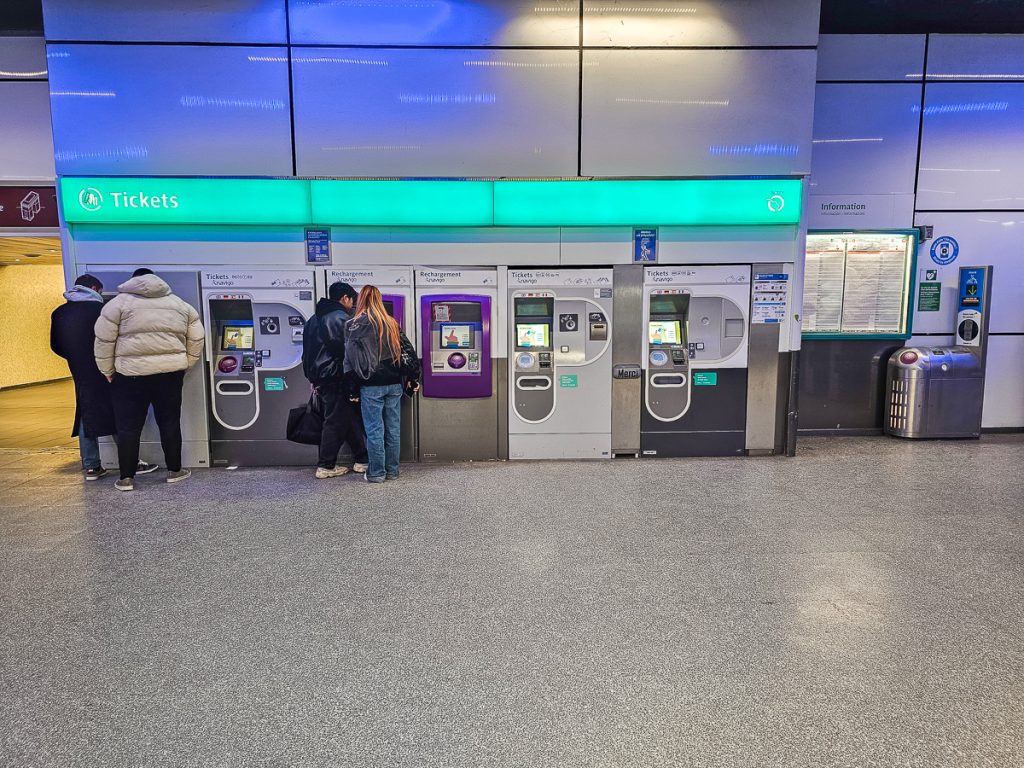
There are a few different ticket and pass options for riding the Metro, and the best one depends on how long you’re staying and how often you plan to ride. Each has its pros and cons, so here’s what to know.
Important: You must use a Metro ticket or pass to ride. You cannot tap in directly with a contactless credit card or mobile wallet like in some other cities.
A. Navigo Easy Pass

The Navigo Easy is a reusable card you load with tickets or passes (after paying an initial €2 fee for the card itself). It has replaced the old paper tickets that are now phased out in Paris. You can load either single-ride tickets or day passes onto it.
You can buy the card and load (or reload) tickets and day passes onto it at kiosks in most Metro stations and RATP ticket counters.
You can also load many of the tickets and passes directly on your phone using the Bonjour RATP or Île-de-France Mobilités apps.
What You Can Load onto a Navigo Easy
👉 Standard Single Tickets
- Cost: €2.55 per ride
- Valid for transfers within the Metro, RER, buses, and trams
- Valid for 70 minutes from your first tap-in
- Great for casual or light Metro use (1-4 rides around Paris per day)
👉Airport Tickets (CDG or Orly)
- Cost: €14 each way
- There is no separate airport train, you’ll simply ride RER B from a central Paris station (like Châtelet or Saint-Michel)
- This is the same RER B line that runs through the city, you just stay on until it reaches the airport
- You can transfer from a Metro line to reach the RER with this ticket
- Must be loaded separately on a physical card (see below)
👉One-Day Navigo Travel Card (Day Pass)
- Cost: €12.50
- Unlimited travel on public transit within Zones 1–5, which includes central Paris and the surrounding suburbs
- Does not include airports
- Good if you’re taking 5 or more rides in one day (rare for most visitors)
👉Paris Visite (Multi-Day Pass)
- This pass has a bit more nuance to it; we’ll discuss it in depth below
Important Limitations of the Navigo Easy
- One ticket type at a time: You can only load one kind of ticket or pass per card at a time. For example, you can’t have both single tickets and an airport ticket on the same card at the same time. If you need two types of tickets, buy a second card.
- That said, an airport ticket still works as a Metro ticket for a single ride. You can start your trip from any Metro station with this ticket, transfer between lines, etc. But once you leave a station to go above ground, the ticket will be used up. So make sure you only exit at the airport.
- One card per person: You can’t share a card between riders. Each person in your group needs their own. If you’re using your phone, each person needs their own device.
Is the Navigo Easy a Good Deal?
Yes, especially for short visits of 2 to 4 days. For most people visiting Paris, the best setup is:
- Buy a Navigo Easy card, either via physical card or on an app
- Add an airport ticket (if arriving from the airport)
- Load a few single tickets the next time you go to use the Metro
- Buy another airport ticket at the end if needed
The €12.50 day pass is usually not needed for most people’s touring habits, but it’s worth looking at your plans and seeing if this would fit your needs.
B. Navigo Découverte Weekly Pass

The Navigo Découverte is a transit pass that gives you unlimited rides on the Metro, RER, buses, and trams in all zones, including the airports. You can buy either a weekly or a monthly version, and both offer excellent value if you’re staying for longer than a few days.
The biggest catch? It runs Monday–Sunday, not for any 7-day window. If your trip overlaps two calendar weeks, you may not get full value.
Costs
- Weekly fare (all zones): €32.40
- One-time card setup: €5 for the physical Navigo Découverte card (reusable)
- Monthly fare (all zones): €90.80 (for longer stays)
When the Navigo Découverte Makes Sense
This pass is ideal if your trip is more than 4 days, falls mostly within a Monday–Sunday calendar week, and you’re planning to use the RER for the airport. Here are a few examples:
- Monday–Saturday: Easy yes, you’ll get your money’s worth.
- Thursday–Monday: Likely worth it, especially if you’re flying in or out.
- Friday–Monday: Break-even if you’re using transit 3+ times per day, plus the airport (but you’ll still have to buy separate tickets for Monday)
- Sunday–Tuesday: Unlikely to be worth it
- Monday–Wednesday with no airport ride: Also unlikely to be worth it
Basic math: The pass is €32.40. That’s about 13 local rides or a round trip to CDG plus 3 local rides. If your plans come close to that, you’re good.
Personally, I really like using the Découverte. Not having to track how many rides you’ve used, or whether it’s worth one more train, is a huge mental load off.
That said, it does take a little extra effort to set up, so it really comes down to your travel style. If you’re someone who likes simplicity and plans to move around a lot, it’s absolutely worth considering.
Where to Get It and What You’ll Need
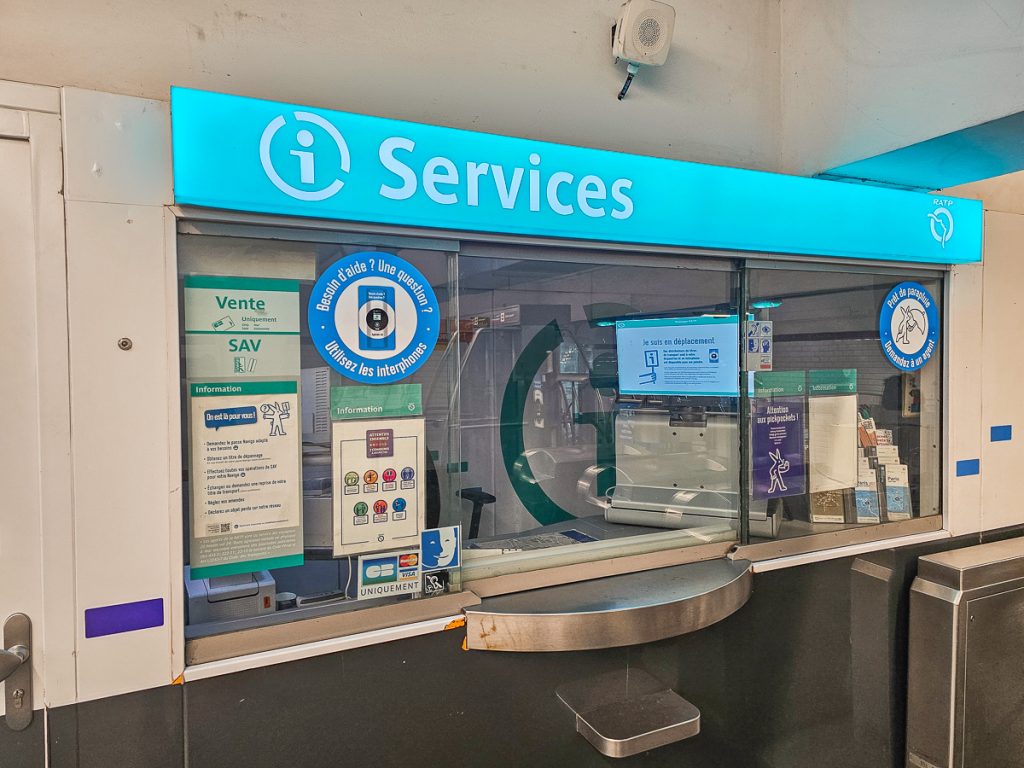
You must buy the Navigo Découverte in person at a staffed ticket counter, not from a machine. Look for:
- Major train stations (Gare du Nord, Montparnasse, etc.)
- Airport RATP ticket desks
- Metro stations with manned booths (most semi-large stations)
You’ll need a passport or ID, and a small printed color headshot, 3 cm tall × 2.5 cm wide. The pics don’t need to be from a fancy spot. We literally printed them at home on standard paper and brought them with us.
C. Paris Visite Pass
The Paris Visite Pass gives you unlimited rides for 1, 2, 3, or 5 consecutive days. It includes Metro, RER, buses, trams, and the airport routes to both CDG and Orly.
How It’s Different From the Découverte
The biggest difference between the Paris Visite and the Navigo Découverte is timing.
- Navigo Découverte: Valid Monday–Sunday, no matter when you buy it
- Paris Visite: You choose the number of consecutive days, and it starts counting from first use
So if you’re arriving on a Friday and staying through Tuesday, the 5-day Paris Visite pass would cover you the entire trip, unlike the Navigo Découverte, which would expire Sunday at midnight.
You also load the Paris Visite onto a Navigo Easy card, not a Découverte. That means no photo and no waiting in line at a staffed counter – you can buy it right at any Metro kiosk.
Pricing
| Days | Adult Price | Child Price (Ages 4–9) |
|---|---|---|
| 1 | €30.60 | €15.30 |
| 2 | €45.40 | €22.70 |
| 3 | €63.80 | €31.90 |
| 5 | €78 | €39 |
Is It Worth It?
Most of the time, no. It’s flexible but expensive, and most visitors won’t take enough rides to make it worth it.
To help illustrate, to break even, you’d need to take:
- 1-day pass (€30.60): Airport round trip + 2 Metro legs or one-way + 7
- 2-day pass (€45.40): Round trip to CDG + 7 rides or 18 Metro trips
- 3-day pass (€63.80): Round Trip to CDG + 15 rides or 25 Metro trips
- 5-day pass (€78): Round trip to CDG + 20 rides or 30 Metro trips
Unless you’re riding constantly or using it for both airport transfers, most people won’t get enough value out of the 1-, 2-, or 3-day Paris Visite pass. The 5-day version is by far the better value, but even then, it depends on your plans.
When It Might Make Sense
- You have a 5-day trip, and your trip is Friday-Tuesday or Saturday-Wednesday
- You’re doing a round trip to CDG
- You don’t want the hassle of printing a photo or standing in line
- You’re okay paying a bit more for easy setup and flexible timing
Otherwise, skip it and go with either single tickets or a Navigo Découverte if your dates line up.
D. Using Your Phone to Buy Tickets
You can buy and manage Paris transit tickets using the Île‑de‑France Mobilités or Bonjour RATP apps on phones with NFC support. These apps lets you:
- Buy and store certain tickets and passes
- Reload a physical Navigo Easy or Découverte card using your phone’s NFC
How Phone Tickets Work
You can use the Île‑de‑France Mobilités app on an NFC-enabled phone to buy and manage tickets for Metro, RER, tram, and bus rides.
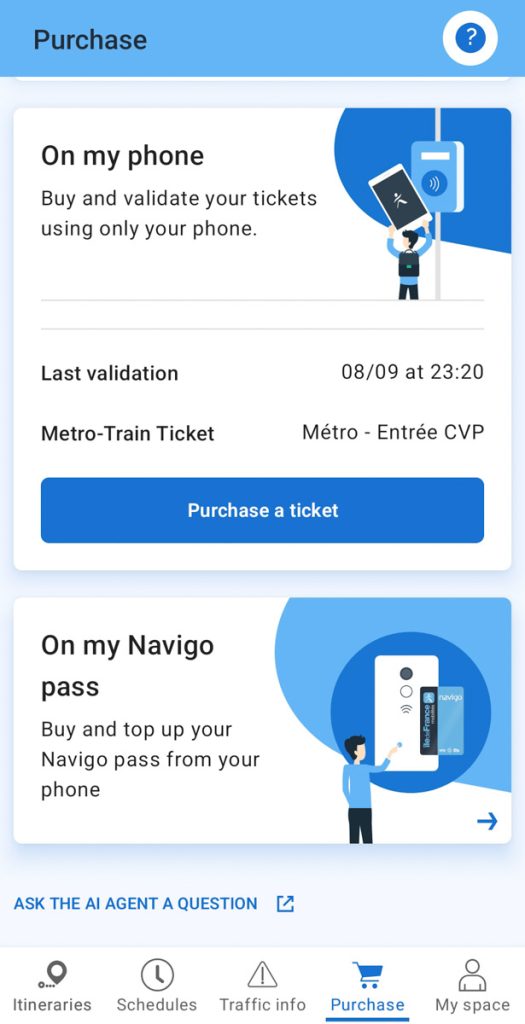
There are two main ways to use tickets bought on your phone:
- Store them directly on your phone
If your device supports it, you can load Navigo Easy tickets or passes into the app and tap your phone at the gate, no physical card needed. - Top up a physical card
You can use your phone to reload a physical Navigo Easy or Navigo Découverte card by placing the card against your phone’s NFC sensor. This lets you avoid kiosks and load tickets anytime.
Important Navigo Découverte Clarification
- You cannot create a new Navigo Découverte card entirely in the app if you’re a visitor without a French mobile number. The system requires a French number to set up a new Découverte account.
- In practice, this means most foreign visitors still need to get the physical Découverte card in person at a staffed ticket counter.
- Once you do have the physical Découverte card, you can reload it using your phone app, you don’t have to go back to a ticket kiosk every time.
- Even when you reload it with your phone, you’ll still tap the physical Navigo Découverte card at the gate (not your phone) to enter the system.
E. Child Fares
Paris offers discounted fares for younger kids, but it depends on the ticket type:
- Children under 4 ride free on all public transit
- Ages 4–9 get 50% off on:
- Single ride tickets (€1.30 instead of €2.55)
- Paris Visite passes (1, 2, 3, or 5 day)
- Airport tickets (€7 instead of €14)
There are no child discounts for the €12.50 Navigo Easy day passes or the Navigo Découverte weekly/monthly passes. Each child needs their own card or pass, just like adults.
F. Comparison Table of Passes

3. Planning Your Route
BonjourRATP and IDF Mobilités are the two official apps for navigating and buying tickets. And while these are good for getting live updates on closures or delays, I don’t find them as user-friendly as Google Maps and Citymapper.
Google Maps: Best for Metro
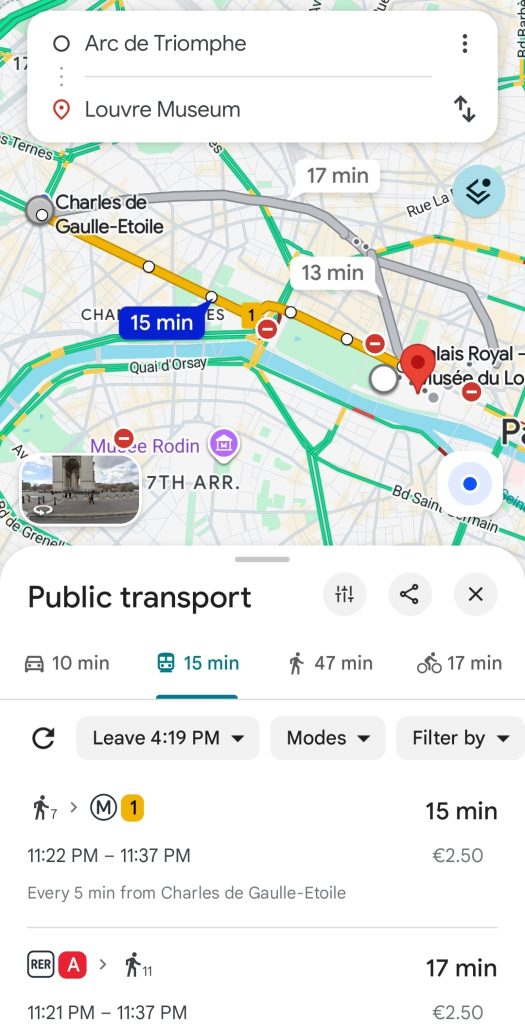

I usually prefer Google Maps for the Metro. Part of that is just familiarity, but it has one feature that makes it invaluable: you can download an entire region for offline use before your trip.
That means even if you have zero cell service or are deep underground with no signal, you can still pull up directions and navigate through your route.
Citymapper: Best for Buses

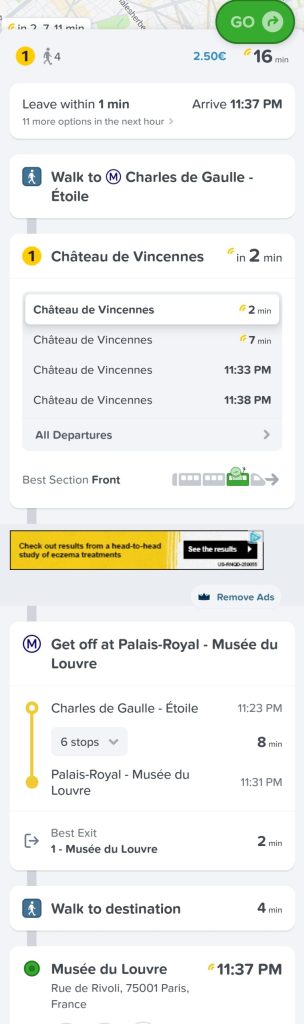
While Citymapper is another great alternate option for navigating the Metro, it’s definitely the best option if you’re using the bus system. It’s more accurate than Google when it comes to bus arrival times and live updates. Google Maps will show you the bus lines and routes, but the timing is almost always way off.
And if you like to see the bigger picture, there are full Metro maps posted in every station, so you can visualize how the lines connect around the city. Or, you can look at a map online and/or save it to your phone.
4. How to Use a Ticket or Pass at the Gate
Once you’ve got your Navigo Easy, Découverte, or Paris Visite pass loaded and ready, using it to enter the Metro is simple, but we’ll talk it through so you know exactly what to do.
Where to Tap or Scan

At the gate, hold your card or phone flat against the purple circle on top of the turnstile. This is the RFID reader. The machine should beep or display a green arrow, and then the turnstile will unlock. Push through right away – the gate doesn’t stay open long.
Sometimes there’s no beep or visual signal, but don’t worry, if your card is valid, just tap and walk forward. It works 99% of the time.
Ignore the little slot at the front of the gate. That was for the old paper tickets, which are no longer in circulation. All the action happens on the top scan panel now.

Common Turnstile Issues (And What to Do)
If the turnstile doesn’t open:
- Tap your card again, it might have been a misread
- Try a different gate, sometimes one will just be out of order for no reason
- If it still doesn’t work, your card may be:
- Out of rides (if using a single-ticket load)
- Expired (in the case of Paris Visite or Découverte)
- Demagnetized (rare, but happens. Go to a staffed ticket window for help)
🚫 Never hop the turnstile. Fare inspectors do patrol, and fines are immediate.
Fare Checks Are Not Uncommon
On my last two-week Paris stay, I was stopped twice for ticket inspection. Inspectors will scan your card to make sure it’s valid and current, so make sure you don’t toss your card on your last use before you’re out of the station. No excuses if you don’t have a valid ticket on you, and fines are issued on the spot.
5. Finding the Right Platform
Once you’re through the gates, the next step is getting to the right platform, and thankfully, the Paris Metro has excellent signage to help you along the way. No need to stress, just follow the signs and keep walking. There are signs at every junction.
How Metro Lines Are Labeled
Each Metro line is identified by a number and color, but signs in the stations usually just show the number in a colored circle.
Paris doesn’t use compass directions like “northbound” or “eastbound.” Instead, each direction is labeled by its terminus station, or the final stop in that direction. For example:
- Line 1 runs between La Défense and Château de Vincennes
- If your app says M1: La Défense, you’ll follow signs for M1, then for M1 – La Défense as you get closer to the platform
This same format applies to all Metro and RER lines – just match the terminus listed in your app with the signs in the station.

Final Sign Before the Platform
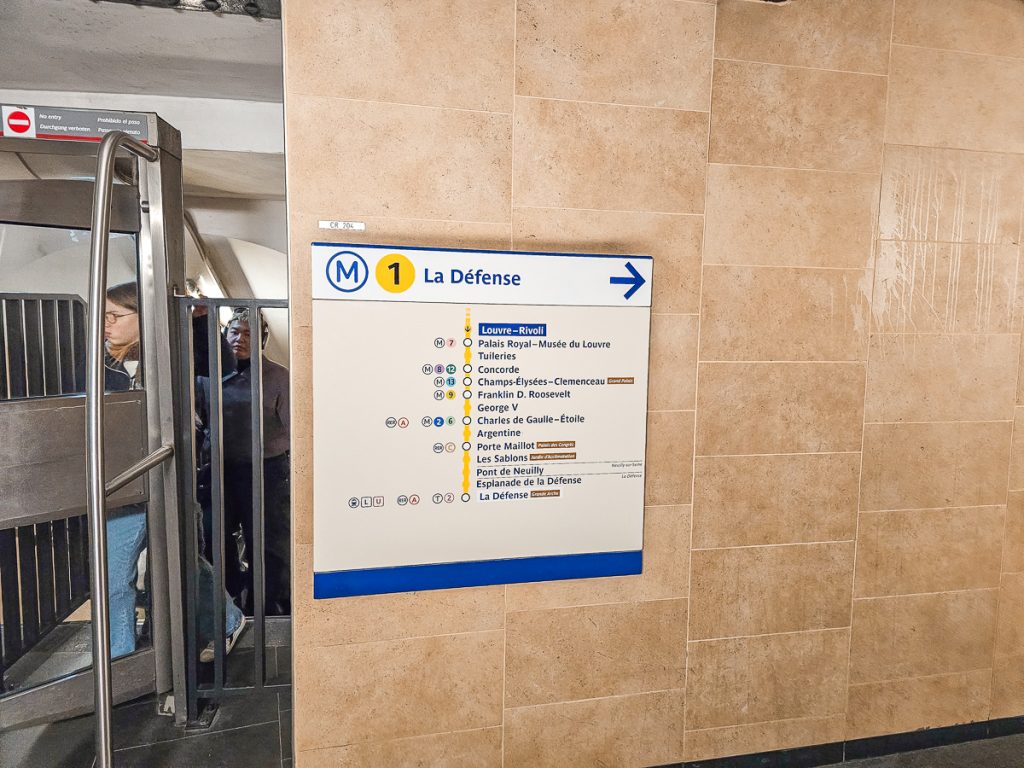
Just before you reach the actual platform, you’ll pass a large sign showing:
- The line number
- The direction (terminus)
- Every stop that train will make
This is your last chance to confirm that you’re going the right way. If your destination isn’t listed, you’re probably headed in the wrong direction, and just backtrack and follow the signs for the other terminus.
6. On the Train

Once you’re on the platform, you’ll see digital signs showing when the next two trains will arrive. One of the best things about the Paris Metro is how frequently it runs.
- During the day, you can expect a train every 2–5 minutes
- Early morning, late at night, or on less-used lines, it’s more like 5–10 minutes
- RER trains tend to run a little less often than the Metro
Boarding and Doors
Most Metro trains open their doors automatically, but some older cars still require you to:
- Press a small button
- Or lift a handle on the door
If the door doesn’t open right away when the train stops, look for one of these and give it a press or lift.
During Your Ride

Above every door, you’ll find a line map showing all the stops, so you can track your progress. Trains also announce each station name over the speaker when you arrive, so it’s easy to stay oriented.
When your stop is coming up:
- Get ready early: Most people stand up or start moving toward the door about 10 seconds before arrival
- Exit promptly: Doors don’t stay open long
Metro Etiquette
Paris Metro culture is pretty low-key:
- Keep your voice down, trains are generally quiet
- Don’t eat on board
- If you’re able-bodied, offer your seat to elderly passengers, pregnant women, or young kids
- Some seats fold down. During busy times, flip them up so more people can fit
Watch for Pickpockets
Pickpocketing is something to be aware of, but not overly stressed about. A few tips:
- Keep an eye on your phone, bag, and pockets, especially in crowded trains or while boarding/exiting
- Be cautious near the doors, as thieves sometimes grab phones and jump off right as doors close
- Avoid leaving valuables in easy-to-access outer pockets
A little awareness goes a long way. I’ve taken hundreds of Metro rides in Paris with no issues, just stay alert and be smart and you’ll likely be fine.
7. Transfers and Exits

It’s common to transfer between Metro lines to reach your destination, and it’s super simple to do so.
Once you get off your first train, just follow the signs for your next line. You’re still inside the Metro system, so there’s no need to tap your card again or do anything special (unless you’re transferring between Metro and RER). Just walk to the next platform and hop on.
Some transfer stations, like Châtelet, Montparnasse, or Gare du Nord, are huge and can involve a decent amount of walking between platforms – just something to be aware of when switching lines.
When you’ve arrived at your final stop, look for signs marked “Sortie,” the French word for exit.
- Most stations have multiple exits, usually numbered or tied to nearby landmarks
- Your Maps app will usually tell you the best exit number for your destination
- But don’t stress too much, as most exits come out within a block or two of each other, and you can always reorient yourself at street level

8. Important Considerations Going To/From the Airport
Aside from the basics we’ve already covered (RER B gets you to both airports, and you’ll need either a special airport ticket, Paris Visite, or Navigo Découverte pass) there are a few other airport considerations.
Luggage
You can absolutely take bags on the Metro or RER, and plenty of people do. But depending on your luggage size, getting through the gates can be a little awkward.
- Carry-on size bags are usually fine at regular turnstiles
- Larger suitcases can be a tight fit and you might have to lift your bag over the barrier as you go through
- Most major stations (like RER hubs and train stations) have wide gates for luggage and strollers. Smaller Metro stops usually don’t, though.
It’s something to keep in mind when deciding whether to take public transport or a taxi, especially if you’ve got more than one bag or large bags.
Time & Transfers
- To CDG: Plan on 45–60 minutes from central Paris
- To Orly: Usually 30–40 minutes, including a transfer to the Orlyval at Antony station
- Trains run frequently, but during rush hour or weekends, give yourself extra buffer time
9. RER Considerations

We’ve touched on the RER a few times already, but there’s one more important difference that’s worth calling out: not every RER train on the same line goes to the same final stop.
At the ends of each RER line, the tracks often split, and some trains terminate earlier than others. For example, one RER B train might go all the way to CDG Airport, while the next one ends several stops short.
To make sure you’re on the right train:
- Check the digital displays on the platform before boarding
- Each screen shows the train’s terminus and a list of all stops it will make
- Confirm your destination is listed. If it’s not, wait for the next train
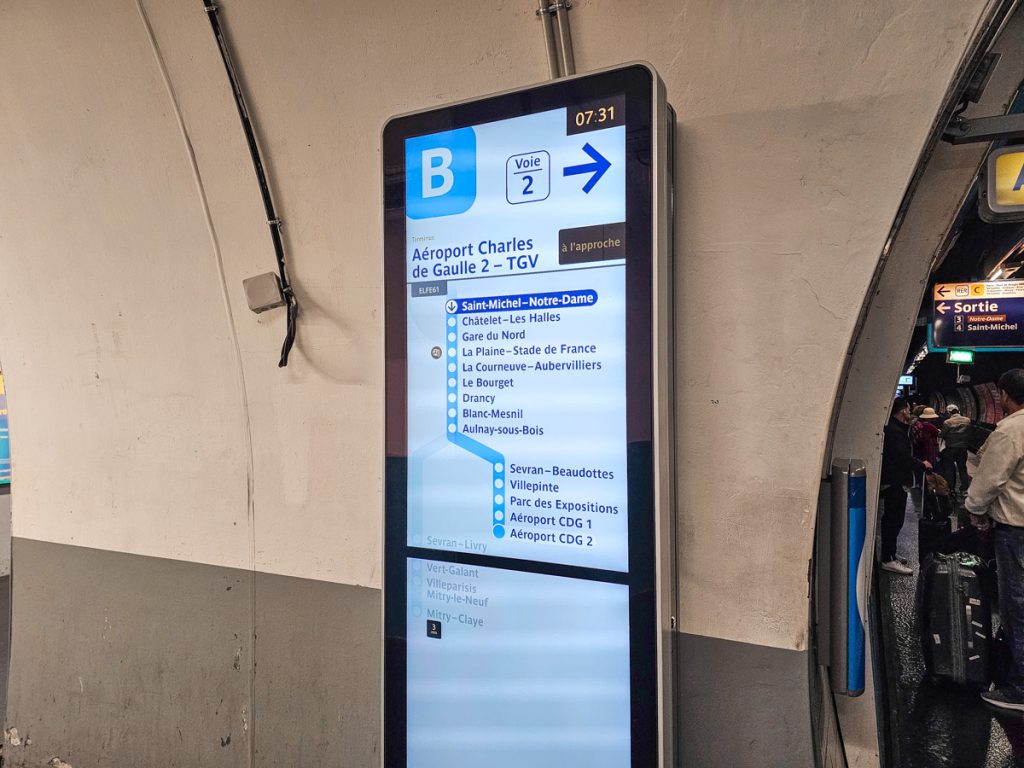
This is especially important when heading to the airport or other outer suburbs. Don’t just board the first train labeled “RER B,” always double-check the display.
10. Accessibility
Paris’s Metro system is not known for being accessible. You’ll encounter a lot of stairs, and some stations require a fair amount of walking to reach the platform or to transfer between lines.
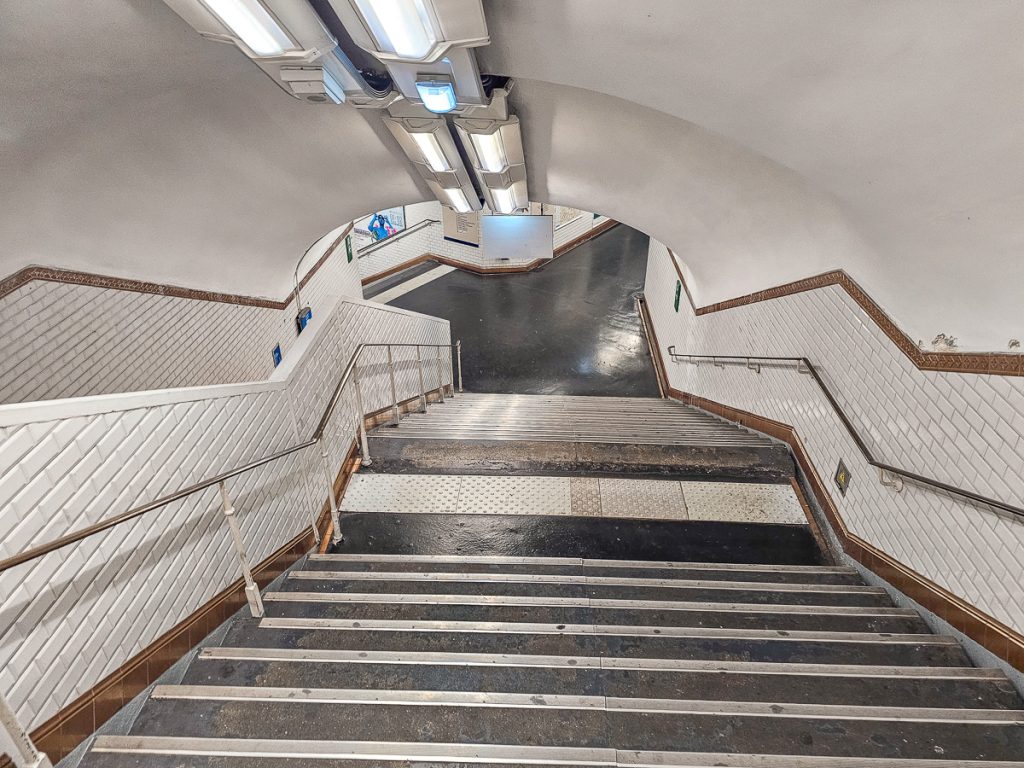
While some stations do have escalators or elevators, they don’t replace every staircase. If stairs are a concern, the Metro may not be the best choice.
Instead, you’ll likely have a smoother experience using buses, which are street-level and more accessible, or taxis and Uber (yes, Uber and Bolt are available in Paris).
11. Using the Paris Bus System
This guide is all about the Metro, but if you’re thinking about using buses too, here’s what to know:
- Why take the bus? It’s slower than the Metro but gives you scenic street-level views and fewer stairs. Great if you’re tired or want to avoid long station walks.
- Use Citymapper, not Google Maps. It’s much more accurate for bus arrivals and routing in Paris.
- Board through the front. Always validate your ticket or pass at the scanner by the driver.
- Valid tickets: Same as Metro – Navigo cards and single tickets both work on buses. You can also buy a €2.05 ticket that is valid ONLY on buses and trams in Paris.
12. Fun Metro Stations

Most Paris Metro stations are purely functional, but a few are surprisingly fun, historic, or straight-up beautiful. For example, at Louvre–Rivoli, you’ll find actual statues from the museum on the platform and Concorde is covered in tiles spelling out the Declaration of the Rights of Man.
These are just a couple of highlights. Check out the dedicated post if you want to see more of the most beautiful, interesting, or unique Metro stations in Paris.
The Wrap Up
It’s totally understandable if the Metro seems confusing at first. But once you know a few tricks, it’s genuinely easy to use, and way more efficient than walking all the way across the city or relying on rideshares.
It’s one of the most user-friendly big-city transit systems out there, and once you’ve done it once or twice, it really does become second nature. I, personally, love using the Metro; it makes getting around Paris so much easier!
