
12 Adorable Villages in France Straight Out of a Storybook

If you’ve spent any time traveling through France, you know the country is packed with cute villages. But every once in a while, you find one that feels next-level pretty, the kind of place where you stop every few steps because how is every corner this adorable?
This list pulls together 12 of my absolute favorites from all over France. Different regions, different vibes, but all of them genuinely beautiful and worth planning a detour for.
1. Eguisheim

Eguisheim, a village just outside of Colmar in the Alsace region, really does feel like stepping into a fairytale. Colorful, half-timbered houses curve along quiet cobblestone lanes and flowers spill out of window boxes.
It was named the “Preferred Village of the French” in 2013, which feels pretty fitting once you see it in person.

The most picturesque spot in Eguisheim is the Rue de Remparts, a circular street that follows the old city walls and wraps around the entire town. Walking this street feels like stepping into a postcard, and every few steps offers another photo-worthy view of the pastel, half-timbered houses.
In the center of the village is Place Saint Léon, a small square with a fountain and a chapel dedicated to Pope Leo IX, who was born here in 1002. The chapel has a colorful interior with painted columns and a mosaic floor that feels surprisingly ornate for such a small town.

Overall, Eguisheim is one of the best examples of that storybook Alsace feel, with plenty of other villages in the region offering a similar kind of charm.
2. Gerberoy

Gerberoy (pronounced gair-ber-wha), often called the Village of Roses, began as a fortified outpost between 900 and 1000 AD. Its early walls and defensive layout date back to the days when the village was an important point in protecting the interior of France from Viking raids.
The village’s reputation as a flower-filled destination started in 1905, when painter Henri Le Sidaner, inspired by Monet’s gardens in Giverny, bought a house here and planted an extensive garden.
He encouraged neighbors to plant flowers around town, and the roses you see today are a direct result of that effort.

The streets wind between half-timbered and brick houses draped in flowers, and it’s the kind of place where you stop every few steps to admire yet another beautiful view. Roses are, of course, the main flower, but geraniums and other blooms spill out of window boxes and courtyards all over town.

There are two main places to visit in town. First, the Jardin Henri Le Sidaner, created by the painter himself, is a fairytale garden with cobblestoned trails, trellises, archways, gazebos, ponds, and an abundance of roses and hydrangeas.
Second, the Jardin des Ifs, once the governor’s residence, has yew trees and boxwood trimmed into quirky shapes that feel like sculptures.
3. Dinan

Dinan is an adorable medieval town in northern Bretagne (Brittany), just south of Saint-Malo and not far from Mont Saint Michel. This walled village features half-timbered and charming stone buildings, winding streets, cobblestoned lanes, and beautiful views over the countryside.

The Rance River flows on one side of the village while rolling hills surround the other side. Dinan’s port has been important since the 11th century, when it was a hub along the trade route of the Rance River. Today, the river sees mostly pleasure boats (and visitors can join a cruise on the river).
The port is incredibly picturesque, lined with restaurants and cafés along a stone walkway, with views of the historic “Vieux Pont” or Old Bridge, just down the lane.
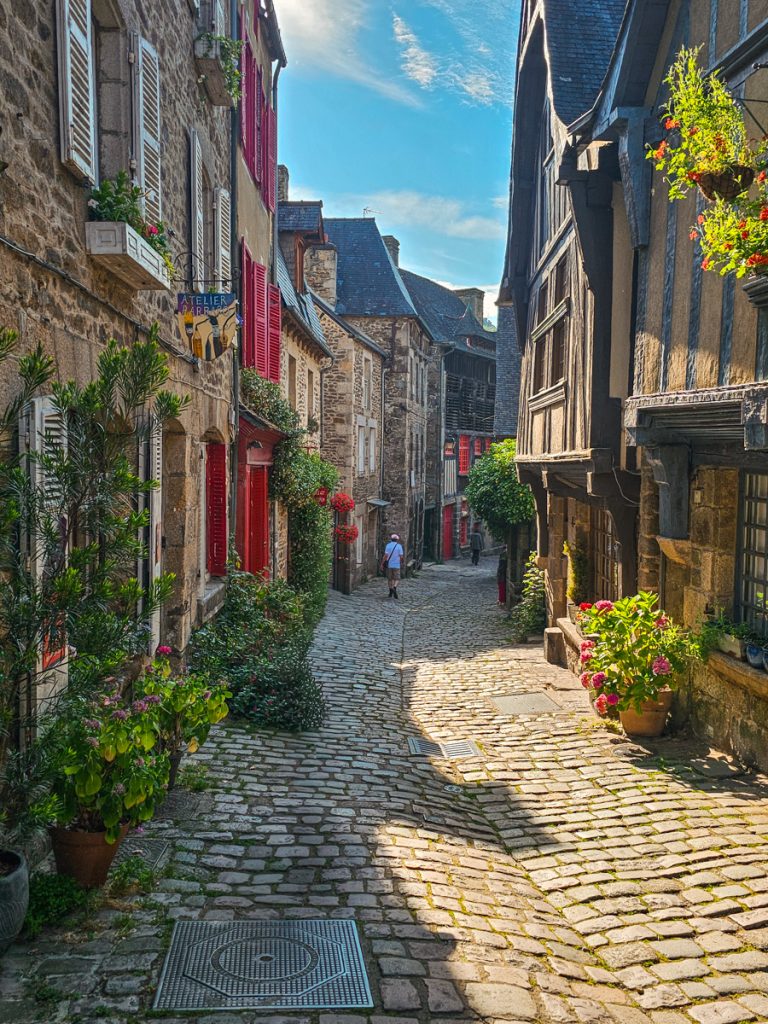
The medieval city center is well-preserved and perfectly quaint, with greenery and flowers accenting the streets. Rue de Jerzual and Rue du Petit Four in particular are absolutely delightful, with some of the prettiest street views in France.
4. Montrésor

Montrésor (which translates to “My Treasure”) is one of the prettiest villages in the Loire Valley, set right along the Indrois River with postcard views of its château reflected in the water. It’s a tiny place, but the mix of white limestone houses, half-timbered buildings, and even a few semi-troglodyte homes gives it lots of character.

The village also has an unexpected Polish connection. After the failed 1830 uprising against Russia, several Polish nobles and intellectuals settled here. One of them, Xavier Branicki, bought the château in 1849 and later became mayor. He brought other Polish families with him, and that influence is still felt in town.
A stroll through Montrésor is simple but lovely. You can walk the riverside path for the classic view of the village and castle rising above the water, then wander the quiet lanes before touring the château itself.

It’s more of a manor house than a grand Loire palace, but that’s part of its charm. Inside, the rooms remain as they were in Branicki’s time, including a dining room filled with taxidermy that’s… memorable, to say the least.
5. Sarlat-la-Canéda

Sarlat-la-Canéda is one of the prettiest villages in the Dordogne, thanks to its golden sandstone buildings that give the entire old town a warm, almost glowing look. Narrow lanes twist between homey façades, opening into little squares that are all unbelievably charming.
The town is also known for its ties to geese. You’ll spot nods to them all over, from the bronze statue of the Three Geese to the many shops selling goose and duck products, including foie gras, which is a local specialty.

Markets are a big part of Sarlat’s atmosphere. The streets fill with a bustling open-air market several days a week, and the former St. Mary’s Church has been converted into a covered market where vaulted ceilings sit right above stalls of produce, cheese, and regional treats.

Sarlat is the kind of place where you stroll without much of a plan, just admiring the golden buildings and little pockets of charm that make this one of the most beautiful villages in southwest France.
6. Cordes-sur-Ciel

Cordes-sur-Ciel sits on a steep hilltop in southern France and feels like one of those places that hasn’t changed much in centuries. As you walk through the village, you’ll pass through a series of picturesque old stone gates, each one a reminder of what an important stronghold this village was during the crusades of the Middle Ages.
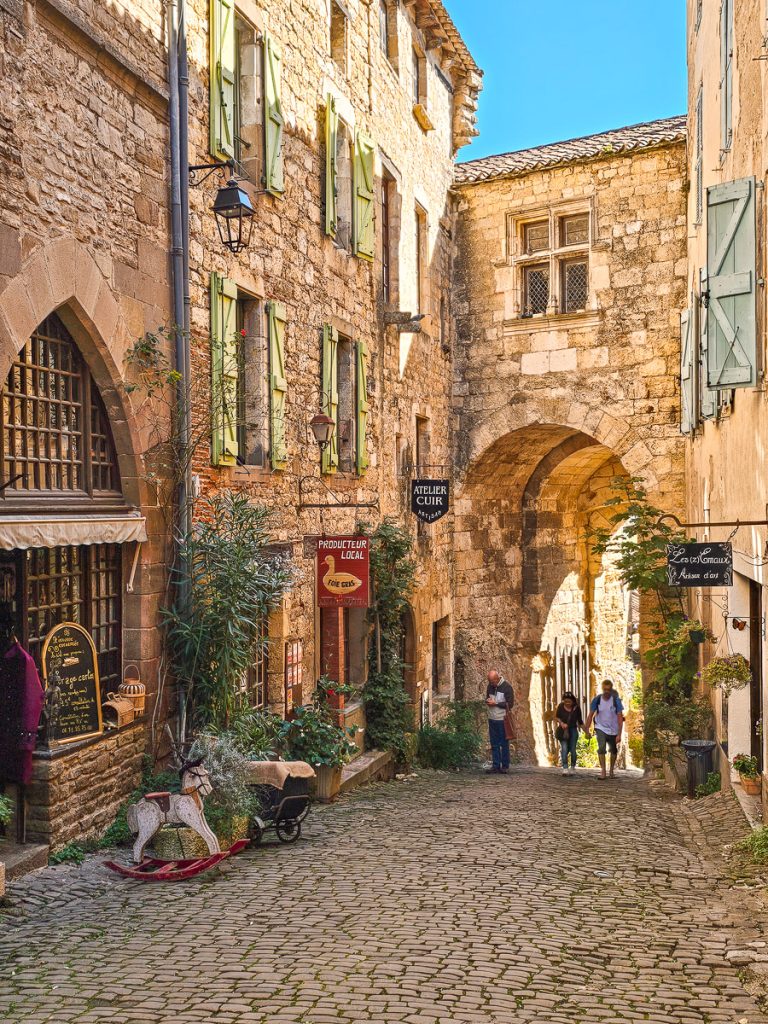
Today, though, the streets are narrow and cobbled, with a feeling of walking into a storybook. You follow them upward past Gothic windows, weathered stone facades, and small artisan and antique shops that spill onto the walkway, with quick views of the countryside through gaps between buildings.
And of course, you can’t skip the panoramic viewpoint from the nearby hill looking over the entire tiny town – it’s a spectacular sight!

7. Roussillon

Roussillon sits deep in the Luberon region of Provence, and is known for its deep red and orange tones that come straight from the surrounding ochre cliffs. The whole village feels connected to the landscape, with homes painted in the same warm pigments you see in the nearby quarries.

The streets are simple but very charming, with small galleries and ceramics shops tucked into corners. As you wander up through the village, the views start opening up, especially from Place de la Forge, where you can look out over the ochre hills and the wider Provençal countryside.

If you want to get closer to the cliffs themselves, the Sentier des Ocres trail just outside the village is an easy walk through the bright red rock formations and a fun way to see the colors up close.
8. St. Remy de Provence

Saint-Rémy-de-Provence sits at the base of the Alpilles and has that relaxed, everyday Provençal feel people picture when they think of this part of France, filled with stone buildings, pastel shutters, and shaded squares.

Van Gogh spent the last year of his life here, and you can still see the places that inspired him. The Van Gogh Trail starts in town and winds past idyllic olive groves and rocky hillsides on the way to the Monastery of Saint-Paul de Mausole, where he lived.

It’s no wonder Van Gogh found so much inspiration in this countryside during the final year of his life, painting masterpieces like Starry Night in Saint Remy.
Just outside town, visit Les Antiques, two remarkably preserved Roman monuments, or explore Glanum, the ruins of a once-thriving Roman city.
9. Villefranche-sur-Mer

Villefranche-sur-Mer sits between Nice and Monaco and is one of the most colorful towns on the Riviera. The pastel houses stack up along the bay, and the whole place feels bright and inviting.

Most of your time here is spent wandering the Old Town’s narrow alleys and staircases as you pass local shops and quaint little corners. One of the most interesting spots is Rue Obscure, a covered passage dating back to the 1300s that once served as a protected walkway for soldiers.

The waterfront Quai de l’Amiral Courbet almost acts like a town square – this is where you’ll find restaurants with waterside seating and a really nice, laidback energy.
A few landmarks to visit include the Chapelle St Pierre, with a unique interior decorated by artist Jean Cocteau, and the 16th-century Citadel, which now houses museums and gardens.
There’s also a sandy beach just a few minutes’ walk from town, perfect for a couple of relaxing hours by the water.
10. Eze

Èze sits high above the French Riviera and is one of the most dramatic hilltop villages in the region.
The village is a maze of narrow cobblestoned lanes, stone archways, and steep stairways. As you climb through the old streets, you’ll pass dozens of artisan shops and small art galleries – Eze has been a haven and inspiration for artists and writers for centuries and continues to be today.

It’s the kind of place where you wander without much of a plan because every turn feels interesting and unbelievably picture-perfect.
At the very top is the Jardin Exotique, a terraced garden filled with cacti and Mediterranean plants, all set against the backdrop of the Riviera coastline. Honestly, photos don’t do this garden justice – it’s a really cool spot.

11. Megève

Megève feels like a storybook Alpine village in the French Alps, filled with wooden chalets and a cozy mountain atmosphere year-round. It’s mainly known as an upscale ski resort that’s full of skiers in winter, but the warm-weather season is just as nice, with hikers and cyclists using the village as a base for exploring the surrounding hills.

In summer, the whole town feels bright and fresh, with flowers spilling from window boxes on alpine buildings and café terraces full of people soaking up the mountain air. And the scenery is just incredible – wherever you stand, you’re looking at green slopes and jagged peaks all around you.
One of the nicest walks is the Calvary Way of the Cross, a short uphill path lined with historic chapels from the 1800s, where you get wide open views over Megève and the valley below.

12. Yvoire

Yvoire sits on the French side of Lake Geneva, right where the water feels impossibly calm and the Alps peek over the horizon. It’s small, but the stone buildings and narrow lanes give it so much charm, and the lake views truly elevate the whole place.
The harbor is one of the prettiest spots in town, with sailboats bobbing in the water and café terraces lining the waterside walkways. From there, you can wander into the beautifully preserved medieval village and explore the maze of alleys framed by stacked-stone houses and wooden balconies covered in greenery.

One of the most interesting places to visit is the Jardin des Cinq Sens (Garden of the 5 Senses). It’s a series of themed garden rooms designed around sight, sound, touch, smell, and taste. You don’t just walk through and look at plants – you get to touch leaves, smell herbs, or even sample what’s growing.

The Wrap Up
This is definitely not an exhaustive list of beautiful villages in France, but it’s a solid place to start if you want to be genuinely wowed. Each of these spots brings something a little different, and together they give you a pretty great look at just how charming France can be.
