
Visiting the Mer de Glace Ice Cave in Chamonix

Mer de Glace is the largest glacier in the Chamonix area, and in fact, the longest glacier in France.
Stretching roughly 11 km and covering about 31 km² as it descends from the heights of Mont Blanc, it’s an impressive feature of the Chamonix valley and one of the area’s most accessible glacier experiences.
However, although it’s the name of the entire glacier, when people talk about visiting Mer de Glace, they’re almost always referring to the smaller, human-created ice cave inside the glacier.
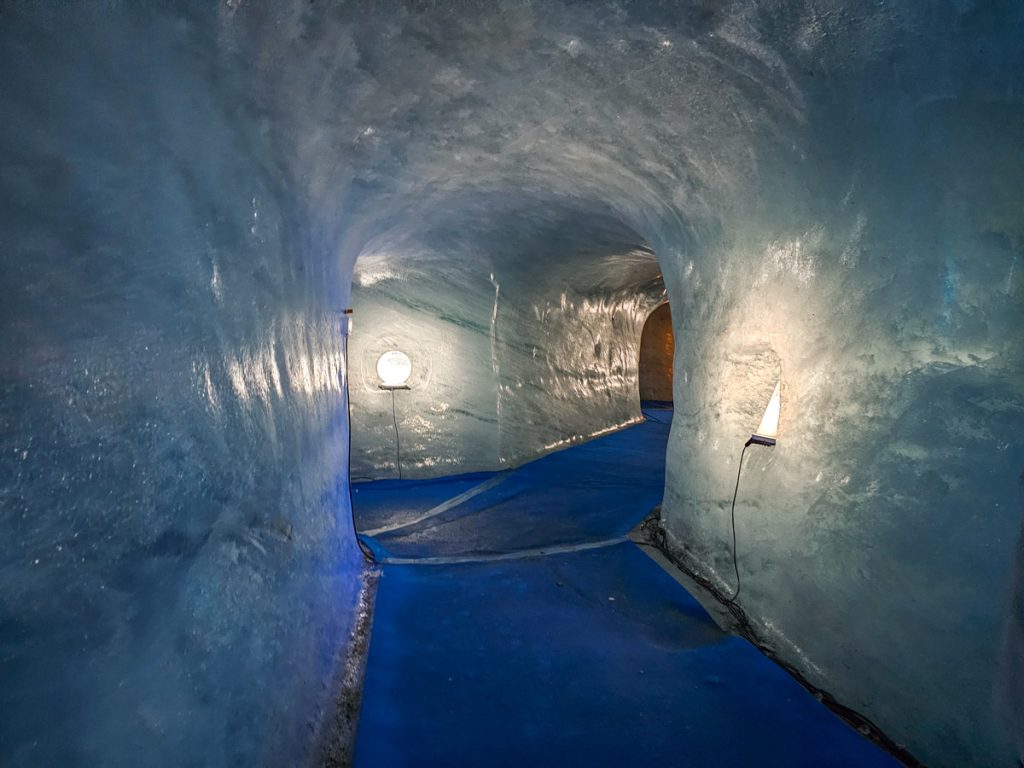
Visiting the Mer de Glace ice cave is a fun and interesting experience, though I’ll be honest: it’s not as jaw-dropping as places like Aiguille du Midi or Lac Blanc.
That said, if you have a Mont Blanc Unlimited Pass, are traveling with kids, or are looking for an easy, educational addition to your itinerary, it’s well worth doing. We found it cool and enjoyable (if a little kitschy) and ultimately were glad we went.
How to Get to Mer de Glace
Getting to the Mer de Glace ice cave is a bit of a process, but the journey is part of the experience. I’ll go into each step in more detail, but the basic process is:
Chamonix city center 👉cog train 👉 gondola 👉 staircase 👉 ice cave
You can hike to Mer de Glace either from Chamonix city center or as part of the Grand Balcon Nord trail, but it’s a fairly long hike. You cannot drive to Mer de Glace. For most visitors, taking the Montenvers cog train up is the best option.

You’’ll board the train at the Montenvers station in the center of Chamonix. The train climbs high into the mountains and offers beautiful views over the valley along the way. Trains typically depart every 30 minutes and take about 20 minutes to reach the Montenvers–Mer de Glace station.

The Montenvers–Mer de Glace station sits along the canyon wall. From the station terraces, you’ll get fantastic views down to the Mer de Glace glacier, along with another nearby glacier and several waterfalls. You really get a clear sense of how massive the glacier and canyon are.


Beyond the terraces, the station complex is well set up for visitors, with clearly marked paths, posted maps, shopping, and food options. There’s also the Glaciorium museum, and of course, the gondola station that takes you down into the canyon to the ice cave.
One thing to note: In summer, the first cog train usually leaves Chamonix around 8:30 am (this varies by the month), but the gondola doesn’t start running until around 10:00 am. We arrived on the first train at about 9am and ended up waiting about an hour before we could continue down to the cave.
The opening hours of the train and gondola change frequently throughout the year, so definitely double-check hours before you make plans.
Don’t Skip the Glaciorium
One of the highlights of this visit, surprisingly, was the Glaciorium, a small, free museum located just behind the hotel near the station, about a four-minute walk from where the train lets you off. The area has good signage, so it’s easy to find.
Inside, you’ll find museum-style exhibits focused on glaciers in general and the Mer de Glace glacier in particular. We learned a lot about the anatomy of a glacier, how glaciers form and move, and how scientists study them. There’s also a presentation showing how dramatically the Mer de Glace has receded over the last 200 years.

Part of this retreat is natural, as Europe emerged from a mini ice age around 1800, but part of it is clearly human-accelerated. What really stood out is that the rate of decline from 1990 to 2026 is nearly as great as the decline from 1860 to 1990, which puts recent changes into stark perspective.
Another very surprising fact we learned is that the Géant Icefall glacier on Mont Blanc advances at a rate of about 2 meters per day, which is far faster than I ever would have guessed. Glaciers in general can move surprisingly quickly.
Another fun fact: Glaciers always flow forward. When it is said that a glacier is retreating, it means that the edge of the glacier, where the ice breaks off for the final time/melts, is moving up the slope. But the ice within the glacier is always moving downhill – that movement is a defining characteristic of a glacier.
Visiting the Ice Cave
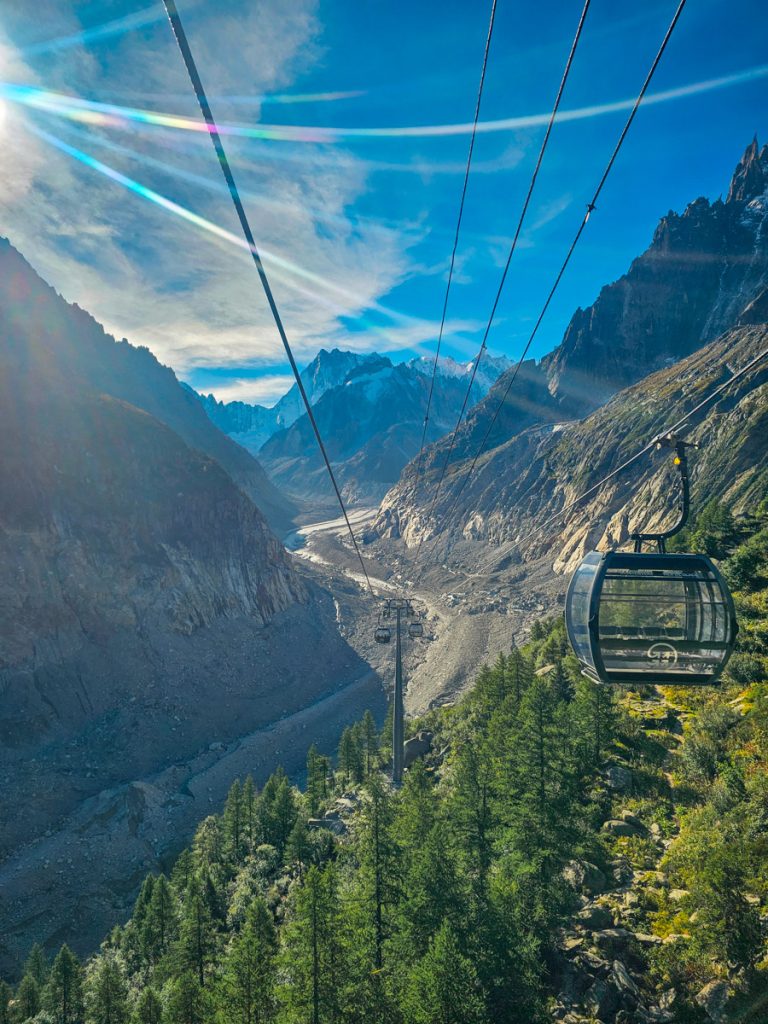

To actually visit the Ice Cave, you’ll take a short gondola ride from the Montenvers-Mer de Glace station down into the canyon. As you descend, keep an eye on the rock walls. You’ll see markers indicating where the glacier sat at different points in history.
Even as recently as 1990, the glacier was dramatically taller and thicker than it is today, which is both fascinating and sobering to see in person.
Once you’re off the gondola and in the canyon, you’ll go down a long 170-step staircase leading down to the cave entrance. Unfortunately, there is no accessible entrance for people of reduced mobility.


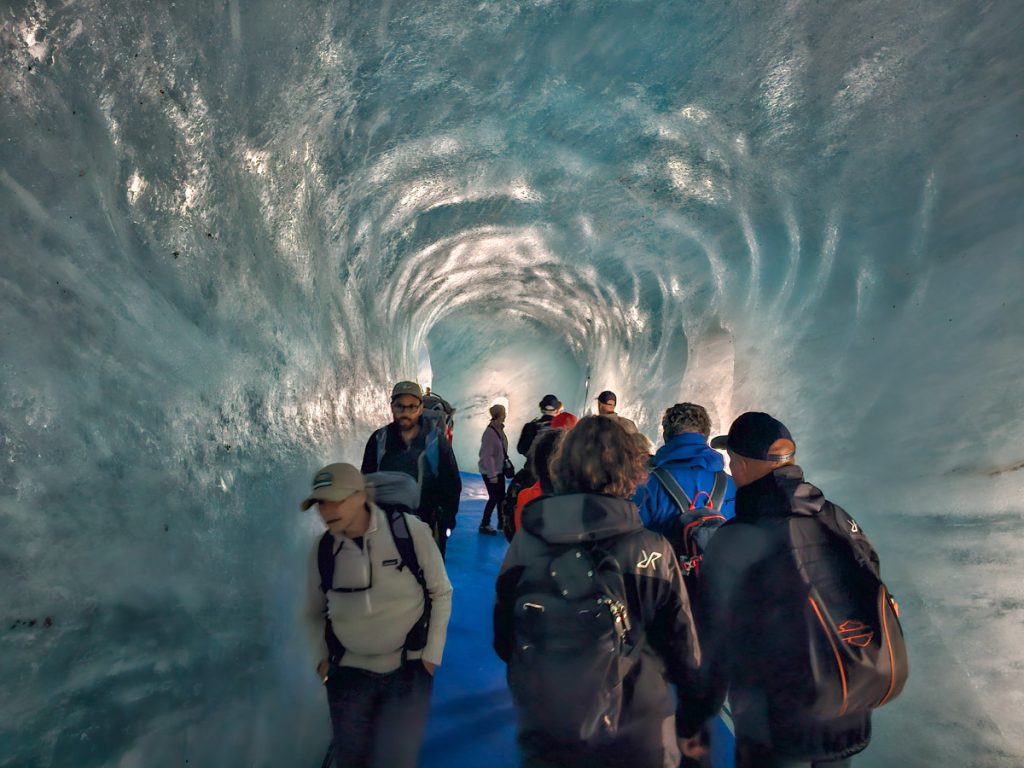
The ice cave itself is a looping tunnel carved directly into the glacier. Every year, the cave is re-carved by hand, so it’s slightly different each season.

Inside, you’ll find various alcoves and themed areas, including small passageways and a little “living room” scenes. This added to the slightly kitschy feel, but it was still a fun and cool experience.


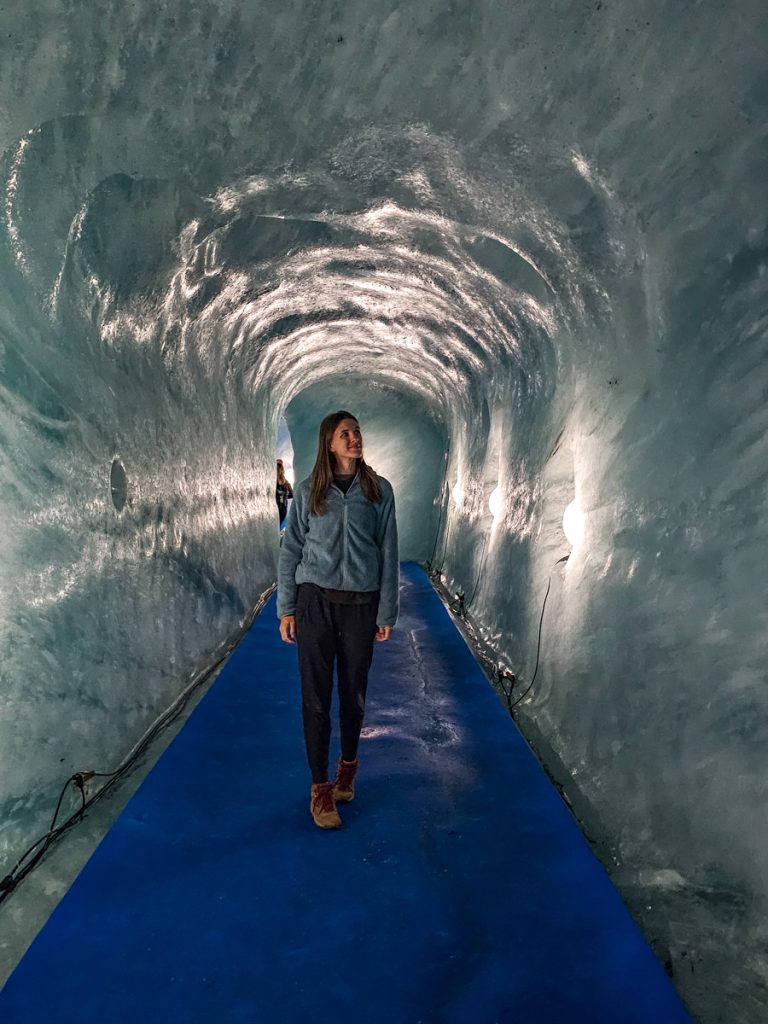

The walls are entirely ice, and you’re allowed to touch them. In some spots, you can see rocks or bubbles trapped in the ice, along with different colors and patterns formed over time. It’s crazy thinking about how some of the ice is up to 500 years old!


The cave floor has a mat laid down to prevent slipping, and overall, the experience feels very controlled and safe. The walk-through is fairly quick. We didn’t rush, we stopped for photos, and we still spent only about 15 minutes inside.
If possible, I’d strongly recommend arriving at the Montenvers-Mer de Glace station about 15 minutes before the gondolas open, so you’re near the front of the gondola line. We were in the third or fourth gondola heading down, and the cave felt quiet and spacious.
By the time we were exiting, though, there were many more people coming in, and I do think the experience loses some of its magic when it’s crowded. People move through quickly, but the constant flow adds noise and distraction.
Tickets
A single adult ticket costs €49.70, which includes the train, gondola, ice cave, and glacorium.
Alternatively, the entire Mer de Glace experience is part of the Mont Blanc Unlimited Pass, which you can buy for multiple days.
If you’re doing several hikes, viewpoints, or experiences around the Chamonix area, the pass is almost certainly going to be your best value.
Timing
The opening and closing hours for the cog train and the gondola change frequently throughout the year. It’s definitely worth looking at the timetables beforehand. Be sure to take into consideration both when the train is running and when the gondola is running when making your plans.
While other trains might run to the Montenvers-Mer de Glace station later in the afternoon (there is a hotel and trail access), you will be too late to head into the ice cave.
I’d plan for 2-3 hours to do the entire visit, starting from Chamonix.
Final Thoughts
For us personally, the Mer de Glace ice cave wasn’t the most awe-inspiring experience in the Chamonix area. That said, it was still a fun and worthwhile visit, especially if you enjoy learning about the landscape you’re exploring.
It’s easy to access, educational, and offers a very tangible way to understand glaciers up close (so don’t skip the Glacorium).
If you have plenty of time in Chamonix, or you’re using the Multi-Pass where the visit is already included, it’s definitely worth adding to your itinerary.
Looking for More Hikes and Experiences in the Alps?
These are some of the other trails and viewpoints we loved in and near Chamonix:
