
The Aiguille du Midi: The Must Do Experience in the French Alps (No Hiking Required)

Visiting the Aiguille du Midi was one of the most memorable experiences of our time in Chamonix. Rising high above the valley on a sharp, needle-like rock formation (aiguille, in French means… checks notes… needle. That tracks), this iconic viewpoint offers some of the most dramatic mountain scenery in the Alps.

The Aiguille sits just barely under the summit of Mont Blanc, the tallest mountain in France and the tallest peak in Western Europe. It’s a stunning mountain, and at 15,766 ft (4805 m), it’s covered in glaciers and snow year-round.
On a clear day, the views from the Aiguille du Midi, the surrounding glaciers, and the jagged peaks of the Mont Blanc Massif are absolutely incredible.

That said, the Aiguille du Midi experience is very weather-dependent. When conditions are right, it is spectacular. When they are not, you may find yourself standing inside a cloud with limited visibility. Because of this, it takes a bit of planning and flexibility to time your visit well, but when it works out, the payoff is huge.
In this post, we’ll cover what to expect on your visit and tips to make the most of your time there.
How to Get There
Access to the Aiguille de Midi is in the center of Chamonix, an alpine resort town in the French Alps. There’s a very large cable car station here, and a very large parking lot nearby.

To visit the Aiguille, you need to make a timed reservation in advance to ride the cable cars up.
The only exception is if you arrive from the mid-station while hiking in from the Grand Balcon Nord trail, in which case a reservation is not required. For most visitors, though, that scenario will not apply, as the hike up along the Grand Balcon Nord is significant.
Tickets
There are a couple different ticket options for visiting the Aiguille du Midi. You can buy a single round-trip ticket just for the Aiguille, which typically costs around €59–81 depending on the season.
The other option is the Unlimited Mont Blanc pass, which gives you access to nearly all lifts, gondolas, and cable cars throughout the Chamonix valley.
These passes are available for multiple days, and the price per day drops the longer your pass is. Unless you’re planning to spend your entire visit in town and not head into the mountains at all, the pass usually ends up being the much better value
The Ride Up
The cable car ride to the Aiguille du Midi is an experience in itself. Unlike many gondolas in the area, these cars do not circulate continuously. Instead, two large cable cars run back and forth on separate lines, and you wait for that car to arrive before boarding.

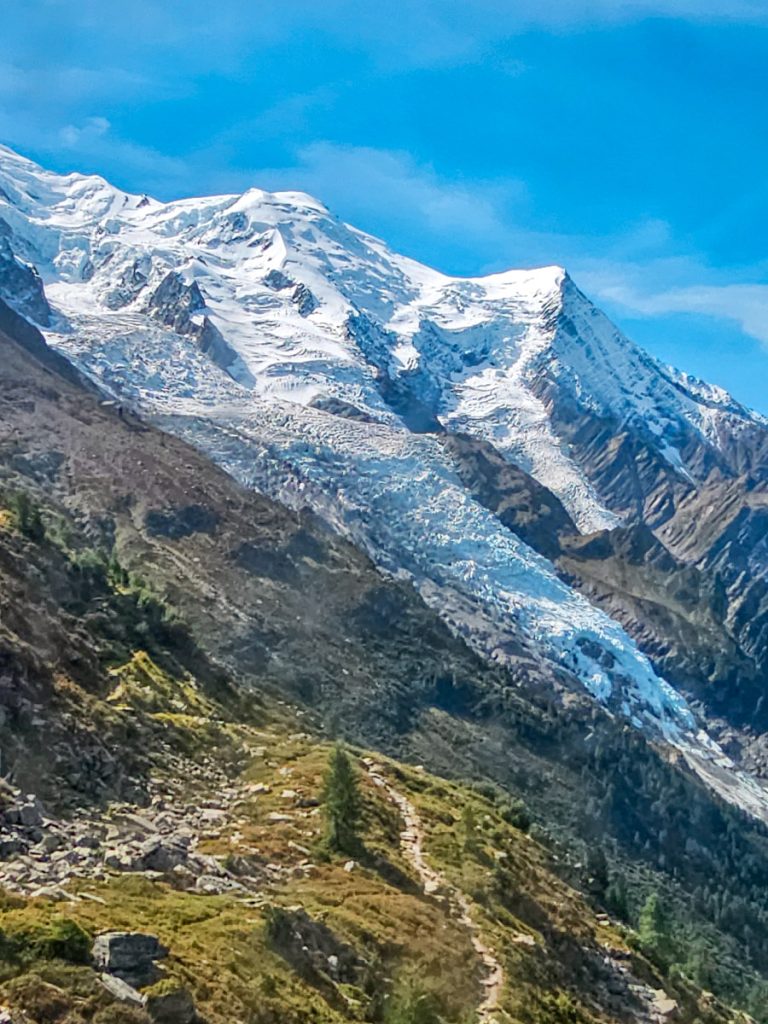
The gondolas are large but standing room only, and they pack people in fairly tightly. Each leg of the ride takes about five minutes, with a transfer at a midway station where you switch to a new line and a new car before continuing to the summit.
While some sections feel relatively gentle, much of the ascent is extremely steep. At times, it feels like you are going straight up the rock face.
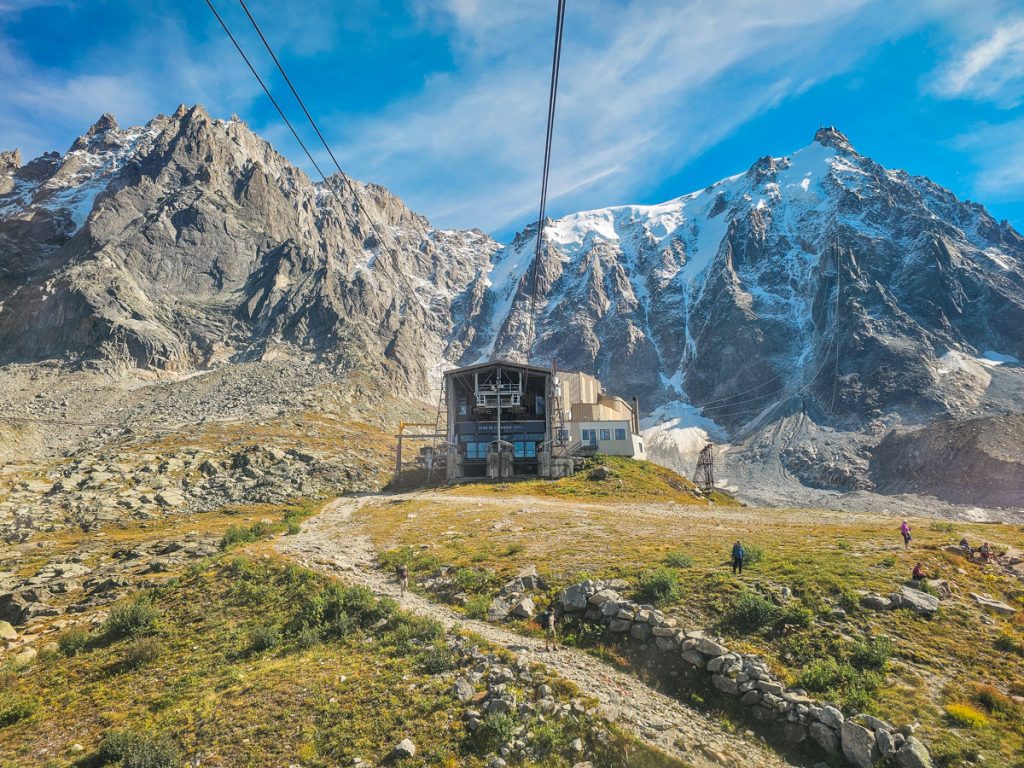


The final approach to the summit is especially dramatic. The rock wall is right in front of you, snow surrounds the cable car, and if you look closely, you may spot mountaineers moving across the snowfields near the Aiguille itself.


You start at about 1,035 meters in elevation on the valley floor and end at 3,842 meters at the top of the Aiguille, a gain of over 2800 meters (9186 feet)! My ears were constantly popping on the way up. Even at that height, you are still ~1000 m below Mont Blanc, which stands at 4,806 meters.
On the Aiguille du Midi
Once you arrive, you exit the cable car directly into the mountain through tunnels carved into the rock. The summit station is fairly large, with multiple terraces, viewpoints, and walkways to explore.

One of the most surprising things to see are the doors that open straight out onto the mountain face.
Visitors can step out into a small sheltered opening in the ice to look around and take photos, while right beside you climbers are gearing up to descend the narrow stairway onto the glacier. You’ll see people adjusting crampons, clipping into ropes, and preparing to head out onto the ice.
It’s a pretty surreal scene, especially considering how easily the general public can reach this point.

Because the Aiguille du Midi is so accessible by cable car, the Mont Blanc massif sees a surprisingly high number of accidents. In fact, there are more mountaineering fatalities here than on many Himalayan peaks.
While it might look tempting to step out onto the surrounding snowfields, it’s not something you should attempt without proper gear and experience.
Exploring the Area and Features

The aptly named Aiguille du Midi sits on a very pointy rocky prominence, and the station even has a pointy tip at the very top. As such, the best thing to do is to simply take in the sights.
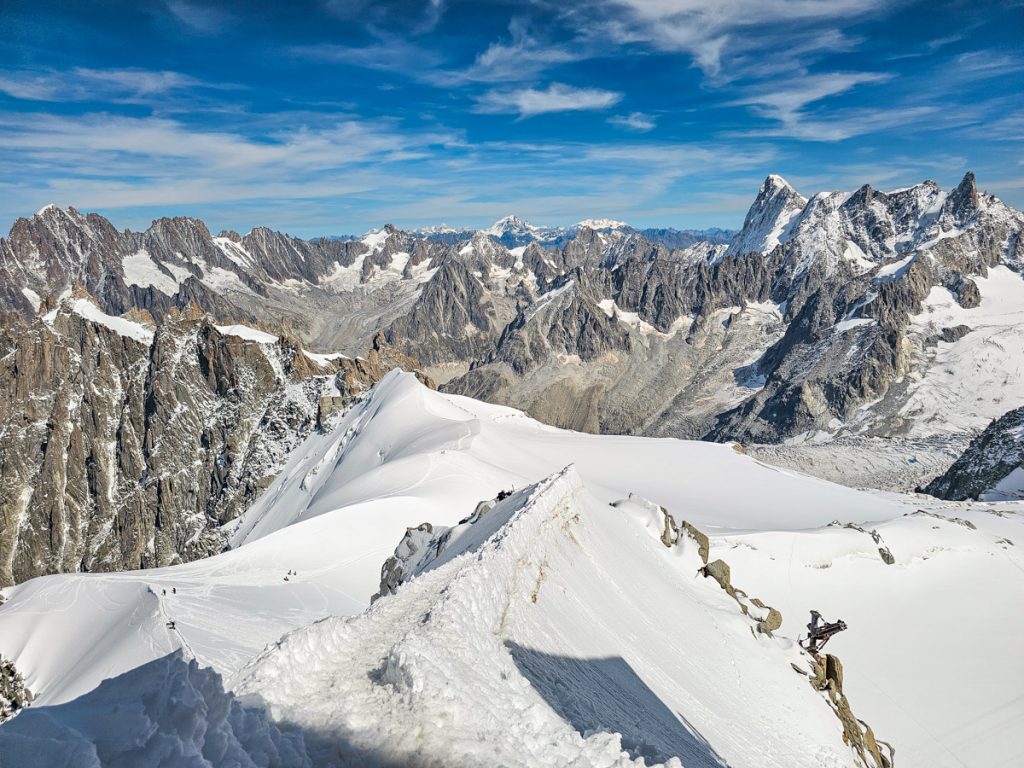
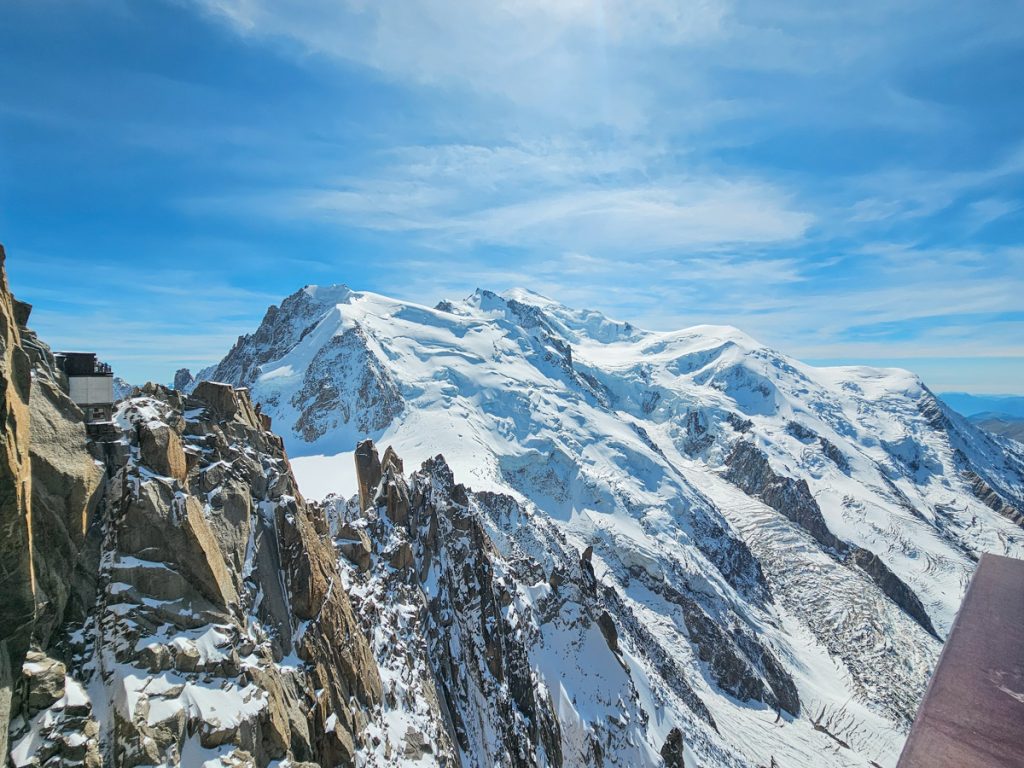
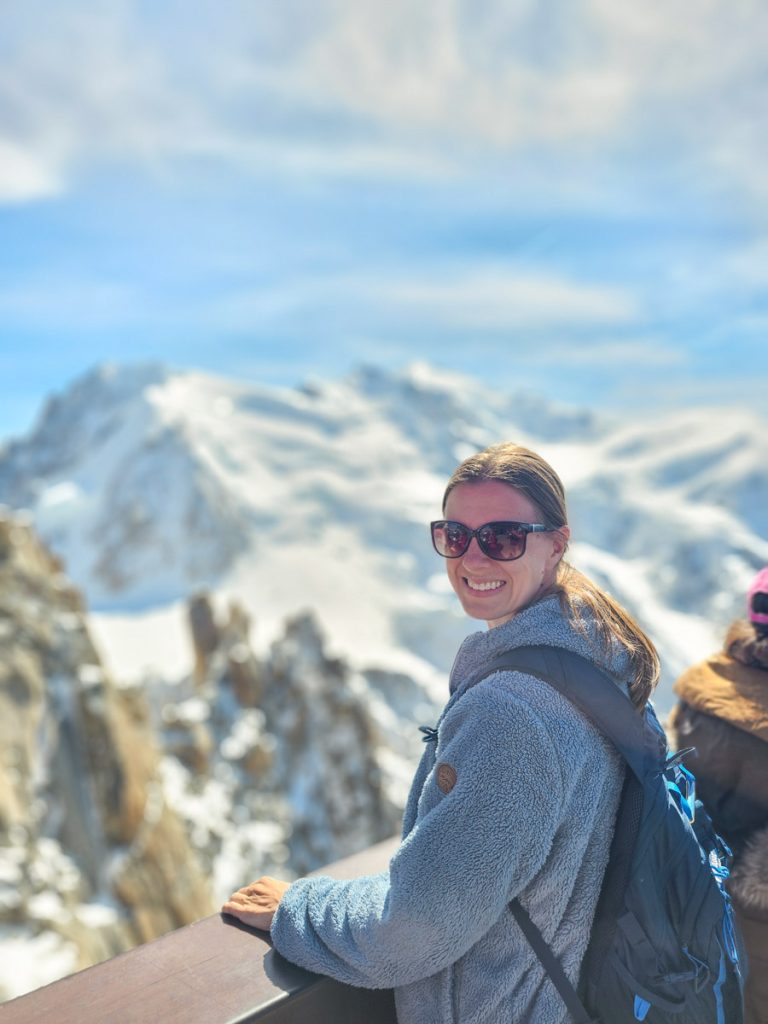
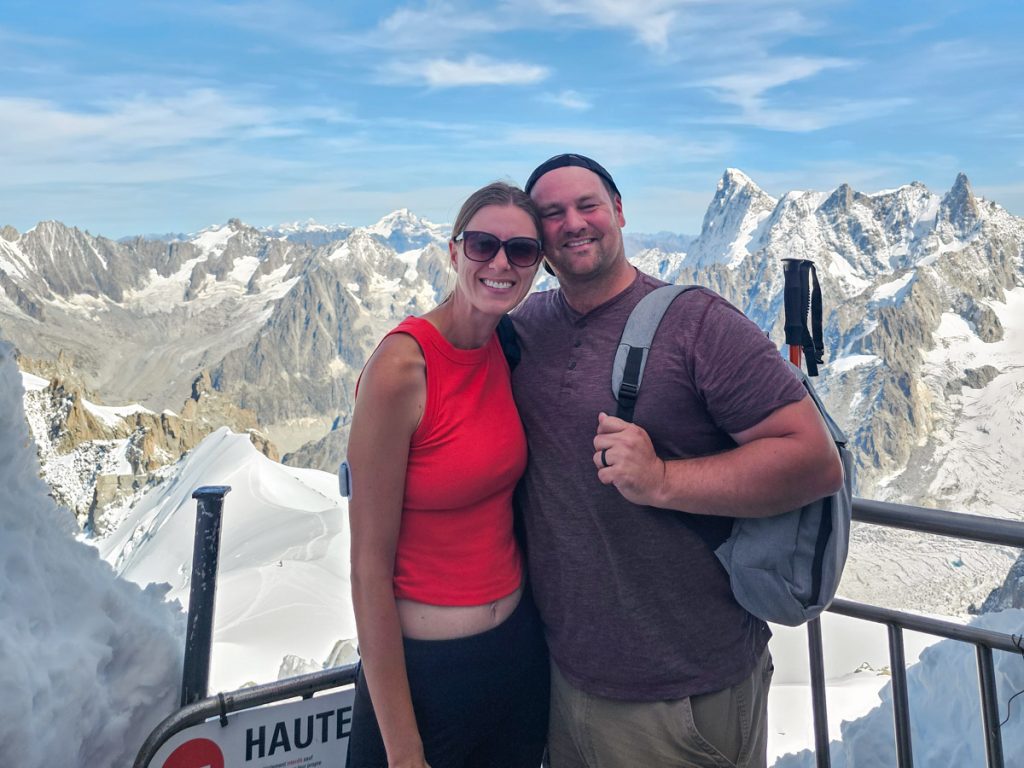
There are multiple panoramic terraces with jaw-dropping views in every direction. Chamonix looks tiny far below, the peaks of the Aiguilles Rouges mountains on the other side of the valley seem almost deceptively short, and you are surrounded by layers of jagged ridgelines and sweeping glaciers. Truly, we were stunned by the views.

There is also a small exhibit about the history of mountaineering on Mont Blanc with pictures, videos, and displays of some of the tools of mountaineering.
On another level, you’ll find a cafeteria and gift shop. The cafeteria was surprisingly good, and sitting by the windows with views over the glacier makes for a memorable lunch or snack.
A unique activity is riding an elevator up to the top of the Aiguille “needle” for panoramic views (and to be in a glass box where it feels like you’re walking on air). This often has a decently long line, though, so be prepared for a 10-30+ min wait.
Finally, you can take a gondola ride over the top of the glaciers over to Italy….
Riding the Gondola Across the Glacier to Italy

One of the most unique experiences at the Aiguille du Midi is riding the gondola across the glacier to Italy and back. The summit sits only about five kilometers from the Italian border, and a long cable line stretches across the mountains to Pointe Helbronner on the Italian side.
This ride takes some time, but it is absolutely worth it.
The gondola line consists of clusters of three small cabins, each seating four people. We waited about 20 minutes to board.
Once inside, you begin gliding slowly across the high alpine landscape, suspended above jagged cliffs, cracked glaciers, and deep crevasses. The scenery was incredible! I felt like I was pulling out my camera to take a picture every 30 seconds.
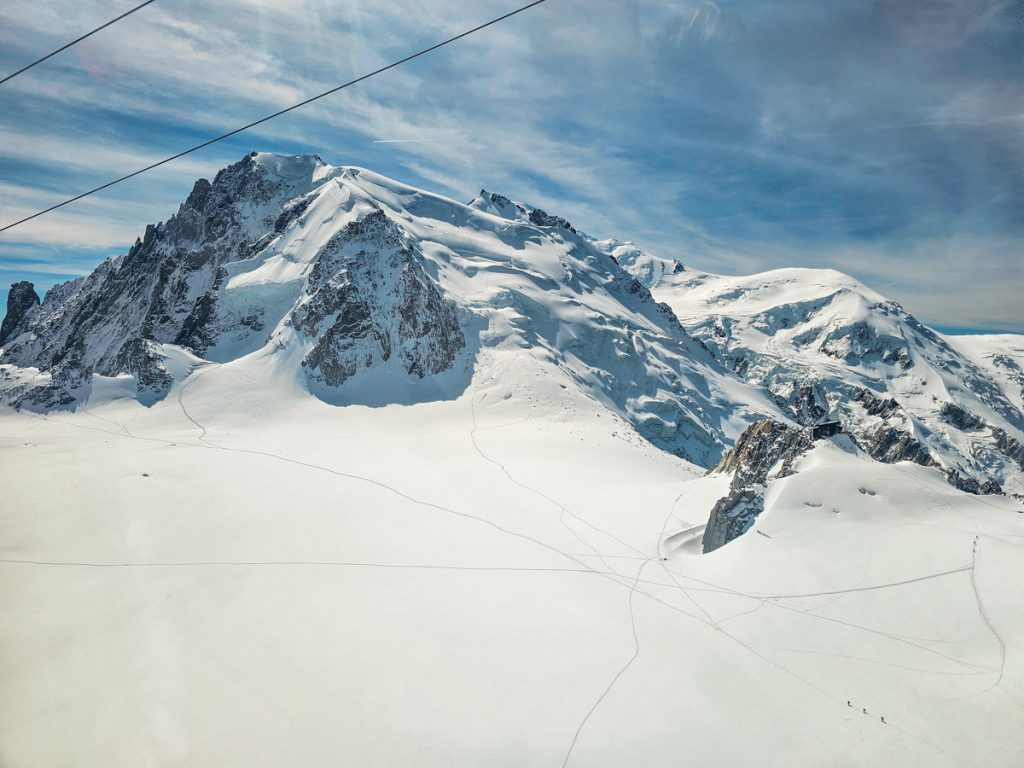

It was also wild to see the tiny specks of hikers far below us, moving along faint trails etched into the snow and ice. I was honestly surprised by how many people were out there.


Because of the long distance and how the system loads and unloads at each station, the gondola stops frequently along the way. It was a little disconcerting the first time the gondola stopped for several minutes, but you get used to it quickly. In total, the ride took us about 30–45 minutes each way.


As you travel, the scenery constantly changes. You pass rugged rock formations, snowy peaks, and the massive glaciers that feed into the Mer de Glace below. Approaching the Italian side, you pass near the Dent du Géant, a striking spire that feels impossibly sharp from this angle.

The Italian Side
The Italian station sits right on the border between France and Italy. From here, you suddenly have views down into Italy, which, at least in summer, was dramatically less snowy than the French side. The difference in sun exposure between the north and south faces of the mountains was immediately obvious.

At Pointe Helbronner, there are panoramic terraces and a café, along with space to simply wander and take in the views. In the distance, on a clear day, you can even spot the Matterhorn between the peaks.
Almost directly below Pointe Helbronner is a little mountain valley, with a base camp set up. Again, it’s a pretty surreal sight.

We spent some time exploring the compound and admiring the views before making the return trip to France. Altogether, I would plan on about two hours round-trip for the gondola to Italy, including wait times, travel, and time on the Italian side.
It is a commitment, but the perspective it gives you on the Alps is completely different from what you see at the Aiguille itself, and we really loved this part of the experience.
Coming Back Down to the Valley

When you arrive at the summit, if you’re not planning to go to Italy, you’ll be given a paper with a designated time slot to return to Chamonix, usually about 2 hours out.
If you do take the gondola to Italy, the process is a little different. When you return to the Aiguille du Midi from the Italian side, you’ll receive a different pass that lets you join the line for the return gondola at any time.
Since several different lines merge into the same queue for the gondola, we ended up having to wait about 20 minutes before getting on our ride down.
Accounting for Weather
Because the Aiguille du Midi is so weather-sensitive, booking a gondola time slot can feel tricky. For the best experience, you want clear conditions, but mountain weather changes constantly, and forecasts in Chamonix aren’t very reliable more than a day or two out.
Locals told us not to trust forecasts beyond 24 hours (and definitely not beyond 48), and we found that to be very true.
One helpful resource is the Chamonix website weather forecast, which shows not only the forecast but also where clouds are expected to sit in the valley and how high or low they may be.

This is especially useful for deciding whether the Aiguille will be above the clouds or stuck inside them. The detailed version only goes a couple of days out, with a more general outlook beyond that.
If you have a Mont Blanc Unlimited Pass (giving you unlimited access to the lifts and gondolas around the valley for a certain length of time), you can make a reservation in advance and then change it later if needed.
Reservations can be modified online or at the information desk near the Aiguille du Midi cable car station, as long as you have a valid pass and there is availability. We ended up changing our reservation about 30 minutes before our first scheduled time.
If you are buying a single round-trip ticket for the Aiguille, you cannot change your time.
If possible, I’d recommend using the Multi-Pass and schedule the Aiguille early in your stay. That way, if the weather doesn’t cooperate, you still have time to move your reservation. We ended up waiting until the last day of our trip for our second attempt—and it paid off with clear skies and incredible views.
Practical Tips
Reservations: Make your timed reservation in advance if possible, but know that changes are sometimes possible if you have a valid pass and availability for upcoming days (we found there to be availability the day before when we visited in September). I would not count on getting a reservation the same day.
Timing: If you want to take full advantage of everything at the Aiguille, including the ride to Italy and the elevator to the very top of the needle, plan to spend three to five hours total.
If you are pairing this with a visit to the Mer de Glace on the same day, it works best to do the Aiguille du Midi first thing in the morning, then head to the Mer de Glace in the early afternoon. Be mindful of last entry times for the ice cave and the final cog train departures for Mer de Glace.
What to Wear: Dress warmly, even in summer. It can be cold and windy at the top, and the temperature difference from the valley is significant.
Weather: As mentioned before, the weather is the single most important factor for visiting the Aiguille du Midi. Clear or mostly clear skies make an enormous difference. There’s really no point in doing the Aiguille if it’s surrounded by clouds. Keep your plans flexible and monitor forecasts closely as your trip approaches.
Final Thoughts
The Aiguille du Midi is one of those places that truly feels unforgettable when conditions are right. The combination of extreme elevation, dramatic terrain, and easy accessibility makes it unlike almost anywhere else in the Alps.
While the views from the terraces alone are incredible, riding the gondola across the glacier to Italy takes the experience to another level. It adds time and effort to the visit, but it also adds depth and perspective that you simply cannot get otherwise, so I would recommend it if you have the time.
All in all, the Aiguille du Midi is a must do experience during your stay in Chamonix.
Looking for More Hikes and Experiences in the Alps?
These are some of the other trails and viewpoints we loved in and near Chamonix:
