
14 French Stereotypes That Are Surprisingly Accurate

Stereotypes are tricky. They’re usually too broad, sometimes unfair, and almost always missing context. Like any country, France has plenty of stereotypes and clichés, and a lot don’t hold up in real life very well.
The idea that French people are rude is a perfect example – this is something many visitors expect and then usually don’t experience at all.
That said, some French stereotypes do have truth to them. Not in an over-the-top, cartoonish way, but in simple, real-life patterns that you notice once you’ve spent some time in the country. With a few caveats, of course, because culture is never as simple as a checklist.
These are 14 French stereotypes that actually hold up:
1. The French Kiss Is a Real Thing
French kiss, as in la bise, the cheek-kiss greeting, is a very real tradition. Once you start paying attention, you see it everywhere; it’s a common way for friends and family to greet each other and say hello.
It’s not something you do with strangers or service staff, and no one expects tourists to jump in. You’ll mostly just observe it happening around you, as locals go about their everyday interactions.
The number of kisses depends on where you are, which can be both confusing and a bit amusing. Two in the standard in Paris, but in parts of northern and southern France, it might be three or even four.
Overall, this is one of those small details that feels oh-so-very French once you notice it.
2. “Oh Là Là” Is Not Just a Movie Thing
“Oh là là” is real, just not in the way movies make it seem. It’s not dramatic or flirtatious, and it’s definitely not said in a sultry tone. In real life, it’s much more understated.
It’s used the same way you might say “oh no,” “wow,” or “yikes,” often under someone’s breath. You hear it when something goes wrong, when something is surprising, or when someone is mildly exasperated.
Sometimes, it even turns into a drawn-out “oh là là là là,” especially when something is particularly annoying or inconvenient.
3. People Really Do Carry Baguettes Under Their Arm

This one is as real as it gets, thanks to the French devotion to good bread and the fact that there’s a boulangerie on practically every corner. Picking up a fresh baguette on the way home is part of daily life, not a special errand.
So yes, you really do see people walking down the street with a baguette tucked under their arm, usually peeking out of a paper bag. Sometimes it’s more than one, especially if dinner involves friends or family.
Snacking while walking isn’t really a thing in France, and eating on the go is generally frowned upon. The baguette is the rare exception, and nibbling the end on the way home is just part of the routine.
4. Scarves Are Practically a National Uniform
Scarves are everywhere in winter, on men, women, adults, teenagers – it doesn’t really matter. Once the weather cools down even a little bit, scarves start appearing as part of everyday outfits.
They’re not an afterthought or something people throw on at the last second. A scarf usually feels like an intentional part of what someone is wearing, even when the rest of the outfit is simple.
If you’re traveling in fall or winter and want to look a little more local, a scarf goes a long way.
5. Smoking Is Still Very Normal in France
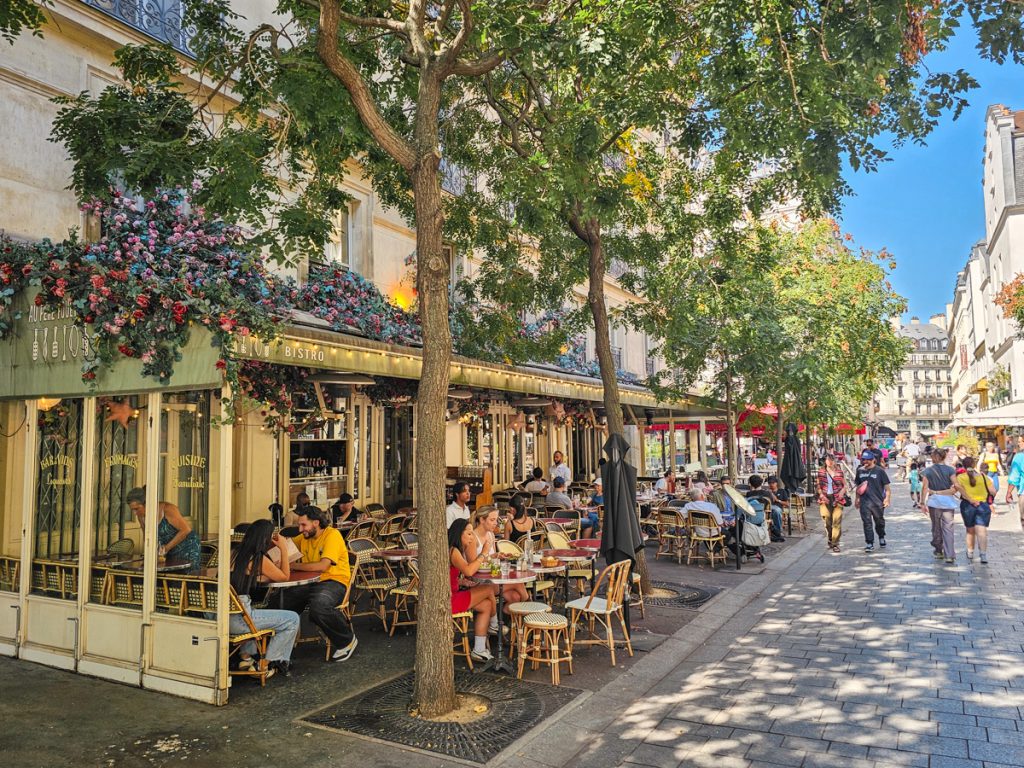
This stereotype is rooted in reality, especially in cities. Outdoor café terraces often come with a faint haze of cigarette smoke drifting by, and vaping is also very common.
Smoking rates in France have dropped significantly over the past few decades, but they’re still higher than in the United States. Depending on the stats you look at, France usually lands in the mid-20% range, roughly 1.5 to 2 times higher than U.S. rates.
Rules are shifting, though. Starting July 1, 2025, smoking is banned in many outdoor public spaces, including parks, beaches, bus stops, and areas near schools. Café terraces remain exempt, and e-cigarettes aren’t included, so smoking will continue to be visible in everyday life.
6. Long, Leisurely Meals Are the Norm

Dining in France really is an event, not something to rush through and move on from. Meals are meant to be enjoyed, whether it’s a long lunch at a café or a restaurant dinner that stretches well into the evening.
Servers won’t hurry you along, and they also won’t drop the check the moment you finish eating. You’re expected to linger, talk, and take your time, and no one finds that strange. Sitting at the table for a while after the plates are cleared is completely normal.
This is a “cliché” most people are very happy to embrace in France 😉.
7. The French Really Are Well Dressed
France, and Paris especially, has a reputation for fashion, and you’ll definitely see plenty of chic outfits. Men in well-tailored coats, sharp shoes, and classic pieces aren’t unusual. That said, most people aren’t dressed fancy in an obvious way.
Instead, the overall look is simply polished and put together, even when it’s casual. Jeans and sneakers are common, but they’re paired thoughtfully, and clothes tend to fit well. Hair and makeup are usually minimal, and nothing feels overly styled.
A big part of this comes down to what people don’t wear. Sweatshirts, hoodies, leggings, joggers, and sweatpants generally stay at home unless someone is actually exercising. The result is an everyday style that is intentional, but also has a feeling of effortlessness.
8. France Takes Vacation Very Seriously

There’s a running joke that French people don’t work, and that part isn’t true. They work hard, but they’re also not married to their jobs. When the workday ends, it ends, and time off is treated as something expected, even sacred, rather than something you earn by burning yourself out.
Summer vacation, in particular, is taken very seriously. August shutdowns are very real. Doctors’ offices close, small shops and restaurants put up signs saying they’ll be back in a few weeks, and entire neighborhoods feel quieter than usual. It can be surprising the first time you encounter it, especially if you’re used to businesses staying open year-round.
Of course, not everyone goes away for weeks at a time, and not everyone can afford a big holiday every year. But the attitude around time off is noticeably different, especially compared to the US. Taking vacation isn’t seen as a luxury or a lack of commitment; it’s just part of life.
9. Cheese Really Is Intense

The stereotype about French cheese being “smelly” is rooted in truth, even if that’s not how it’s described in France. Instead, you’d call it strong, and that strength is something people actively seek out and appreciate.
Fromageries are shops dedicated entirely to cheese, and a single counter might display dozens of varieties. Some are mild and creamy, others are sharp, earthy, or pungent enough that you notice them immediately. And it’s not unusual to smell a fromagerie before you see it.
Even if stronger cheeses aren’t to your taste, they’re treated as something crafted and intentional rather than something off-putting. Cheese isn’t just another food here, it’s an integral part of the dining experience and a big part of French culture.
10. Wine Is a Daily Part of Life
France is world-famous for its wine, so it’s no surprise that wine shows up in everyday life here. Wine in France is closely tied to place, with specific regions and appellations protected by name and tradition. It’s treated as a normal part of meals rather than something saved for special occasions.
At restaurants, you’re often asked directly if you’d like wine, not just if you’d like something to drink. Sometimes, if I’ve just ordered water, the server will clarify that I don’t also want wine as well.
You see the same relaxed relationship with wine outside of restaurants, like sharing a bottle with friends along the Seine, which feels almost like a Parisian rite of passage.
11. France Might Be the Capital of Roundabouts

The stereotype that Europeans love roundabouts exists for a reason, and France fully lives up to it. In fact, France has more roundabouts than any other country, whether you look at population or road length. They show up in big cities, mid-sized towns, villages, country highways – everywhere.
The most famous example is the huge roundabout at Place Charles de Gaulle in Paris, circling the Arc de Triomphe. It was one of the first of its kind and helped kick off France’s love of roundabouts in the first place.
12. Servers Say “Bon Appétit”
“Bon appétit” is one of those French phrases that feels almost too cliché to be real. In a lot of cases, expressions like that fade out or shift meaning over time, especially once they cross into other cultures.
This one hasn’t. Servers regularly say it when they bring your food, and you’ll hear it in casual settings, too. Every time it happens, it still feels oddly delightful, like a small reminder that meals are meant to be enjoyed rather than rushed.
13. They Really Do Eat a Lot of Escargots

Escargots are genuinely part of restaurant culture in France. You’ll see them on menus regularly, especially at traditional restaurants and brasseries, and people order them without hesitation. They’re a familiar, classic dish, not a novelty.
They’re usually served as a starter and are most closely associated with Burgundy, where the dish originated.
(Frog legs, on the other hand, are a different story. They’re another stereotypical French dish, but much less common in everyday dining. I have had them in France and they’re very good, just nowhere near as ubiquitous as escargots.)
14. Cars Are Small
Small cars are a bit of a French cliché, and while it’s not all Smart cars all the time, vehicles in France really are much smaller than what most Americans are used to.
This is partly a European thing in general, and there’s also a very practical reason for it. Roads are narrower, lanes are tighter, and parking spots and garages are smaller. An SUV or even a “regular” sedan (by US standards) can honestly be pretty stressful to drive around in France.
Cars aren’t the only thing that feel scaled down. Elevators are often tiny, sometimes just big enough for one person and a suitcase. Staircases are narrow, hotel rooms are smaller, and even things like fridges and washing machines tend to be more compact. And don’t get me started on showers.
When you remember that so much of the country is built around historic buildings and older layouts, it all starts to make sense pretty quickly.
The Wrap Up
What makes these stereotypes interesting isn’t that they’re true, but how they’re true. They usually come from small, everyday habits rather than anything exaggerated. Once you notice them, they stop feeling like clichés and start feeling like normal life in France.
