
Fontainebleau: The French Palace Everyone Forgets — And Why It Might Be the Most Important One in France

While it might not be the most famous palace in France, the Château de Fontainebleau is undoubtedly one of the country’s most important royal residences.
Rather than serving as a single ruler’s showcase, Fontainebleau functioned as a long-term royal residence that generations of monarchs returned to again and again.

It was used by French rulers for more than 800 years, from the Middle Ages through the reign of Napoleon III in 1870. Thirty-four kings and two emperors spent time here, along with queens, heirs, and visiting dignitaries.
Napoleon famously referred to it as the “true home of kings, house of centuries,” a phrase that still feels accurate when you walk through the palace today. Its long, uninterrupted role in royal life is also why Fontainebleau is recognized as a UNESCO World Heritage Site.
And honestly, I was blown away by the interiors. The rooms are lavish, and there were several that I walked into and literally just stopped in my tracks by the level of decoration and gold detailing.

Many of the rooms easily rival what you’ll see at Versailles, but unlike Versailles, I often found myself alone or sharing rooms with just a handful of other visitors.
And that’s one of Fontainebleau’s biggest surprises. Despite its significance, it remains remarkably calm and uncrowded, something that’s increasingly rare at France’s most famous sites.

A Palace Shaped by Centuries of French Power
Fontainebleau isn’t tied to a single king or a single moment in French history. It functioned more like a long-term royal residence, shaped by generations of rulers over centuries.
From the Middle Ages through the 19th century, French monarchs kept returning here, often for hunting seasons or extended stays. Rather than simply occupying the palace, they remodeled rooms, expanded wings, and adapted the space to reflect their priorities and tastes.
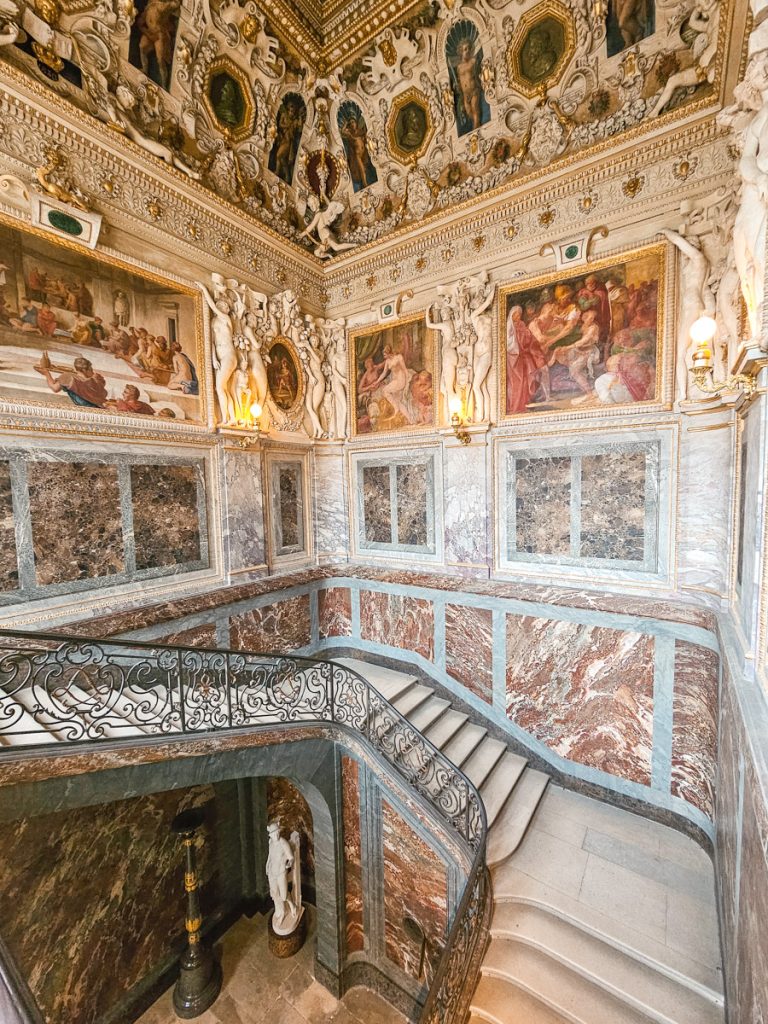
That ongoing use is what gives Fontainebleau its distinctive character today. It wasn’t built once and preserved. It evolved continuously, alongside the people who ruled France.
From Medieval Fortress to Renaissance Showpiece
Fontainebleau began as a medieval royal residence, with the earliest references dating to the late 11th century. Most of that original castle no longer survives, but the old keep, likely built in the late 11th or early 12th century, was incorporated into later palace buildings.
Everything changed in the 16th century under François I. Drawn to the surrounding forest and interested in creating a residence that reflected his power and interests, he began rebuilding Fontainebleau in 1528, turning it from a medieval castle into a large, Italian-inspired palace.
Francois I
François I played a major role in bringing the Renaissance to France. He was a serious patron of the arts and actively sought out Italian artists, including Rosso Fiorentino and Primaticcio, whom he brought to work at Fontainebleau.
Together, they introduced a new decorative approach that blended painting, sculpture, and architecture, a style that later became known as the School of Fontainebleau.
If you’ve visited the Loire Valley, his name and influence will likely feel familiar. François I was instrumental in building Chambord, lived regularly at Amboise, and spent time at Blois and Azay-le-Rideau. He also famously hosted Leonardo da Vinci nearby at Clos Lucé, where Leonardo spent the final years of his life.
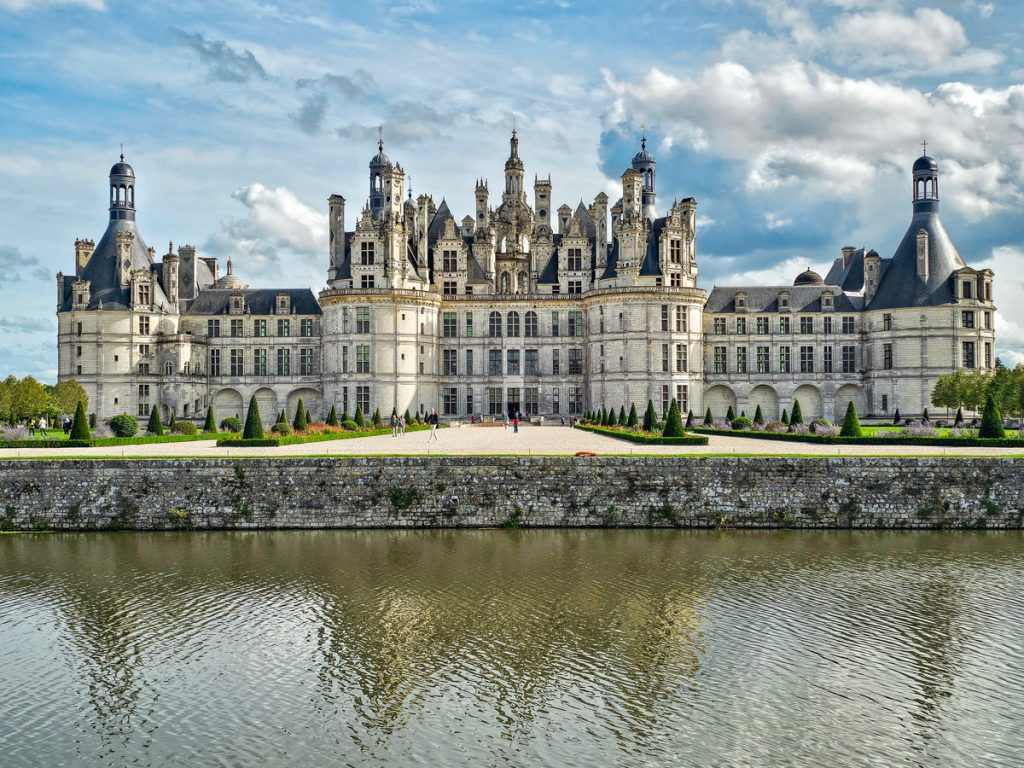
Fontainebleau fits directly into that story, showing how Renaissance ideas moved beyond the Loire and into royal residences closer to Paris.
A Royal Residence That Kept Evolving
Later monarchs didn’t replace François I’s vision, instead they built and expanded on it. Henri IV (1589-1610) improved the palace significantly, and his reign marked another big period of growth at the palace.

The birth of the future Louis XIII (1601) here made Fontainebleau the cradle of the Bourbon dynasty, and Louis XIV used the palace to assert royal authority long before Versailles became the symbol of his reign.
By the 18th century, Fontainebleau began to serve a slightly different role. Louis XV, Louis XVI, and Marie Antoinette used it as a place to step away from the formal court life of Versailles, and apartments were again often redesigned for their tastes and comfort.
Napoleon and the End of an Era
After the French Revolution ended in 1799, Fontainebleau entered a new chapter as an imperial residence. Napoleon I restored and refurnished the palace, leaving behind some of its most historically significant spaces.

Fontainebleau is home to the only Napoleonic throne room still preserved in France, and it was here that Napoleon abdicated in 1814 before departing for exile.
The palace didn’t stop changing after that, however. Napoleon III later carried out additional renovations, helping make Fontainebleau one of the most fully furnished royal palaces in the country.
By the time the monarchy finally came to an end, Fontainebleau had become something unusual. It reflected not just a single ruler or dynasty but shows how power in France shifted over centuries, and that long history is what makes the palace so distinct and significant today.
Book Your Tour to Fontainebleau
Group Tour: An affordable option that includes transportation, entrance fees and audioguides (no tour guide, but logistics are handled)
👉 View current prices & availability
Private Tour: A fantastic option if you want to have a more curated day trip. A private car, driver, and guide take you around and give you a personal tour of the chateaux and gardens.
👉View current prices & availability
What You’ll See Inside the Palace
Fontainebleau is enormous. The château contains more than 1,500 rooms, though only a portion of them are open to visitors.
Most visits begin with the Pope’s Apartments. From there, the main touring path leads through the Renaissance Galleries created under François I, followed by the Grands Appartements, which include the royal and ceremonial rooms used by generations of kings and queens.
Finally, the Napoleon Museum, in its own separate wing, focuses on Napoleon’s life, rule, and legacy.
In the sections below, we’ll focus on the most important parts of each of these areas to give you a clear sense of what you’ll see as you move through the palace.
The Pope’s Apartments

The Pope’s Apartments are a short offshoot at the beginning of the visit and are best known for their connection to Pope Pius VII.
He first stayed here in 1804 when he came to France for Napoleon’s coronation. Several years later, he remained at Fontainebleau for nearly 18 months between 1812 and 1814, held there under political pressure and compelled to sign the Concordat of Fontainebleau.
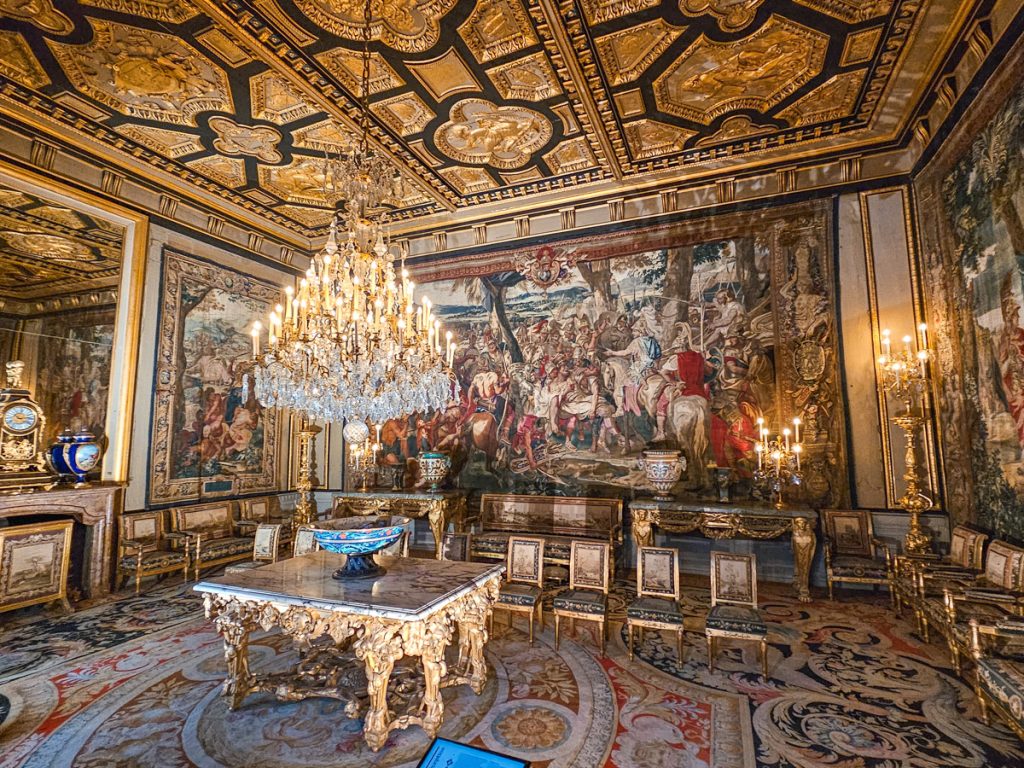
The rooms themselves are richly decorated, and were used by royalty long before the pope stayed here, and sometimes as apartments for important guests.
As part of the visit, they’re an interesting detour and of course, historically significant, but they don’t feel like the main focus of Fontainebleau.
The Showstopping Renaissance Halls
These grand rooms: the Francois I Gallery, the Trinity Chapel, and the Ballroom, are some of the most famous rooms of the chateau, and absolutely jaw-dropping in their beauty and design.
Francois I Gallery

The Gallery of François I is the earliest and most influential of these rooms. It was created beginning in 1528, when François I decided to remake Fontainebleau into a Renaissance palace inspired by what he had seen in Italy.
The gallery was designed to physically connect the royal apartments with the Chapel of the Trinity, but it was also meant to send a message about royal power.
Italian artists Rosso Fiorentino and later Primaticcio were brought in to design the space, and what they created was completely new for France at the time.
The walls combine painted frescoes, sculpted stucco figures, carved wood paneling, and gilded details. You’ll see François I everywhere here: his initial “F,” his salamander emblem, and royal symbols are frequently worked directly into the decoration.

Ballroom

Just beyond the gallery is the Ballroom, which dates largely from the reign of Henri II, who continued and expanded François I’s vision. This is one of the largest ceremonial rooms in the palace, with frescoed walls, an ornate paneled ceiling, and an enormous fireplace at one end.
Chapel of the Trinity

The Chapel of the Trinity comes from yet another phase. It was begun under François I but completed later, under Louis XIII, which explains why it feels a bit different from the rooms around it. The chapel is tall and richly decorated, with an elaborate painted ceiling and heavy use of gold.

One notable moment in its history came in 1725, when Louis XV married Marie Leszczyńska here, after the marriage was arranged quickly following a near-death illness.
The Grands Appartements

After the Renaissance halls, the visit moves into a long sequence of royal apartments that were actually used as living and working spaces.
Salles Saint-Louis

You pass through a series of salons and private rooms known as the Salles Saint-Louis, which once included royal bedrooms, dining rooms, and sitting rooms.
One of the most notable is the Louis XIII Salon, named because Louis XIII was born here in 1601, underscoring Fontainebleau’s role as a place where dynasties quite literally began.
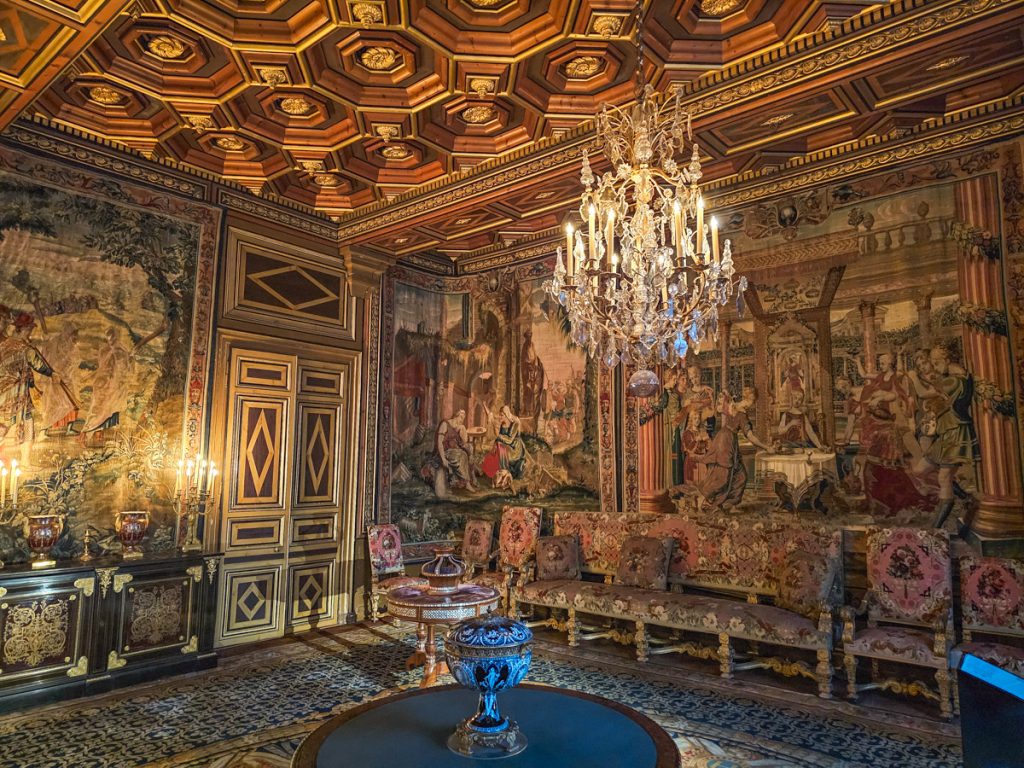
The Room of Tapestries is another remarkable space, where massive woven tapestries with colorful scenes cover the walls. They immediately draw your attention and were meant to impress visitors.
Diana Gallery

The route then leads into the Diana Gallery, named after the goddess of hunting. Originally created under Henri IV, the gallery went through several major changes over time before Napoleon III transformed it into a library, holding around 16,000 volumes.
The centerpiece of the room is Napoleon Bonaparte’s globe, which immediately draws your attention. Unhappy with how quickly existing maps became outdated, Napoleon commissioned a new globe showing the most recent discoveries of the era. The globe took an incredible nine years to complete (finished in 1811) and has been housed at Fontainebleau since 1861.
Salon Blanc

The Salon Blanc was used by queens and empresses as a sitting room and was reworked several times. Before the Revolution, it was Marie Antoinette’s grand study and reception space. Under Napoleon I, it became the Empress’ grand salon, marking the change from royal to imperial life.
Empress’ Bedchamber

The Empress’ Bedchamber was one of the most lived in rooms in the palace. Every queen of France, from Marie de Medici to Empress Eugénie, stayed here at some point. The room is a mix of different periods, with doors and architectural details created for Marie Antoinette and furniture dating to the time of Empress Joséphine.

This room is just unbelievably opulent and intricately decorated, and my jaw literally dropped when I came in. The ceiling in particular is a work of art in and of itself.
The Throne Room

The Throne Room is one of the most incredible spaces in the palace. Before the Revolution, this was the king’s bedchamber, and it functioned as the symbolic center of royal power. Rather than removing that meaning, Napoleon leaned into it and converted the room into a throne room instead.

Today, it’s the only throne room in France still preserved with its original furniture. And like the Empress’ Bedchamber, the opulence is astounding. The walls and ceilings are covered in dense gold detailing and truly the best word I can think of is dazzling.
Abdication Room

Just beyond is the Emperor’s Private Room, better known as the Abdication Room. This is where Napoleon I signed his abdication on April 6, 1814, at a simple table that’s still in the center of the room. Afterward, he stepped outside to the courtyard to say goodbye to his troops before leaving for exile.
Compared to the rooms that come before it, this space is far more simple, but it represents a huge moment in French history.
Napoleon Museum

By the time you reach the end of the Grands Appartements, you’ve already seen much of Napoleon’s presence in Fontainebleau. However, you can also visit the Napoleon Museum in an adjacent wing, which includes ten rooms and focuses on Napoleon’s decade as emperor, from his coronation in 1804 to his abdication at Fontainebleau.

The collection includes furniture, portraits, uniforms, weapons, and personal objects, offering context and filling in the details of Napoleon’s public image, family, and daily life.
The Gardens and Grounds
The grounds at Fontainebleau are massive, comprising a 130-hectare estate, with a whole collection of courtyards, formal gardens, landscaped parks, and wooded areas that all feel different from one another. The courtyards and gardens are free and open to the public. These are some of the main areas to visit:
The Cour d’Honneur (Cour des Adieux)

This is the courtyard most people picture when they think of Fontainebleau. It’s the main entrance area, wide and open, framed by palace wings on three sides and facing the town.
The first thing your eye is drawn to is the famous Horseshoe Staircase, an iconic spot that has become symbolic of the chateau.
This is also where Napoleon descended these steps and delivered his farewell to the Imperial Guard before leaving for exile.
The Grand Parterre

Behind the palace is the Grand Parterre, designed in the 1660s by Louis Le Vau and André Le Nôtre, the same landscape architect behind the gardens at Versailles. At 14 hectares, it’s actually the largest formal garden in Europe.
That said, it doesn’t feel nearly as rigid or overwhelming as Versailles. The layout is still grand and symmetrical, with fountains and pathways, but today it feels calmer and more open.
This was Louis XIV’s idea of space and order, and is a genuinely pleasant and peaceful place to walk.
The Canal and Parkland

Beyond the Parterre, the landscape opens even more. Henri IV’s Grand Canal cuts straight through the park, creating long sightlines that pull your eye outward.
This area functions like a public park today, and is open 24/7. You’ll see people walking, sitting, or just enjoying the open space, and the wooded, natural areas remind us that Fontainebleau was originally used as a hunting residence, closely tied to the surrounding forest.
The Carp Pond

On the southern side of the palace is the Carp Pond, a wide, reflective body of water that’s been part of Fontainebleau since the Middle Ages.
The carp themselves date back to the time of Henri IV, and the pond was once used for elaborate water festivals during the late Medieval and early Renaissance period. An octagonal pavilion sits at the edge of the pond, lined up perfectly with the Grand Parterre and the canal beyond.
The Diana Garden
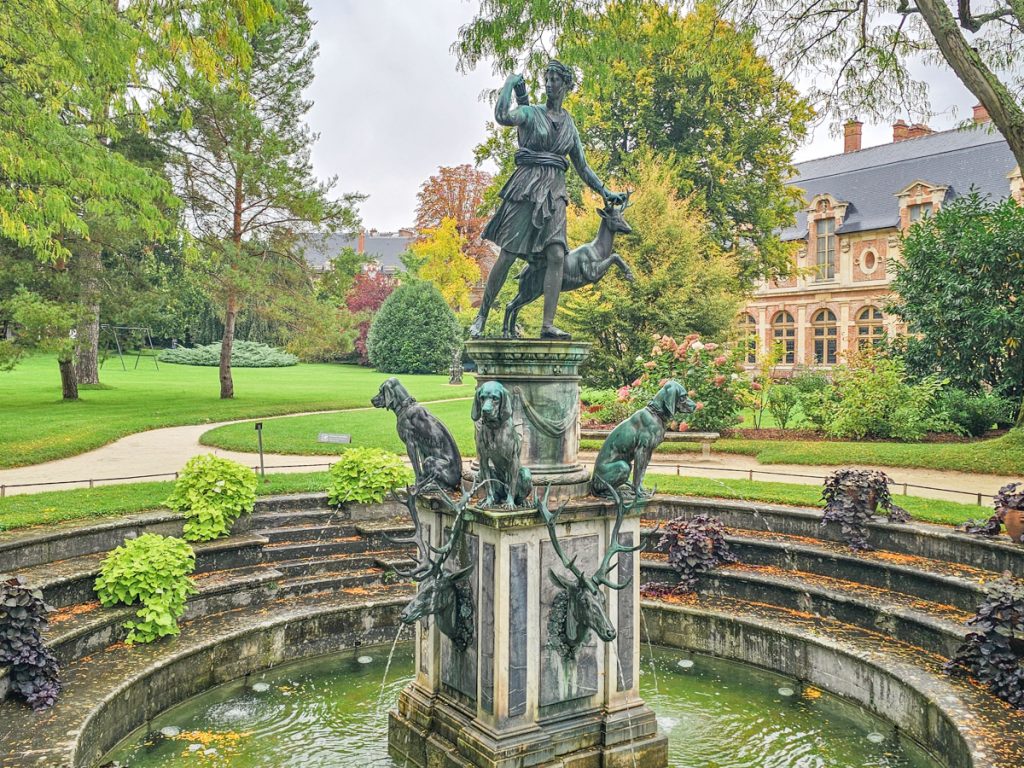
The Diana Garden was once the queen’s private garden, tucked behind the most intimate apartments in the palace. In the 19th century, it was redesigned in the English landscape style and opened outward toward the town.
At its center is a fountain topped with Diana the Huntress, surrounded by dogs, a nod to Fontainebleau’s long history as a royal hunting ground.
The English Garden and Western Grounds

The English Garden on the western side of the estate is quieter still. Designed in the early 19th century, it follows the then-fashionable English landscape style, even though Napoleon himself reportedly wasn’t a fan.
It’s full of winding paths, rare trees brought from around the world, and small hidden corners that feel almost secret. Somewhere in here is the spring that gave Fontainebleau its name, the “Belle-Eau,” which monarchs took great pride in.
Is Fontainebleau Worth a Trip From Paris?
I’ve loved my visits to Fontainebleau and, in general, would absolutely recommend it, with a few caveats.
If you only have a few days (3-4) in Paris, this probably isn’t the best use of your time. There’s so much to see in the city itself that I’d prioritize first, and I’d say the same thing about visiting Versailles (or any other day trip) on a short trip.
Plan for a solid half day to a full day to get here, tour the château, walk the gardens, grab something to eat, and make your way back to Paris. If you arrive right at opening, you could be back in the city by early afternoon. If you arrive later and really linger, it can easily fill most of the day.
Another good option is to visit Fontainebleau first thing in the morning and then continue on to the nearby Château de Vaux-le-Vicomte in the afternoon. It makes for a long, but unforgettable, day.
How to Get to Fontainebleau From Paris
Getting to Fontainebleau from Paris isn’t difficult, but there are a few options, and if you take public transit, there are several important steps. It’s not hard, but because there are quite a few things to know, I wrote a dedicated guide about how to get to Fontainebleau.
If you don’t want to mess with any logistics, you could also book a guided day tour that takes you to Fontainebleau and Vaux-le-Vicomte, which is another fantastic castle nearby and is often paired with Fontainebleau.
Recommended Tours
Group Tour: This is a great, affordable option that takes you to both chateaux in a coach bus. Entrance fees and audioguides are included in the price. Note that this is really just transportation and entrance, there is no tour guide included, but it does take care of logistics.
👉 View current prices & availability
Private Tour: This is a fantastic option if you want to have a more curated day trip. A private car, driver, and guide take you to both castles, and gives you a personal tour of the chateaux and gardens.
👉View current prices & availability
Other Practical Info
Hours: The chateau opens at 9:30am and closes at 5pm from Oct-March, and 6pm from April-Sept.
Dates: The chateau is open every day of the week except Tuesday.
Tickets: Regular adult tickets cost €14. You can buy tickets on-site, or pre-purchase online to save a bit of time (but the line is rarely that long).
Final Thoughts
Truly, Fontainebleau is a masterpiece, full of history and architectural beauty. I had a wonderful time wandering the chateau and gardens. If you’re looking for something significant to do near Paris that’s slightly off the beaten tourist track, Fontainebleau is an excellent option.
