
5 Ways I Practice French When I’m Not in France (That Aren’t Duolingo)

I love speaking French. In fact, taking French in high school was what first sparked both my love of France and my love of travel. Looking back, it’s wild to realize that class eventually led to a career writing about France. So thank you, Madame Cook and French 1.
Over the years, I’ve done quite a bit to improve my French, from high school and college classes (just shy of a minor) to participating in a language immersion program where my roommates and I were supposed to speak only French in our apartment. Let’s just say we had varying levels of success with that.
These days, I don’t live in France and I’m no longer in school, so I don’t have built-in opportunities to practice. But I travel to France frequently, and one of my favorite parts of those trips is being able to have real conversations in French. At the same time, language skills disappear surprisingly quickly if you don’t use them (it’s so sad).

I’d describe my current level as squarely intermediate, somewhere between B1–B2. I can usually hold conversations comfortably, take tours in French, and understand quite a bit. But I still make mistakes all the time, there are plenty of words I don’t know, and I definitely sometimes miss things when people speak quickly.
All that to say, I’m always looking for ways to maintain and improve my French. I don’t pretend to be an expert, and my routine is far from perfect, but these are a few things that have helped me the most over the years.
1. italki
Of everything I’ve done to improve as an intermediate speaker, italki might be the most effective. The concept is simple: italki is a platform where students can book video lessons with native speakers and teachers in dozens of different languages.
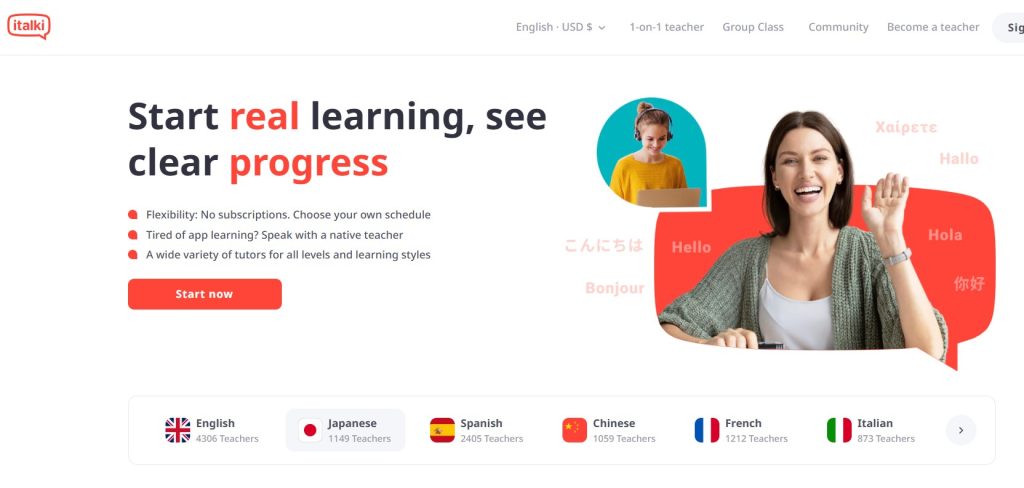
I use the terms “teacher” and “lesson” somewhat loosely because some instructors are trained language teachers while others are simply native speakers offering conversation practice.
Personally, I’m not too concerned with qualifications. What I love is the opportunity to have regular conversations with native French speakers. It’s fantastic practice and forces you to think on your feet in a way that apps and textbooks just can’t.
Each teacher provides information about their background, teaching style, and interests, along with a short introduction video and student reviews. That makes it easy to find someone who matches your personality and learning goals. There’s also no long-term commitment if a teacher isn’t the right fit.
I’ve found plenty of teachers offering 30-minute lessons for around $12 to $15, which I think is an incredible value.
2. Inner French Podcast
This is hardly a groundbreaking recommendation, but podcasts are one of the easiest ways to fit language practice into your day. My favorite by far is InnerFrench.
The podcast is aimed at intermediate learners, so the host speaks clearly and uses a wide range of vocabulary and grammar without talking so quickly that you get completely lost. It’s advanced enough to engage me, but not so difficult that I find myself constantly struggling to keep up.
The episodes cover everything from French culture and history to current events and psychology, which keeps them interesting even after you’ve listened to dozens of them. These days, I usually listen at 1.3x speed for a bit of extra listening practice, but when I was starting, I found the 1x pace better.
3. Parisian Agency TV Show
Like podcasts, TV series are really useful for practicing listening comprehension. The show I’ve watched the most is The Parisian Agency (L’Agence in French), which follows a family of four brothers and their parents as they run a luxury real estate agency in Paris and, later, throughout France and around the world.

It really ticks a lot of boxes for me. I usually watch with English subtitles, which helps me catch words and expressions I don’t know while still following the conversation.
Just as importantly, it helps train my ear for words and phrases that I technically know, but don’t always recognize when they’re spoken quickly, mumbled, or run together with other words. Occasionally I’ll hear a phrase that feels particularly useful and repeat it back out loud.
The other reason I love this particular show is the visuals. There’s footage of Paris and other parts of France, beautiful properties, châteaux, and Haussmannian apartments. I love French architecture so much, so it’s just extra fun from that perspective too.
4. Talking to Myself
Speaking is honestly one of the most challenging parts of learning a language, but it’s also one of the most important. One way I’ve tried to get more speaking practice is by simply talking to myself in French.
Usually, this happens when I’m driving by myself and lost in thought. Instead of thinking through something in English, I’ll try to talk through it out loud in French. Sometimes it’s what I’m planning to do that day, or sometimes it’s just whatever happens to be on my mind.
It’s obviously not the same as having a real conversation, but it forces me to actually put together sentences, so I call it a win. It also helps me identify words or phrases I don’t know and would likely use in a real conversation, which I can then look up and practice later.
5. Reading Text Out Loud
One final thing I’ll do is read French text out loud. It gives me a chance to practice speaking more fluidly while using a wider range of vocabulary, expressions, and sentence structures than I might come up with on my own.
What I like about this exercise is that I don’t have to think about what to say. Instead, I can focus on speaking smoothly and getting my mouth used to saying French words, phrases, and sentence structures.
I’ve found material for this in a couple of places. Of course, you can always just get a book in French to read. But I’ve also read the transcripts from the InnerFrench podcast out loud, which are available on their website, and occasionally ask ChatGPT to generate paragraphs using a variety of grammar and vocabulary for me to read aloud too.
Final Thoughts
Nothing I’ve mentioned here is particularly revolutionary, and you’ve probably heard some of these ideas before. But they’ve all helped me maintain and improve my French over the years, especially when it comes to listening and speaking.
Most of these are things I use because they’re practical and easy to fit into everyday life. And I’ll be honest, I don’t follow a super strict routine—there are certainly weeks when I practice more and other weeks when I do very little. But I figure anything helps!
And if you have something that’s worked particularly well for you, I’d love to hear about it! I’m always looking for new ways to keep improving.
