
12 Best Apps for Travel to France That Make Your Trip Easier

There are a handful of apps that I use on practically every trip to France, and they’ve made traveling around the country so much easier.
From planning your trip to getting around once you’re there, having the right apps downloaded can save you time, make things more convenient, and help you avoid some unnecessary headaches. And a few are just plain fun!
Here are 12 of my favorite apps to use when traveling in France.

1. SNCF-Connect

If you’re planning to travel around France by train, I’d definitely recommend downloading SNCF Connect, the official booking app for France’s national railway company.
You can use it to search train schedules, compare prices, and book tickets for high-speed TGV trains, regional TER trains, and other rail services throughout France.
Once you’ve booked, your tickets are saved directly in the app, making them easy to pull up when you need to board. You can also check platform assignments, track delays, and receive notifications about changes to your journey.
Pro tip: SNCF Connect also lets you search for bus journeys, so when comparing transportation options, don’t forget to check the bus tab. Depending on your route, taking a bus can sometimes take about the same amount of time as the train, but cost significantly less.
2. Bonjour RATP or IDF Mobilités

If you’re visiting Paris, you’ll definitely want an app to help you navigate the city’s public transportation system.
Bonjour RATP and Île-de-France Mobilités are two of the main options, and both let you plan routes, check schedules, and purchase tickets for public transportation throughout Paris and the surrounding region.
You can even load metro, bus, and train tickets directly onto your phone and use it to tap through the metro gates or validate your ticket on a bus. Alternatively, you can use either app to reload a physical Navigo card.
So what’s the difference?
Île-de-France Mobilités is the official app of the regional transportation authority, while Bonjour RATP is operated by the company that runs much of Paris’s metro and bus network.
Both work well for tourists, so you don’t need to download both. Personally, I’d just choose whichever interface you find easier to use. I usually buy a weekly unlimited transit pass when I’m in Paris, and I’ve found that IDF Mobilités is easiest to buy and load the card.
One extra feature of Bonjour RATP is that you can also find and rent certain shared bicycles and scooters through the app.
3. CityMapper or Google Maps
Google Maps and Citymapper are two excellent navigation apps, whether you’re exploring a city on foot or figuring out how to get around using public transportation.
If you’re visiting Paris, you’ve probably heard people recommend Citymapper for navigating the metro and other public transit. And it really is a great app, with detailed routes, transfers, walking directions, and service updates.
However, I personally tend to use Google Maps more often, even when taking public transportation in Paris. Both apps do a good job of showing you how to get from one attraction to another, including any walking you’ll need to do before or after taking the metro.
The official Bonjour RATP app (mentioned above) is another excellent option for planning public transportation routes, particularly if you want to check service disruptions. But in practice, I find it easier to use Google Maps or Citymapper for everyday navigation.
One major advantage of Google Maps is that it works throughout France, including small villages, rural areas, and highways, while Citymapper is primarily designed for navigating bigger cities.

I also love creating my own customized Google Maps with all the attractions, restaurants, and other places I want to visit. Since I’m already using Google Maps to organize my trip, it’s usually the app I default to for navigation.
Finally, Google Maps lets you download entire areas for offline use, which is incredibly helpful if you lose cell service or have limited data. You’ll still be able to view the map and use navigation for driving directions. I highly recommend you download a map before your trip!
4. Flash Invaders
As you walk around Paris, you’ll start to notice little pixelated mosaics scattered around the city, often high up on the sides of buildings. They’re the work of a French street artist known as Invader, who has installed more than 1,500 of these colorful mosaics around Paris.
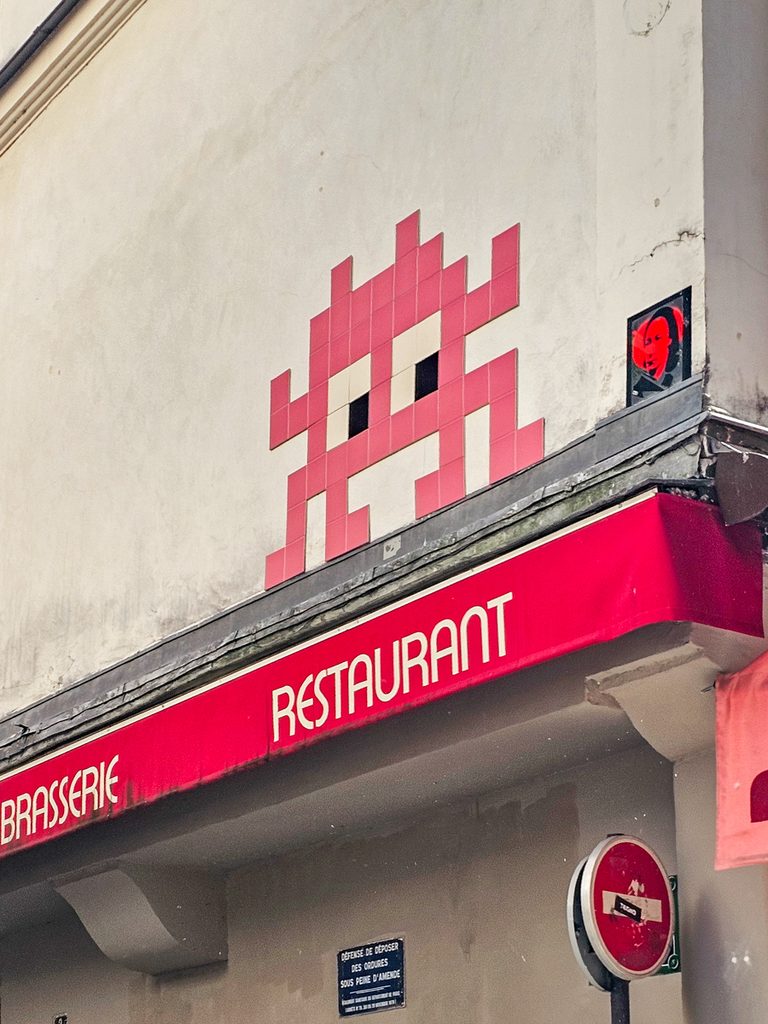
And there’s actually a game you can play to collect them!
With the Flash Invaders app, you can take pictures of the mosaics you find as you’re exploring Paris. The app recognizes each one, adds it to your collection, and awards you points.
It’s essentially a real-life scavenger hunt, and once you start looking for the mosaics, you’ll notice them everywhere. This is a particularly fun activity to do with kids, but honestly, I think it’s just as entertaining for adults.
5. Google Translate

Google Translate is seriously one of the most useful apps you can have when traveling in France, especially if you don’t speak much French.
While most people are familiar with the web-based Google Translate, it’s absolutely worth downloading the actual app. You can download French for offline use, translate spoken conversations, and even use your phone’s camera to instantly translate text.
That camera feature is particularly helpful when you’re trying to decipher a restaurant menu, read signs, or figure out instructions on a ticket machine. Just point your camera at the text, and the English translation appears right on your screen.
I’ve used Google Translate countless times while traveling in France, and I highly recommend downloading the app, downloading the language, and getting familiar with a few of its features before your trip.
Check out my dedicated post about all the Google Translate hacks you need to know.
6. Uber, Bolt, G7
Yes, France has Uber and Bolt, so if you plan to use rideshare services, having either app downloaded is a good option. If you’re in Paris, you might also want to consider G7, a major Paris taxi company with its own app for booking licensed taxis. Sometimes, taking a traditional taxi can even be a better option than using a rideshare service.
One thing to keep in mind is that rideshare availability can be pretty limited outside major cities. I’ve occasionally had trouble getting picked up in smaller French towns, so if you’re relying on Uber or a taxi to get somewhere, make sure you have a backup plan. For some parts of the countryside, you may need to arrange a driver in advance.
7. Bounce

Bounce is an affordable luggage storage service, perfect if you’re staying in an apartment rental and need somewhere to store your luggage for a few hours before checking in or after checking out. For example, maybe checkout is at 11 am, but your train doesn’t leave until 7:15 pm.
With Bounce, you can search for luggage storage locations near you, compare prices, and book a spot directly through the app. I’ve usually paid around €5 per bag per day, although prices vary depending on the location.
Most Bounce locations are actually local businesses, like shops or hotels, that will store your luggage in a back room or designated storage area. That might sound a little sketchy, but I’ve never had a problem, and Bounce has saved me from some serious logistical headaches on multiple trips.
If you’re staying in a hotel, you probably won’t need a service like this. Most hotels in France will hold your luggage before check-in or after checkout, often for free.
8. Viator/Get Your Guide


Viator and GetYourGuide are two of my favorite platforms for finding and booking tours and experiences in France.
You can browse everything from food tours and cooking classes to boat cruises, walking tours, day trips, and hands-on workshops. I particularly like being able to compare different options, read reviews from other travelers, and discover experiences I might not have found otherwise.
I’ve booked some fantastic experiences through these platforms, including:
- This food tour in Nice
- This perfume workshop in Grasse
- This private history tour in Carcassonne
- This Catacombs tour in Paris
- This hot air balloon ride over castles in the Loire Valley
- Or this bay tour in Mont Saint Michel.
All of these ended up being highlights of my trips.

Even if you don’t have a particular tour in mind, I think it’s worth browsing Viator or GetYourGuide to see what’s available in the places you’re visiting. You might discover an experience you’d never have thought to look for.
Once you’ve booked, the apps also make it easy to access your tickets, check meeting locations, and keep track of your upcoming tours.
9. Airalo
Having reliable mobile data while traveling in France is incredibly helpful, and you have several options for how to get it. Some phone carriers offer excellent international coverage at reasonable prices, or even include international data in certain plans. So before your trip, I’d definitely recommend checking what your current carrier offers.
However, if your carrier has expensive international day passes or roaming fees, an eSIM can be a fantastic alternative.
I’ve tried several different ways to get data while traveling abroad, and using an eSIM through Airalo has become one of my favorite options. For me personally, eSIMs are significantly cheaper than purchasing an international pass through my regular phone carrier.

With the Airalo app, you simply choose your destination, select a data plan based on how much data you need and how long you’re traveling, and follow the instructions to install the eSIM on your phone. No need to install a physical sim card, no standing in line when you arrive in France.
Personally, I usually buy ~15 GB for a 2-week trip, and there’s always the option to buy more later if you run out.
One important thing to check before purchasing: Your phone needs to support eSIM technology and be carrier-unlocked. Not all phones are compatible, so make sure to verify this ahead of time.
10. WhatsApp
If you’re traveling to France, I’d highly recommend downloading WhatsApp, even if you don’t regularly use it at home.
WhatsApp is a very popular messaging app in Europe, and I’ve found that apartment owners, tour guides, and other local businesses will often use it to communicate with you.
For example, I’ve had apartment hosts send check-in instructions through WhatsApp, and tour guides use it to confirm meeting locations or share last-minute updates. It’s much easier to have the app downloaded and ready to go before your trip.
You can also use WhatsApp to make free voice and video calls over Wi-Fi or mobile data, which can be particularly helpful if your phone plan charges extra for international calls.
Just remember that while WhatsApp itself doesn’t charge for calls or messages, your regular mobile data charges still apply.
11. Booking/VRBO/Airbnb
Booking.com is usually my first choice when looking for hotels in France, but I also frequently book apartment rentals through Airbnb or Vrbo.
Whichever platform you use, I do recommend downloading the app before your trip, even if you’ve already booked all your accommodations.
It’s much easier to pull up your reservation details, find the property’s address, and check arrival instructions. But most importantly, having the app makes it easy to message your hotel or host directly.
If you’re staying in an apartment rental, you’ll likely be sending several messages back and forth, especially when coordinating check-in. Having the app is particularly helpful if an issue comes up, you’re running late, or you need to contact the property while you’re on the go.
12. Mobile Passport Control

If you’re an American traveling to France, Mobile Passport Control can potentially save you a lot of time when you return to the United States.
This free app from U.S. Customs and Border Protection allows eligible travelers to submit their passport information and customs declarations through their phones, potentially speeding up the immigration process.
You can download the app and enter your passport information ahead of time. Then, within four hours of landing in the US or after you’ve arrived, you’ll take a photo, answer a few questions, and submit your information.
Once you reach passport control, look for the designated Mobile Passport Control line, if your airport has one. Depending on how busy the airport is, you may be able to get through faster than the regular immigration line.
Another nice feature is that families can submit their information together, with up to 12 travelers on a single device.
More Tips for Planning Your France Trip
If you’re in the middle of planning your France trip, these are a few more guides to help you prepare and make the most of your visit:
- 15 Unwritten Rules of Dining Out in France – Everything you need to know about eating at French restaurants, from ordering to paying.
- What to Book in Advance in Paris – Find out which popular attractions require advance reservations and which ones you can visit spontaneously.
- 18 Common Mistakes to Avoid in Paris – Practical tips to help you avoid some of the most common tourist mistakes.
And if you’re feeling overwhelmed or short on time, I also offer France planning calls.
These one-on-one video sessions are great for getting feedback, asking questions, and sorting through options, whether you need a full plan or help fine-tuning what you already have.
